


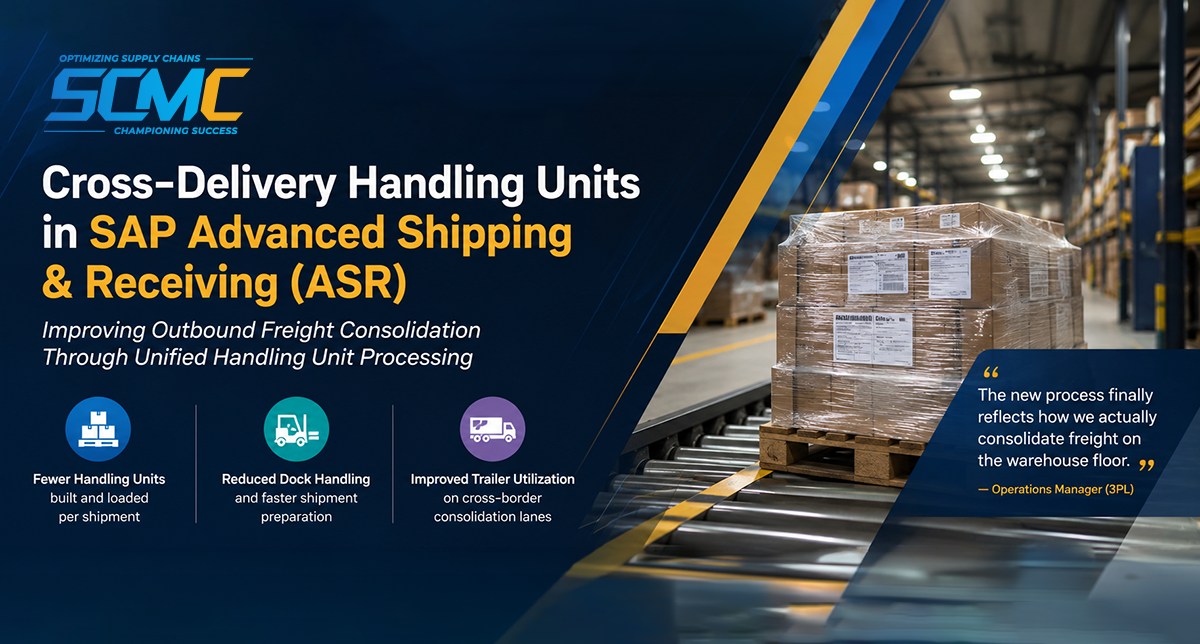
Improving Outbound Freight Consolidation Through Unified Handling Unit Processing
| Client Industry | Texas-based third-party logistics provider (3PL) specializing in outbound consolidation of automotive parts and industrial components for maquiladora supply chains (client anonymized under NDA) |
| SAP Landscape | SAP S/4HANA 2023 · Embedded EWM · Embedded Transportation Management · Advanced Shipping & Receiving (ASR) |
| Scope | Cross-Delivery Handling Unit enablement within the existing outbound ASR process |
| Implementation Partner | SCM Champs |
| Region | Texas, USA — Dallas–Fort Worth & Laredo |
Business Value at a Glance
A one-page summary for readers who need the essentials before reading further. It also works as a standalone handout.
Business Challenge
- Single physical pallets held product from multiple outbound deliveries.
- Standard processing forced a separate Handling Unit per delivery.
- Duplicate dock touches, wasted trailer floor space, and rising detention on the DFW–Laredo lane.
SAP Solution
- Cross-Delivery Handling Units enabled within the existing ASR outbound flow.
- One Handling Unit spanning multiple Outbound Deliveries under a shared consolidation group.
- The TM Freight Order remains the single orchestrating document across EWM and TM.
Business Outcomes (DFW–Laredo lane, first 8 weeks post-go-live)
- Trailer utilization up from 67% to 88%.
- Handling Units per shipment down ~40% (18.4 → 11.2).
- Freight cost per shipment down ~20%; prep and loading times each down about a third.
SCM Champs Contribution
- Solution design and EWM–TM integration for Cross-Delivery HUs.
- BAdI-based consolidation-group validation (explicit enhancement).
- Testing, user training, cutover, and hypercare through go-live.
Snapshot — Industry: Automotive-parts 3PL · SAP Scope: Embedded EWM + TM + ASR · Warehouses: 2 (DFW + Laredo) · Duration: 4.5 months · Team: 4 FTE · Result: trailer fill 67% → 88%, ~40% fewer HUs per shipment
Executive Summary
The client is a Texas-based third-party logistics provider (3PL) operating on the Dallas–Fort Worth–to–Laredo corridor, one of the busiest cross-border freight lanes in the United States. (Its full profile — sites, volumes, and SAP landscape — appears in Client Background below.)
The business problem was rooted in daily warehouse reality. Operators frequently built a single physical pallet that carried product belonging to three or four different outbound deliveries destined for the same shipment — but standard outbound processing required each delivery to sit on its own Handling Unit (HU).
The result was duplicated warehouse work — building, labeling, moving, and loading multiple pallets where one would do — along with wasted trailer floor space and higher detention charges on the long DFW-to-Laredo leg that feeds tightly scheduled border crossings.
The solution was to enable Cross-Delivery Handling Units within the client’s existing, stable Advanced Shipping & Receiving (ASR) process. A Cross-Delivery HU allows items from more than one Outbound Delivery to be packed into a single HU while each delivery retains its own document integrity. The TM Freight Order continued to act as the single orchestrating document across Extended Warehouse Management (EWM) and Transportation Management (TM), so no parallel objects or middleware were introduced.
The business impact is detailed in the Results section below. Operators now consolidate multiple deliveries onto a single Handling Unit — the way they always did physically — so a shipment that once required several separate units moves through packing, loading, and Goods Issue as one.
SCM Champs delivered this outcome end to end — assessment, design, EWM and TM configuration, testing, training, cutover, and hypercare — almost entirely through standard SAP functionality, with a single, clearly identified BAdI enhancement for consolidation-group validation.
The engagement ran 4.5 months from kickoff to go-live, including a two-week hypercare window, delivered by a four-FTE SCM Champs team working alongside client-side EWM and logistics subject-matter experts.
Client Background
The client is a third-party logistics provider specializing in the outbound consolidation of automotive parts and industrial components for maquiladora supply chains, operating in one of the busiest freight corridors in the United States. Its network is built around two distribution centers: a 250,000-square-foot domestic consolidation hub in the Dallas–Fort Worth metroplex, and a 120,000-square-foot cross-dock and transload facility in Laredo that handles border-crossing freight destined for maquiladoras and automotive supply chains in Mexico.
The distribution model is almost entirely business-to-business. It mixes full-truckload consolidation with multi-customer less-than-truckload (LTL) shipments, and the Laredo site plays a specialized role in staging and transloading freight for cross-border movement. Combined daily volume runs between 600 and 900 outbound orders, drawn from an active base of about 18,000 SKUs with a wide range of pack profiles — palletized goods, crates, and loose cartons. Warehouse headcount is approximately 140 floor associates and supervisors per shift.
The SAP landscape is SAP S/4HANA 2023 (on-premise), running Embedded EWM and embedded Transportation Management on the same S/4HANA instance. This co-deployment is a prerequisite for Advanced Shipping & Receiving, which the client had been running in production for its outbound shipping processes for roughly 18 months before this project began. The Cross-Delivery Handling Unit capability was therefore introduced as a targeted addition to a mature and stable ASR foundation, not as part of a new implementation.
Business Challenge / Problem Statement
Picture the dock on a typical afternoon. A loader is staging freight for a Laredo-bound trailer, and in front of him sit three pallets that, by every physical measure, should be one. The cartons are the same size, they are going to the same place, and they would nest together perfectly on a single pallet.
But the system will not let him treat them as one unit — because the product on those cartons belongs to three different Outbound Deliveries. So he builds three pallets, labels three pallets, moves three pallets, and loads three pallets. Multiply that by a trailer, by a shift, by 600 to 900 orders a day, and the pattern is unmistakable.
This is not an edge case for the client — it is the core of the business. Because its value proposition is consolidation, it is routine for a single shipment, particularly one bound for a border crossing, to combine goods from several manufacturers and several Outbound Deliveries. Operators naturally want to place product from three or four deliveries onto one physical pallet, because that is the most space-efficient way to fill the trailer.
Standard outbound processing, however, did not permit one Handling Unit to span multiple deliveries. Each delivery had to be packed into its own HU. That single constraint rippled across the operation:
- Operators built and labeled multiple Handling Units for what was physically a single pallet, adding avoidable packing steps.
- Every additional HU meant additional dock touches — moving, staging, and loading units that could have been consolidated.
- Trailer floor space was used inefficiently, because the packing pattern was driven by system constraints rather than by how freight actually fit.
- On the long DFW-to-Laredo leg, slower loading and lower trailer utilization added pressure on tightly scheduled cross-border departures and increased detention risk.
The cost of doing nothing. This was a recurring cost, not a one-time problem — every consolidation pallet forced into three units doubled or tripled the handling effort for zero operational benefit, and that cost scaled with volume as the business grew. In short, the warehouse was absorbing the cost of a document-level limitation with physical labor and wasted capacity. The client needed the system to model what the dock was already doing physically: one pallet, several deliveries, one Handling Unit.
Project Objectives & Scope
Objectives
- Simplify outbound warehouse execution by allowing one Handling Unit to carry items from multiple Outbound Deliveries.
- Improve loading efficiency and trailer utilization on consolidation and cross-border lanes.
- Reduce manual Handling Unit handling — fewer units to build, label, move, and load.
- Enable unified shipment execution while preserving the document integrity of each individual delivery.
- Achieve the above using standard ASR capability wherever possible, with any enhancement clearly identified.
In scope:
- SAP S/4HANA 2023 with Embedded EWM and embedded Transportation Management.
- Advanced Shipping & Receiving (ASR) outbound process only.
- Cross-Delivery Handling Unit enablement, configuration, and integration validation.
- One BAdI-based consolidation-group validation in the packing work center.
Out of scope:
- Inbound and returns processing — not affected by this engagement.
- Greenfield ASR setup — the ASR foundation was already live and stable.
- Transportation planning redesign, carrier tendering logic, and Yard Logistics.
SAP Standard Process Overview
Before describing what SCM Champs configured, it is worth establishing how Cross-Delivery Handling Units behave in the standard Advanced Shipping & Receiving process — because the capability is delivered SAP standard functionality, not custom logic.
A Cross-Delivery Handling Unit is a single packing unit, such as a carton or pallet, that contains products originating from more than one Outbound Delivery. Where standard packing associates an HU with a single delivery, a Cross-Delivery HU is recognized by the system as spanning several deliveries and is flagged accordingly in the relevant EWM screens (identified as a Cross-D HU). Each contributing delivery keeps its own identity and document flow; the HU simply becomes the shared physical container.
Two standard prerequisites govern the process:
- Shared consolidation group — all deliveries packed into the same Cross-Delivery HU must belong to the same consolidation group; otherwise the system prevents the cross-delivery packing.
- Joint readiness — the deliveries sharing a Cross-Delivery HU must be set to “Ready for Shipping” together. Because they share one physical HU, selecting only one of them for that step results in an error; all must be processed as a set.
Within ASR, the packed HU is reflected against the Freight Order in Transportation Management, which remains the single orchestrating document. The HU is then loaded and Goods Issue is posted. Cross-Delivery Handling Units are supported as part of the standard ASR process in SAP S/4HANA releases that include this capability; this project used that standard behavior as its foundation.
Solution Approach
The approach was deliberately incremental. Because the client already ran a stable ASR outbound process, the goal was not to re-architect anything but to extend the existing flow so that consolidation pallets could be modeled as they physically existed. The design keeps the Freight Order as the single orchestrating document and layers Cross-Delivery HU behavior into the packing step, where the consolidation actually happens on the dock.
Why this approach
Before committing to Cross-Delivery HUs, the realistic alternatives were weighed:
- Live with it. The path of least effort, but it meant permanently accepting the ongoing cost described above. Rejected.
- Throw labor at it. More associates could move the extra pallets faster, but this treats the symptom, scales cost with volume, and does nothing for trailer utilization or detention. Rejected.
- Redesign the outbound process or build custom logic. A heavier, higher-risk route that would disturb a stable production system and introduce custom code to maintain. Rejected as disproportionate.
- Enable Cross-Delivery Handling Units on the existing ASR foundation. This models the dock reality directly, uses delivered SAP standard functionality, keeps the Freight Order as the single source of truth, and requires no parallel objects. Selected.
The deciding factor was simple: the physical process was already correct, so the lowest-risk route was to let the system represent what the dock was doing rather than rebuild anything. Cross-Delivery HUs did exactly that using standard capability — the least disruption for the highest-value outcome.
At the level of business flow, the end-to-end process connects as follows. The critical point is the packing step: freight planning and delivery creation continue exactly as before, and the Cross-Delivery HU is formed during packing, after picking, when operators consolidate multiple deliveries onto one physical unit. From there, the single HU — not several — moves through loading and Goods Issue.
SAP Solution Design & Implementation
Standard SAP Capability — Unless explicitly identified as an enhancement, all solution components described in this case study were implemented using standard SAP S/4HANA Advanced Shipping & Receiving functionality.
ASR integration model. The client’s outbound ASR integration was already configured through the TM–EWM integration model, using the relevant Shipping Point (location type 1003) and Loading Point (location type 1200) business locations. These participate in the integration model and are among the settings that make a location relevant for ASR — part of the configuration, not on their own the entire activation. Because ASR was already live, the project verified that the existing model supported the Cross-Delivery HU flow rather than re-establishing it.
Consolidation group and Handling Unit design. The heart of the design is the consolidation group. Since a Cross-Delivery HU may only span deliveries that share a consolidation group, the work centered on making that grouping automatic and consistent. In SPRO, under Define Consolidation Group Determination, a derivation rule was set to pull the TM Freight Order number as the consolidation group for every delivery belonging to the same shipment — so all deliveries planned onto one Freight Order were, by definition, eligible to share a Handling Unit. Packing was performed through transaction /SCWM/PACK (Pack Outbound Deliveries profile), surfaced to operators via a Fiori tile, Pack Handling Units – Cross Delivery (a custom tile built on the standard catalog). The HU was then created to hold items across those deliveries, with the system recognizing and flagging it as a Cross-Delivery HU. In practice, 2 to 4 outbound deliveries were consolidated per HU; the largest observed in the first month was 7 deliveries on a single oversized automotive-crate pallet.
Freight Order integration and document flow. Throughout, the TM Freight Order remained the single orchestrating document. The packed Cross-Delivery HU was reflected against the Freight Order, so TM retained an accurate picture of what was physically on the truck without duplicated or parallel objects. The deliveries sharing the HU were set to “Ready for Shipping” together, the HU was loaded against the Freight Order, and Goods Issue was posted — with the document flow updating consistently across EWM and TM.
Enhancement (Custom). A single BAdI-based validation was implemented in the packing work center. The BAdI /SCWM/EX_CORE_PACK_VAL, method CHECK_CROSS_DELIVERY_CG (implementation ZSCM_CROSS_DLV_CG_CHECK), validates consolidation-group alignment across the deliveries assigned to the same Freight Order at the moment of HU assignment — so misaligned deliveries are caught early rather than surfacing later as a “Ready for Shipping” error. This is the only custom component in the solution; every other element is standard ASR functionality.
The rationale for the enhancement was operational, not technical. Standard behavior correctly prevents an invalid Cross-Delivery HU, but does so downstream — at the readiness step — by which point operators may already have packed the pallet. Validating consolidation-group alignment during packing shifts the check to the moment of the decision, where a floor associate can act on it without rework. In practice, the mismatch the BAdI catches is not the routine case where every delivery already sits on the same Freight Order — it is the exception, such as a delivery that had not yet been assigned to that Freight Order at the moment the operator started packing, or a late re-plan that moved a delivery onto a different order after packing was already under way.
Figure 1 — System Architecture (co-deployed on one S/4HANA instance)
Because EWM and TM are co-deployed on the same S/4HANA instance, Freight Order data is directly available to warehouse execution without replication into a separate EWM transportation object — the foundation on which ASR, and therefore Cross-Delivery HU processing, depends.
Challenges Faced & Mitigation
The engagement was an enhancement to a live production system, which raised specific risks around data consistency, user behavior, and process stability. Each was addressed deliberately.
| Challenge | SCM Champs Mitigation |
|---|---|
| Maintaining Handling Unit consistency across multiple Outbound Deliveries sharing one HU. | Warehouse execution rules were designed to align with the ASR document flow, keeping HU content and delivery references consistent through packing, loading, and Goods Issue. |
| Consolidation-group misalignment surfacing only as a downstream “Ready for Shipping” error. | A BAdI-based validation (the engagement’s single enhancement, /SCWM/EX_CORE_PACK_VAL → CHECK_CROSS_DELIVERY_CG) was added in the packing work center to catch misaligned deliveries at the moment of HU assignment, before the error could occur. |
| Warehouse operators unfamiliar with the Cross-Delivery HU process on a live system. | Hands-on warehouse simulation was run before go-live for 36 warehouse associates (12 per shift across three shifts at DFW) plus 4 Laredo cross-dock leads, walking them through building, labeling, and setting deliveries to Ready for Shipping as a set. |
| Introducing change into a stable production ASR process without disrupting daily throughput. | End-to-end ASR scenario testing was performed rather than isolated task testing, and a phased go-live (April 14, 2026) with two-week hypercare protected daily order flow. |
Results & Business Benefits
On the floor, the change was immediate and visible: where an operator once built three pallets for one consolidated shipment, he now builds one — and the loaders stopped shuffling half-empty units to make the freight fit.
That is the shift in a sentence. The pallet that always should have been one unit finally is one unit, and every downstream step inherits the simplification. Before, a consolidated shipment generated a separate Handling Unit per delivery, each demanding its own labeling, movement, staging, and loading. After, a single Cross-Delivery HU carries those same deliveries as one physical unit and moves through readiness, loading, and Goods Issue exactly once. The benefits fall into three categories.
Operational benefits
- Fewer Handling Units built per consolidated shipment, since one HU can now span multiple deliveries.
- Reduced dock handling — fewer units to label, move, stage, and load.
- Packing patterns driven by how freight physically fits, not by document constraints.
Business benefits
- Faster shipment preparation on consolidation and cross-border lanes.
- Improved trailer utilization, easing pressure on the DFW-to-Laredo leg and its scheduled border crossings.
- Reduced exposure to detention charges caused by slower loading.
System benefits
- The Freight Order remains the single orchestrating document — no parallel objects introduced.
- Consistent document flow and visibility across EWM and TM through packing, loading, and Goods Issue.
- Earlier error prevention at packing, reducing downstream readiness failures.
“For the first time, the screen matched the dock. We used to apologize to the system while we built the pallet anyway. Now the system works the way we do — one good pallet instead of three that don’t make sense.” — Warehouse Operations Manager, DFW Consolidation Hub
Measured outcomes. The figures below compare an identical shipment profile — consolidated LTL trailers on the DFW–Laredo lane — across the first eight weeks after cutover. The client has cleared them for publication on the condition that the end-manufacturers whose product sits inside the consolidated pallets are not named.
| KPI | Before (Mar 2026) | After (Jun 2026) |
|---|---|---|
| Trailer Utilization (floor-loaded, Laredo lane) | 67% | 88% |
| Average HUs per Shipment | 18.4 | 11.2 |
| Shipment Preparation Time (mean) | 47 min | 29 min |
| Freight Cost per Shipment (net, excl. fuel) | $1,842 | $1,470 |
| Dock Loading Time (mean) | 52 min | 34 min |
The pattern is consistent across every measure: Handling Unit count per shipment dropped roughly 40%, trailer fill rose more than 20 percentage points, and both shipment-preparation and dock-loading times improved by about a third. In cost terms, that is a reduction of $372 in net freight cost per shipment — about 20% — on a lane the client runs repeatedly. The same consolidation freed dock labor and trailer capacity that had previously been consumed building and moving redundant Handling Units, so the per-shipment saving is compounded by throughput the operation recovered.
Industry context — the size of the opportunity. For external perspective, published logistics data shows why outbound consolidation matters. U.S. industry studies put average trailer utilization at roughly 60–80%, and Flock Freight’s 2025 Shipper Research Study found that 58% of truckloads moved with empty trailer space in 2024 — up from 43% a year earlier.¹ Consolidation programs that fill trailers more completely are consistently reported to reduce handling touches and deliver double-digit improvements in equipment utilization.
These figures are industry benchmarks for freight consolidation generally — not measurements from this engagement.
Lessons Learned & Best Practices
Several practical lessons emerged that transfer to any organization enabling Cross-Delivery Handling Units on an existing ASR foundation.
- Validate the warehouse process before enabling Cross-Delivery HUs. The capability is only as good as the consolidation-group discipline behind it; confirm that deliveries for a shipment can reliably share a consolidation group first.
- Stabilize transportation planning before extending warehouse execution. A mature, stable ASR foundation made this a low-risk enhancement rather than a re-architecture.
- Keep Handling Unit management aligned with shipment execution. HU content and delivery references must stay consistent all the way through loading and Goods Issue.
- Test end-to-end ASR scenarios, not just individual warehouse tasks. The value — and the risks — of Cross-Delivery HUs appear at the seams between packing, readiness, loading, and Goods Issue.
- Train users on the full document flow. Operators work far more confidently once they understand how Deliveries, Freight Orders, and Handling Units relate — especially the rule that shared deliveries must be set to Ready for Shipping together.
- Shift error prevention upstream where it helps the floor. Moving the consolidation-group check to the packing step, via a targeted enhancement, prevented rework that standard downstream validation would have caught too late.
Why SCM Champs
The result turned on diagnosis, not just delivery. Early on, SCM Champs reframed the problem in a way the client had not: this was a modeling gap, not a technology gap — the warehouse was already consolidating freight correctly; the system simply was not allowed to represent it. That single distinction shaped every decision that followed, and it is why the engagement delivered high value at low risk:
- Diagnosis over delivery — named the real problem (a modeling gap) before touching any configuration.
- Standard SAP over custom — solved it with delivered functionality, adding only one clearly identified BAdI where it measurably helped operators.
- Extend, don’t re-architect — built on an ASR foundation that had run cleanly for 18 months instead of disturbing it.
- De-risk a live operation — proved the change on the warehouse floor through hands-on operator simulation and a phased cutover, not just in a test client.
SCM Champs’ Role & Value Delivered
SCM Champs delivered the engagement end to end with a four-FTE team — a part-time solution architect, two senior EWM/TM consultants, a change-management and training lead, and a cutover coordinator — working alongside the client’s own EWM and logistics experts. The timeline ran 4.5 months from kickoff to an April 14, 2026 go-live, with two weeks of hypercare ending April 28, 2026 (on-site at DFW for the first three days, then remote on-call).
The client began cautious about touching a stable, live system — and SCM Champs treated that caution as a design constraint, not an obstacle. By go-live it had turned into confidence, because the change had been proven on the floor rather than only in a test client.
Scope of work, in delivery order:
- Assess — map the dock reality of consolidation pallets against the system’s HU constraints.
- Design — the Cross-Delivery HU solution and consolidation-group handling on the existing ASR foundation, with no parallel objects.
- Configure & integrate — EWM and TM setup, plus the one custom BAdI, validated for consistent document flow with the Freight Order as the single orchestrating document.
- Test — end-to-end SIT and UAT scenarios with warehouse operators, not isolated tasks.
- Train — hands-on simulation for 36 DFW associates (12 per shift, three shifts) plus 4 Laredo cross-dock leads on the full Cross-Delivery HU process.
- Cut over & support — phased go-live on April 14, 2026 with two weeks of hypercare to protect daily throughput.
Conclusion & Future Roadmap
This engagement turned a persistent dock-level inefficiency into a modeled, repeatable process. By enabling Cross-Delivery Handling Units on a stable Advanced Shipping & Receiving foundation, the client can now pack a single physical pallet the way its operators always did — spanning multiple Outbound Deliveries — while the system keeps each delivery’s integrity intact and the Freight Order remains the single orchestrating document. The technical achievement was to deliver this almost entirely through standard SAP functionality, with a single, clearly identified enhancement addressing where the standard error check landed relative to the operator’s workflow.
The result is fewer Handling Units per shipment, less dock handling, faster shipment preparation, and better trailer utilization on the consolidation and cross-border lanes that define this business — achieved without disrupting a live production operation.
Future roadmap
- SAP Yard Logistics integration — extending visibility and control from the dock into the yard, particularly valuable at the Laredo cross-dock.
- Advanced Shipping & Receiving optimization — continuing to refine consolidation and readiness handling as volumes grow.
- Transportation planning automation — tightening the link between warehouse execution and carrier scheduling on cross-border lanes.
- Warehouse analytics — surfacing HU, loading, and utilization metrics to sustain and measure continuous improvement.
-
Work With SCM Champs
Facing similar consolidation challenges in SAP EWM or TM?
SCM Champs helps logistics teams unlock hidden efficiencies using standard SAP capabilities — without disrupting live operations. From outbound consolidation and Cross-Delivery Handling Units to end-to-end ASR integration, our focus is measurable outcomes on your existing SAP investment.