


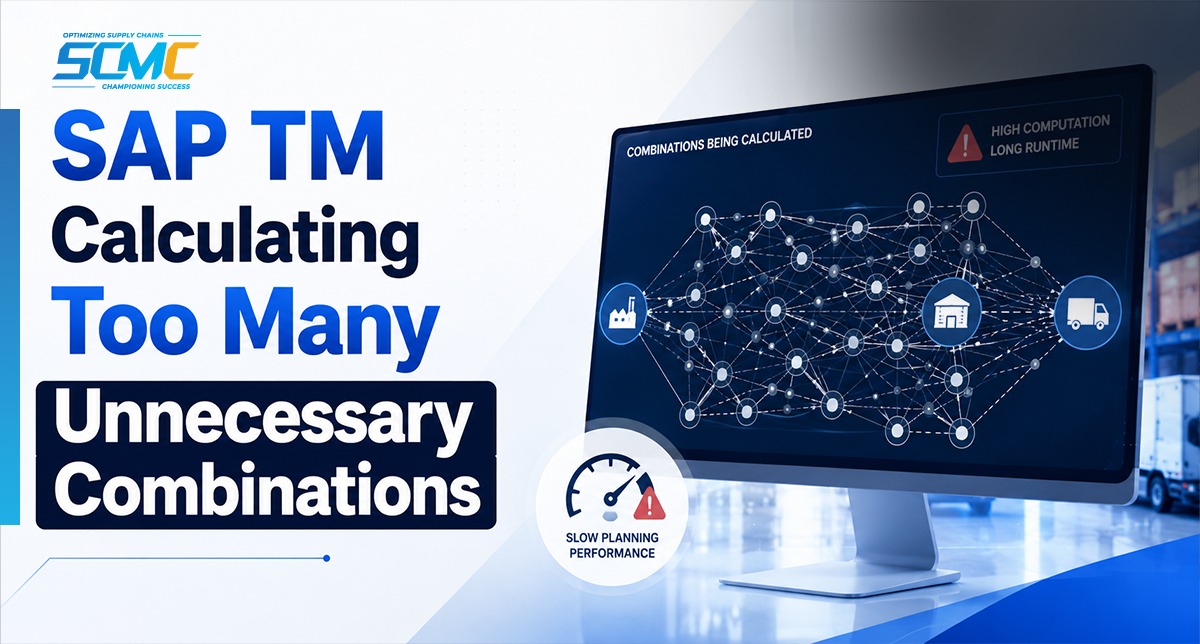
How an oversized VSR search space slows down SAP TM planning
What the Client Was Facing
The client was running SAP TM’s VSR (Vehicle Scheduling and Routing) optimizer across a large pool of freight units. Runtime was generously configured, yet runs were still finishing late — and when they did finish, the plans often needed manual cleanup before anyone could use them.
The pattern showed up most clearly when freight from different regions, planning requirements, or operational flows all landed in the same run.
What Was Causing It
The issue was not simply the volume of freight. A major factor was the size of the search space the optimizer had to work through.
When unrelated freight sits inside the same run, the VSR engine still has to check whether each unit can be:
- combined with others
- assigned to shared resources
- sequenced together
- routed through compatible locations and time windows
So if 500 freight units enter one run and only a small share could ever realistically share a vehicle or route, the optimizer still burns cycles testing pairings that were never going to work. The freight count matters — but what really drives runtime is how many of those combinations are worth evaluating at all.
Why It Mattered to the Business
Long runs are not just a technical annoyance. They show up as:
- planning cycles that stretch past the window planners actually have
- runs that time out or return plans too rough to execute
- planners waiting, rerunning, or fixing results by hand
- transportation decisions made late, sometimes against carrier cutoffs
- and slowly, a loss of trust in automated planning altogether
That last one is the expensive one. Once planners stop trusting the optimizer, they go back to manual overrides — and the value of the whole TM investment quietly drains away.
How SCM Champs Solved lIt
We reviewed the client’s planning scope and identified freight that had no realistic chance of interacting with anything else in the same run.
Instead of feeding everything into one large optimization problem, we restructured the scope around freight that genuinely shared operational relationships grouped by region, route structure, planning requirements, and resource compatibility.
The line we drew was simple: if two freight units could plausibly share a vehicle, a route, or a time window, they stayed in the same run. If they couldn’t, there was no reason for the optimizer to keep testing them against each other.
This reduced the search space while keeping together the freight that actually benefited from being planned as a group. SAP TM was left with a tighter, more relevant problem — so its processing capacity went toward combinations that mattered.