


Real Challenge
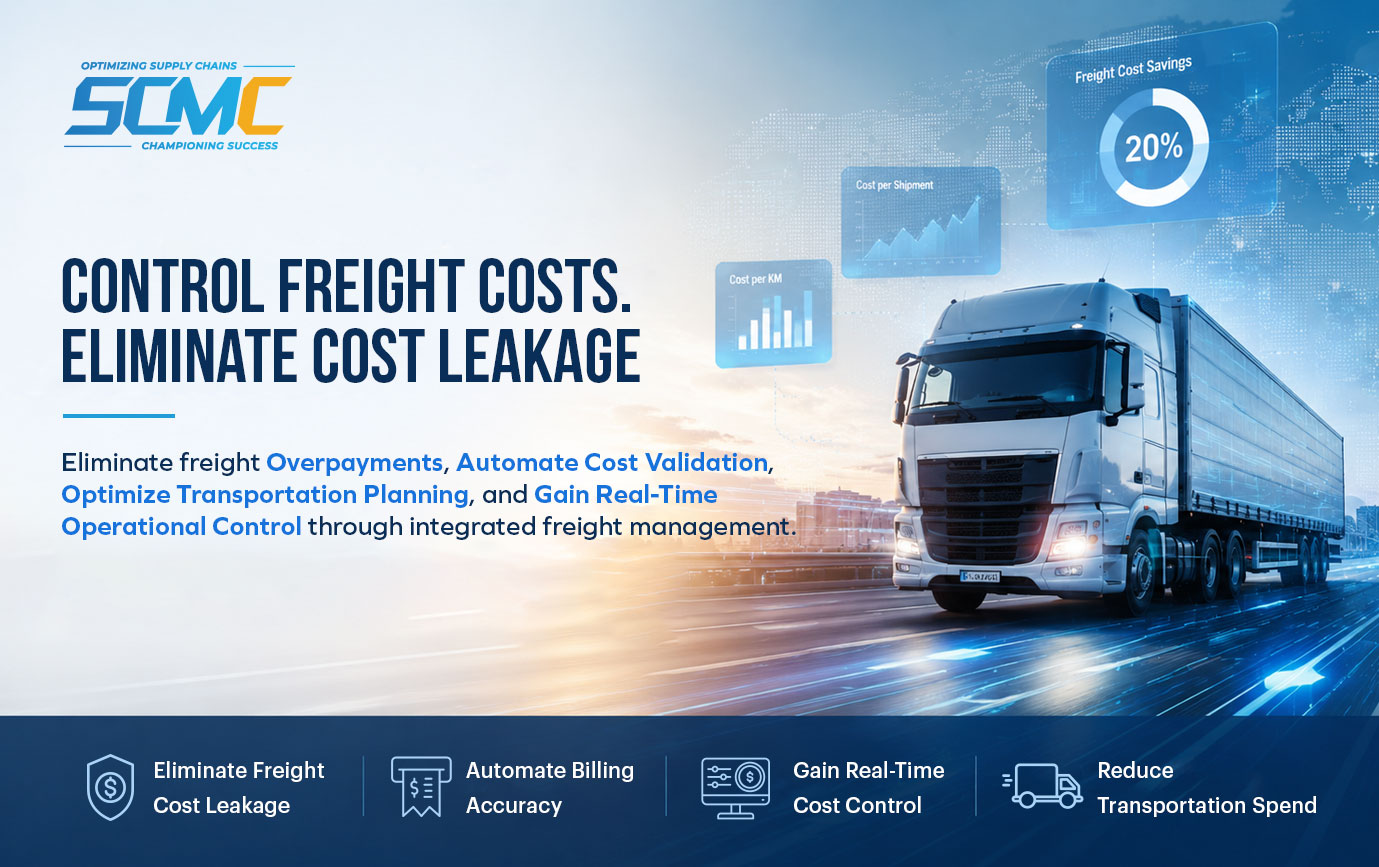
Lack of real-time freight cost visibility and control is leading to continuous over payments, billing inaccuracies, and significant logistics cost leakage.
Here Is What Actually Solves It
Freight Cost Centralization (Foundation Fix)
Why does this problem happen?
Freight rates are often scattered across Excel files, emails, and carrier contracts. When pricing data exists in multiple places, inconsistencies and manual errors become unavoidable. Companies managing freight rates manually commonly face 15–20% pricing inconsistencies that are discovered only after costs are incurred.
Solution
- Centralized Freight Rate Repository
- All carrier contracts stored and maintained in one system
- Automated freight rate calculation for every shipment
Business Impact
- ❌ Eliminates manual pricing errors
- ✅ Same rules → same freight cost calculation every time
Straight line:
“The rate that was agreed upon — the system automatically applies it to every shipment. No exceptions, no shortcuts.”
Freight Cost Calculation & Validation Automation
Where companies lose money
Overbilling and invoice mismatches remain one of the biggest hidden cost leakages in transportation operations. In many organizations, finance teams still validate invoices manually — and errors continue to slip through.
Solution
- System-driven freight cost calculation at Freight Order level
- Automated freight settlement
- Automatic invoice vs. contract validation
Business Impact
- ❌ Eliminates overpayments
- ✅ Reduces billing disputes
- ✅ Significantly lowers finance team workload
Real benefit:
“Whatever invoice the carrier sends, the system automatically validates it against the agreed contract rates. No manual checking. No missed errors.”
Real-Time Cost Visibility Dashboard
The operational gap
Many companies lack clear visibility into actual transportation costs. By the time issues are identified during month-end reviews, the financial impact has already occurred.
Solution
- Live dashboards by lane, carrier, and shipment
- Transportation cost analytics and reporting
- KPI tracking (cost per km, cost per shipment, etc.)
Business Impact
- ✅ Faster decision-making
- ✅ Better cost control
- ✅ Easier trend analysis
What decision-makers gain:
“Teams can now see a complete breakdown of transportation costs in real time — before they become financial problems, not after.”
Transportation Planning Optimization (Largest Untapped Savings Area)
This may appear optional at first, but in reality, this is where some of the largest transportation cost savings are achieved. Most organizations focus heavily on invoice correction, while 30–40% of recoverable freight savings typically sit within planning and execution optimization.
Solution
- Route optimization
- Load consolidation
- Intelligent carrier selection
Business Impact
- Fewer trucks required
- Lower fuel consumption
- Direct transportation cost savings
End-to-End Integration (ERP + EWM + TM)
Why integration matters
Without proper integration, the same transportation data often exists across multiple systems with different values — creating confusion, delays, and reconciliation issues.
Solution
- Full integration from Order → Delivery → Shipment → Billing
Business Impact
- ✅ Single source of truth
- ✅ Minimal manual intervention
- ✅ Improved operational accuracy
Implementation Perspective
While these capabilities are standard within SAP Transportation Management, the real challenge is not the availability of features it is how effectively they are designed, configured, and aligned with actual transportation operations.
In real-world implementations, companies rarely struggle because the system lacks functionality. The bigger challenge is achieving the right balance of:
- Cost control
- Automation
- Operational visibility
- Planning efficiency
across complex transportation environments.
This is where experienced implementation partners become critical.
Teams like SCM CHAMPS bring hands-on transportation and supply chain expertise with a business-outcome-first approach configuring SAP TM around actual operational requirements, not the other way around.
The focus is always on turning SAP TM capabilities into measurable business outcomes:
- Reduced freight spend
- Improved billing accuracy
- Real-time operational visibility
- Better transportation planning and control
Companies that implement these five layers together typically recover 8–15% of total freight spend within the first year not as a projection, but as a measurable operational outcome.