


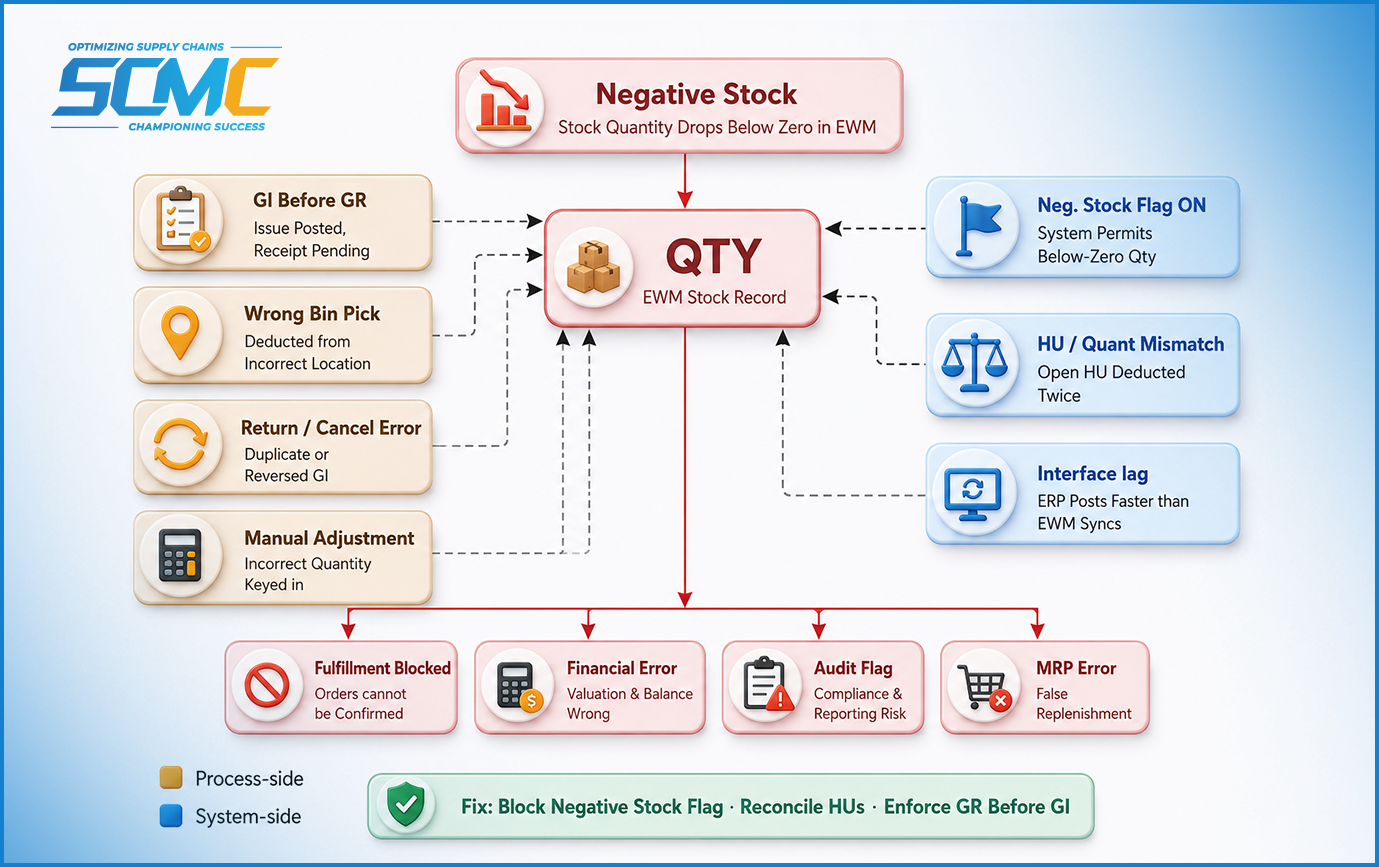
Negative stock in SAP EWM is one of those problems that does not announce itself loudly. It creeps in quietly. And by the time someone raises a flag, it has already touched your warehouse operations, your finance closing, your customer shipments, and the confidence of every person who depends on SAP to tell them the truth. We have seen what it does to teams. It is not just a system issue. It is exhausting.
Business Impact
- Inventory Valuation Becomes Unreliable
Your finance team is working with numbers that do not match reality. Wrong stock figures mean wrong asset values and that creates a real mess during audits. - Customer Deliveries Start Failing
SAP confirms the order because it sees stock available, but the warehouse finds empty shelves. The customer ends up waiting and your service reputation takes the hit. - Unnecessary Purchasing Gets Triggered
MRP sees negative stock and raises purchase orders that were never actually needed. You end up buying material you already had and wasting procurement budget. - Shop Floor Starts Doubting SAP
When workers find empty bins where SAP shows quantity, they stop trusting the system completely. Manual workarounds start replacing standard processes and things get messier from there. - Production Schedules Break Down
Manufacturing planned everything based on confirmed stock availability in SAP. When that stock is not physically there, production orders get stuck and the entire schedule falls apart. - Period-End Closing Becomes a Nightmare
Accounting cannot close the books cleanly when negative stock is sitting unresolved in the system. Every month-end turns into emergency correction work instead of routine closing. - Compliance and Audit Exposure Increases
Auditors treat negative stock as a clear sign of weak inventory controls. It puts your company under unnecessary scrutiny and creates compliance risk that is hard to justify.
The Solution
A Real Warehouse. A Real Problem. A Real Fix.
The Situation —
A mid-sized automotive parts distributor in Chicago was running SAP EWM for their warehouse operations. On paper everything looked fine. But on the ground, things were falling apart quietly. Stock figures in SAP never matched what was physically sitting in the bins. Shipments were getting delayed. Finance was raising flags every month-end. Production lines at their client sites were getting affected because parts were showing available in SAP but were nowhere in the warehouse.
The team tried fixing it internally for weeks. Nothing worked. The problem kept coming back.
The warehouse manager had started coming in early every single morning just to manually walk the bins and build his own picture of what stock was actually there — because he had stopped trusting what SAP was telling him. The finance team had quietly given up on the month-end numbers being clean. And inside the building, the conversations had gotten hard. IT was pointing at the process. Operations was pointing at the system. Everyone was tired and nobody had an answer that stuck.
That is when they contacted SCM Champs.
SCM Champs Team Steps In
Step 1 — Initial Call and Understanding the Pain
Before anything else, our team sat with their operations head, warehouse manager, and SAP team on a call. No assumptions. No shortcuts. We listened to exactly what was happening on their floor daily and mapped out where the breakdowns were occurring.
Step 2 — On-Site Warehouse Visit
Our consultants visited the Chicago facility in person. We walked the warehouse floor, observed live picking and putaway operations, watched how warehouse tasks were being confirmed, and cross-checked physical bin stock against what SAP EWM was showing in real time.
What we saw on the floor told us more than any report could.
Step 3 — Deep System Analysis
Back on the system, our team ran a full diagnostic —
Checked stock overview using /SCWM/MON — Warehouse Monitor
Compared EWM physical stock vs available stock for all affected materials
Monitored integration queues using SMQ1 and SMQ2 to check EWM to ERP communication health
Reviewed storage type configuration in Customizing for negative stock settings
Checked all open and unconfirmed warehouse tasks sitting in the system
Step 4 — Root Causes Found
After full analysis our team identified the following issues —
Issue 1 — Goods Issues were being posted before Goods Receipts completed. Outbound was always running ahead of inbound in their process.
Issue 2 — Storage type configuration had the negative stock indicator switched on without any business justification. Nobody had reviewed this setting since go-live.
Issue 3 — Integration queues between EWM and ERP were failing silently during peak hours. Warehouse tasks were confirming in EWM but stock movements were never reaching ERP.
Issue 4 — Warehouse staff were occasionally posting direct goods movements in ERP to save time, completely bypassing EWM. This was breaking the stock sync every single time it happened.
Issue 5 — Several warehouse tasks were stuck in partially confirmed state. Stock was neither fully moved nor reversed, sitting in a broken position across multiple bins.
Step 5 — Solutions Implemented by SCM Champs
Our team resolved each issue one by one through standard SAP process —
Fix 1 — Enforced the correct sequence. Goods Receipt must complete and warehouse task must be confirmed before any Goods Issue is processed for the same material. Process discipline was documented and trained.
Fix 2 — Removed the negative stock indicator from all storage types where it had no business reason to exist. Kept it active only for interim storage types where SAP standard design requires it.
Fix 3 — Cleared all stuck queues in SMQ1 and SMQ2. Reprocessed failed messages so EWM and ERP stock figures came back in sync. Set up regular queue monitoring as a daily operational check.
Fix 4 — Locked direct ERP goods movement posting for warehouse-managed storage locations. All movements made mandatory through EWM only. User access was adjusted accordingly.
Fix 5 — Identified all partially confirmed warehouse tasks and closed them through the correct SAP standard process. Stock was corrected using the standard adjustment process — no direct table changes made.
Step 6 — Result on the Ground
Within two weeks of SCM Champs engagement —
Negative stock entries dropped to zero
EWM and ERP stock figures matched completely
Month-end closing ran clean for the first time in several months
Warehouse team started trusting SAP figures again and manual workarounds stopped
Customer shipments went out on time without any stock-related delays
And here is why that matters when you are choosing who to call —
SCM Champs is an officially recognized SAP Partner in North America. We do not generalize across every SAP module. We specialise and our specialisation is deep. SAP EWM is what we live and breathe every single day.
We have worked with warehouse operations across the United States and Europe — different industries, different warehouse sizes, different SAP landscapes — and the one thing that stays constant is that we always come in, find the real problem, and fix it the right way.
Our team has resolved some of the most complex EWM challenges that internal IT teams and other consultants could not crack for months. Not because we are lucky — but because we have seen these problems before, across dozens of real warehouse environments, and we know exactly where to look.
When a decision maker walks into a board meeting and needs answers, they need a partner they can stand behind with confidence. Not a vendor. Not a ticket-raising support desk. A real team that understands their warehouse, understands SAP, and delivers results that actually hold.
That is what SCM Champs is. That is what we do.
If negative stock is showing up in your SAP Extended Warehouse Management (SAP EWM) and your team has run out of answers — that is exactly the moment we were built for. We have walked into situations like yours more times than we can count. And we have never left without fixing it permanently. Let us find the real problem and close it for good.