


Business Impact
- Warehouse tasks blocked in EWM despite batch release completed in QM
- LIMS lab results not updating SAP QM inspection lots in real time
- Batch status mismatch between LIMS, QM and EWM creating compliance audit gaps
- TM freight orders created on unreliable batch availability data
- Manual coordination between QA lab, warehouse and logistics replacing system automation
- Shipment delays and missed delivery windows due to disconnected release workflow
- 21 CFR Part 211 batch release audit trail fragmented across disconnected systems
- Restricted stock sitting in warehouse blocking physical space and working capital
The Challenge
Edison, New Jersey. A mid-sized pharmaceutical manufacturer — producing finished dosage form medicines for distribution across the United States and international markets.
New Jersey is not just any location for a pharma company. It sits in the heart of the most heavily regulated pharmaceutical manufacturing corridor in the world. The FDA is practically a neighbour. Audits are not a distant possibility — they are a scheduled reality. Compliance is not a department — it is the culture.
This company knew that. They had built their SAP landscape carefully — SAP EWM for warehouse execution, SAP QM for quality management and batch release, SAP TM for transportation planning, and an enterprise LIMS for laboratory result management.
Four strong systems. Each one doing its job well individually.
The problem was they were barely talking to each other.
And in a pharmaceutical warehouse — where a batch of finished medicine cannot legally move until it is formally released — a disconnected system landscape is not an inconvenience.
It is a daily operational crisis.
Here is what was actually happening on the warehouse floor every single day —
The QA lab would complete their analysis in LIMS. Results looked good. The batch was clean. Technically it was ready to release.
But that information was not flowing automatically into SAP QM. A QA analyst had to manually take the LIMS result, log into SAP, record the inspection lot results in QM and post the usage decision transaction — a process that took anywhere from two to four hours depending on workload, shift patterns and whether the right person was available.
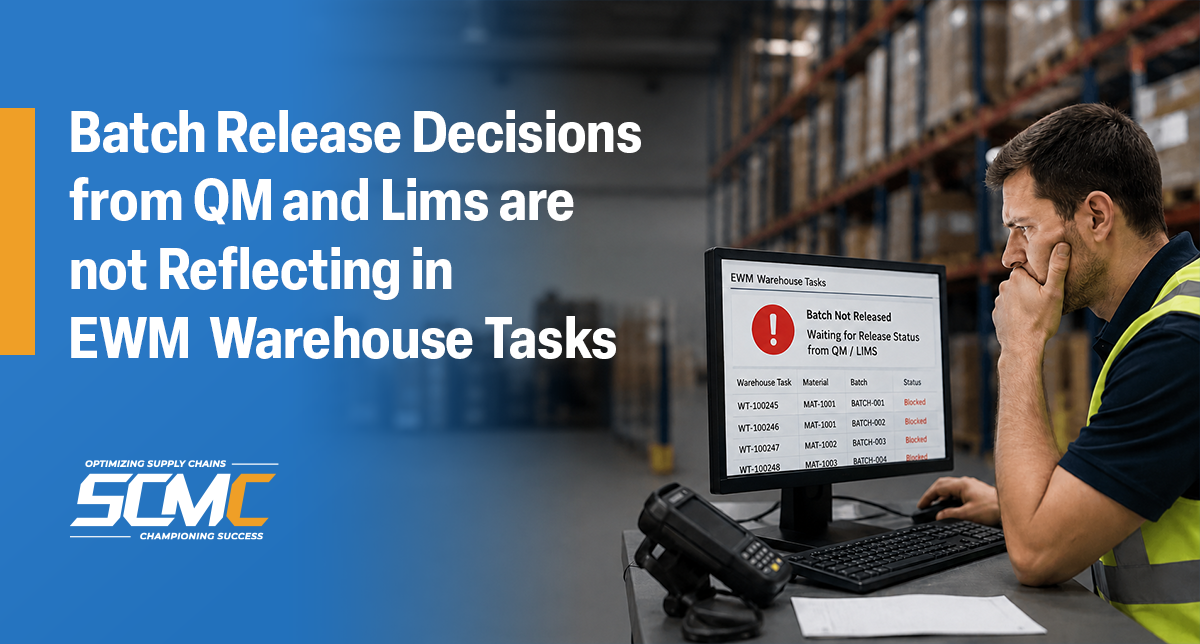
Meanwhile the warehouse team was sitting with blocked stock. Warehouse tasks could not be created in EWM because the batch status was still showing restricted. Workers were standing at picking stations waiting. Supervisors were calling the QA lab. The QA lab was calling back to say the batch was released in LIMS three hours ago. The warehouse team did not care about LIMS — they needed EWM to show unrestricted stock.
And transportation? The TM team was building freight orders based on delivery schedules that assumed batch release had happened — because on paper it had. But in SAP it had not. Freight orders were being confirmed for shipments that could not physically leave the building yet.
That disconnect — playing out across dozens of batches every week — was quietly destroying the operation.
What the business was losing every month —
- Over $55,000 monthly (as reported by the client) in expedited freight costs, shipment rescheduling fees and penalty clauses from distribution partners who were receiving late or incomplete orders
- An average of 4 to 6 hours of delay per batch (as reported by the client) between LIMS release and EWM warehouse task creation — purely due to manual data handoff between systems
- QA analysts spending 30 to 40 percent (as reported by the client) of their working day on manual SAP data entry that should have been automated — time pulled directly away from actual quality work
- Three FDA 21 CFR Part 211 internal audit findings related to batch release documentation gaps — the audit trail between LIMS results, QM usage decisions and EWM goods movements was fragmented and inconsistent
- TM freight orders being built on unreliable data — causing logistics planning errors that cascaded through the week
- Warehouse utilisation suffering — restricted stock occupying physical locations that could not be cleared until manual release completed
- Two near-miss compliance incidents where batches were inadvertently picked before QM usage decision was formally posted in SAP — caught internally but flagged as serious process gaps
The operations director described the situation in a team meeting with a single sentence —
“We have four systems and none of them know what the others are doing.”
The Call to SCM Champs
The company had raised the integration issue internally multiple times. Their existing SAP support partner had looked at it twice and recommended a custom development approach — a bespoke middleware solution that would take eight months to build and cost significantly more than the budget available.
Eight months. For a problem that was costing them $55,000 every month.
That was when a colleague at a pharma industry networking event in Princeton mentioned SCM Champs. Not in a sales context — just a casual conversation about SAP integration headaches. The colleague had worked with SCM Champs on an EWM QM project the previous year.
“They know this integration properly. Not just the theory — the actual configuration. Call them before you build anything custom.”
The operations director made that call the following morning.
SCM Champs was on a discovery call within 48 hours. No lengthy statements of work upfront. No generic integration proposals. Just precise, technical questions from a team that clearly understood exactly which system boundaries were breaking down and why.
What SCM Champs Actually Found
The findings were specific, technical and — for anyone who has worked in SAP pharma integration — entirely recognisable.
Finding 1 — LIMS to SAP QM interface was not configured
The LIMS system — a LabVantage installation — had no live interface to SAP QM. There was no automated connection between the two systems. Lab results were sitting in LIMS with no pathway into SAP QM inspection lots. Every result transfer was manual — a human being carrying data from one system to another by hand. In a regulated pharmaceutical environment, this was both an operational bottleneck and a compliance exposure.
Finding 2 — QM usage decision was not triggering EWM batch status update
Even when QA analysts did manually post the usage decision in SAP QM via transaction QA32 — the batch status change was not automatically flowing through to EWM. The batch classification update via transaction MSC2N was a separate manual step that was frequently missed, delayed or performed by a different team member hours later. EWM was reading restricted batch status long after QM had formally released the batch.
Finding 3 — EWM warehouse task creation had no automated trigger from batch release
There was no automated workflow configured in EWM to monitor batch status changes and trigger warehouse task creation upon release. The warehouse team had no system notification that a batch had moved from restricted to unrestricted. They were relying entirely on phone calls and emails from the QA team — a human relay system running inside a multi-million dollar SAP landscape.
Finding 4 — SAP TM had no real time visibility of batch release status
TM freight orders were being created based on planned delivery dates — with no live feed from QM batch release status. Transportation planners were committing to pickup times and carrier bookings without any system confirmation that the goods were actually cleared for shipment. When batches were delayed in QM — which happened daily — the TM team found out through the same phone call chain, not through the system.
Finding 5 — Audit trail was fragmented across four systems
The regulatory requirement under 21 CFR Part 211 is clear — the complete batch release record must be traceable, consistent and available for inspection. What existed in Edison was four separate records in four separate systems — LIMS lab results, QM inspection lot documentation, EWM goods movement records and TM shipment records — with no automated linkage between them. During an internal audit, reconstructing the complete batch release trail required pulling records from all four systems manually and reconciling them by hand.
What SCM Champs Delivered — Step by Step
Step 1 — Designed and Implemented LIMS to SAP QM Integration
SCM Champs designed and implemented a structured interface between the LabVantage LIMS system and SAP QM. The integration approach was selected based on the client’s existing technical landscape and SAP environment — SAP supports several standard integration methods for external system connectivity including IDocs, BAPIs via RFC, SAP Integration Suite — Cloud Platform Integration, and SAP Process Integration and Process Orchestration for on-premise middleware environments. The appropriate method was selected after a thorough technical assessment — ensuring the interface was maintainable, supportable and aligned with the client’s long-term SAP roadmap.
Lab analysis results completed in LIMS now trigger an automatic posting into SAP QM — updating the relevant inspection lot with result recordings without any manual intervention. The four-hour manual data transfer between LIMS and QM was reduced to a system-driven automated process from day one of go-live.
Where standard configuration alone was insufficient to meet specific client requirements, enhancements were implemented using SAP’s standard extensibility framework — BAdIs and user exits — keeping all developments within SAP’s supported and upgradeable architecture rather than introducing fragile bespoke outside development.
Step 2 — Automated QM Usage Decision to EWM Batch Status Update
The connection between QM usage decision posting and EWM batch status was configured correctly — ensuring that when a QA analyst posts the usage decision in SAP QM via transaction QA32, the batch classification is automatically updated via the standard batch status management process in transaction MSC2N without requiring a separate manual step.
The batch status change — from restricted to unrestricted — now flows automatically into EWM immediately upon QM usage decision posting. No secondary manual step. No delay. No phone calls between QA and warehouse.
Step 3 — Configured Automated Warehouse Task Trigger in EWM Upon Batch Release
An automated workflow was configured within SAP EWM to monitor batch status changes and trigger warehouse task creation the moment a batch moves to unrestricted status following QM release. The warehouse team now receives an automatic system notification and the relevant warehouse tasks are created and available for execution without any manual intervention from the QA team.
Where standard EWM workflow configuration required extension to meet the client’s specific batch release and task creation requirements, enhancements were delivered cleanly within SAP’s BAdI framework — ensuring full system supportability going forward.
The human relay system — phone calls, emails, waiting — was replaced by a system-driven automated trigger operating within the SAP EWM standard architecture.
Step 4 — Connected SAP TM to Live Batch Release Status
SAP TM was integrated with the batch release workflow via SAP Event Management — providing transportation planners with real time visibility of batch release status directly within their TM workspace. Freight orders are now only confirmed and carrier bookings only committed once the system confirms that the relevant batch has been formally released in QM and the goods are physically available in EWM.
The practice of building freight orders on assumed batch availability — which had been generating costly logistics errors daily — was addressed at the configuration and integration level.
Step 5 — Established Unified Batch Release Audit Trail Across All Four Systems
A unified audit trail framework was established — linking LIMS lab results through QM inspection lot documentation, QM usage decision records, EWM batch status changes, warehouse task execution records and TM freight order confirmations into a single traceable chain.
Every step in the batch release and warehouse execution process now generates a consistent, time-stamped electronic record — fully aligned with the traceability requirements under 21 CFR Part 211 and the electronic record integrity standards under 21 CFR Part 11. During any inspection, the complete batch release trail from lab result to shipment confirmation is retrievable in a single coherent sequence — not reconstructed manually from four disconnected systems.
Step 6 — End-to-End Integration Testing and Regulatory Readiness Review
Before go-live, SCM Champs executed a comprehensive end-to-end testing programme covering every integration touchpoint —
- LIMS result posting to QM inspection lot — verified across multiple batch types and result scenarios
- QM usage decision to EWM batch status update — tested across restricted, unrestricted and blocked stock scenarios
- EWM warehouse task creation trigger — verified across goods receipt, internal transfer and outbound delivery scenarios
- TM freight order status update from EWM batch release — tested across standard and expedited shipment scenarios
- Audit trail completeness — verified end-to-end from LIMS result through to TM shipment confirmation
Regulatory readiness was reviewed against 21 CFR Part 211 batch release documentation requirements and 21 CFR Part 11 electronic record standards before any process was signed off for production use.
What Changed — Business Impact After Delivery
The warehouse floor felt the difference within the first week.
- Batch release to warehouse task creation time reduced from 4 to 6 hours to under 15 minutes (as reported by the client) — driven by system automation replacing manual data handoff
- Expedited freight costs and shipment rescheduling fees reduced meaningfully (as reported by the client) — TM planning now based on confirmed batch availability rather than assumed schedules
- QA analyst manual SAP data entry time reduced by approximately 70% (as reported by the client) — restoring bandwidth to actual quality work
- Batch status consistency across LIMS, QM and EWM — mismatches eliminated, manual confirmation calls ended
- 21 CFR Part 211 audit trail gaps addressed — complete, consistent and connected batch release records across all four systems
- Internal audit findings related to batch release documentation closed — regulatory readiness strengthened
- TM freight planning accuracy improved — carrier commitments based on confirmed system data
- Warehouse utilisation improved — restricted stock cleared faster, physical locations freed up sooner (as reported by the client)
The QA manager — who had spent months carrying lab results from LIMS to SAP by hand — sent a message to the SCM Champs team two weeks after go-live —
“I spent the whole of yesterday doing actual quality work. I cannot remember the last time that happened.”
That message said everything about what disconnected systems really cost — not just in money, but in the daily working lives of the people running them.
Why SCM Champs
In pharmaceutical manufacturing, the gap between a released batch and a moving warehouse task should be measured in seconds — not hours. And it certainly should not depend on a phone call.
SCM Champs specialises in closing exactly these gaps — connecting SAP EWM, QM, TM and external LIMS systems into a single, automated, compliant workflow that reflects the real state of your operation in real time.
With deep experience across pharmaceutical manufacturing and distribution operations in North America and Europe — and a thorough understanding of the regulatory standards that govern batch release, electronic records and audit trail integrity in this industry SCM Champs brings both the technical precision and the compliance awareness that these integrations demand.
If your warehouse is still waiting on a phone call to find out whether a batch has been released —
That is not a process problem. That is a solved problem. Call SCM Champs.