


Introduction
For a U.S. semiconductor manufacturer, a single hour of warehouse downtime can cost millions and shatter delivery commitments to global customers. As the industry moves rapidly to SAP S/4HANA, the choice of warehouse platform becomes a strategic decision: migrating from classic SAP WM to SAP EWM is not just an IT upgrade — it is a business-critical move to protect production, quality, and revenue.
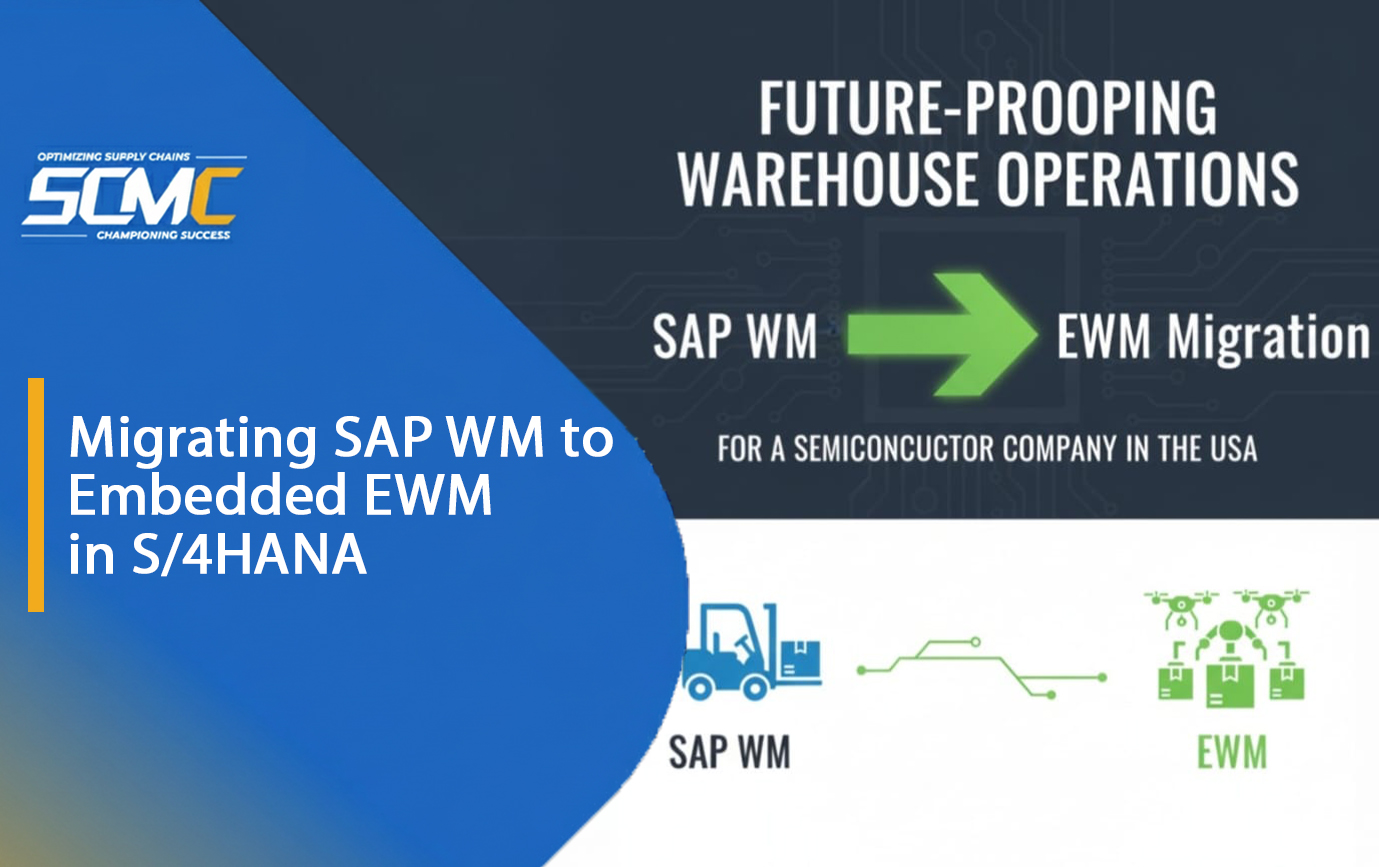
This post explains how a semiconductor company can migrate from WM to EWM embedded in S/4HANA without interrupting operations. You’ll get a clear view of the real risks, a proven migration blueprint, and the advanced technologies that make modern warehouse operations resilient and high-performing.
Challenges
Migrating warehouse software in high-tech manufacturing exposes direct business risks. Below are the core challenges — each tied to a tangible business cost or risk.
1. Production Halt Risks — Immediate Revenue Impact
Semiconductor fabs run 24/7. A mis-picked lot or delayed issue can halt a production line within hours, producing seven-figure losses and damaging customer trust.
2. Traceability Gaps — Regulatory and Quality Exposure
Legacy WM often lacks the granularity today’s traceability and audit rules demand. Slow or incomplete traceability causes lengthy investigations and costly recalls.
3. Environmental & Handling Sensitivity — Product Loss and Yield Risk
Moisture, particle contamination, and incorrect ESD handling can compromise entire lots. Poorly monitored storage and transfers translate directly into yield losses and scrap.
4. Disconnected Quality & Manufacturing Flows — Blind Spots
When quality inspections, MES events, and warehouse movements live in separate silos, defects or quarantined lots may accidentally enter production — creating rework and warranty risk.
5. Complex Physical Flows — Mapping & Control Challenges
Cleanroom transfers, staged kitting, and specialized storage bins need exact mapping in EWM. Misconfiguration leads to misplaced stock and slowed throughput.
6. People & Adoption — Productivity Drag
If mobile screens and workflows aren’t optimized for speed and clarity, operators slow down, error rates climb, and the migration fails to deliver promised benefits.
Our Proven Migration Methodology
This is a practical, risk-focused blueprint for moving from WM to EWM while protecting production and quality.
1. Executive alignment and risk scoring
Start by scoring warehouse processes by business criticality (production-facing, customer-facing, regulatory). This focuses the first migration waves on highest-risk areas.
2. Phased cutover with parallel runs (gold-standard)
Migrate in waves and run WM and EWM in parallel for critical processes such as goods receipt and cycle counts. Parallel runs validate EWM outcomes against the live WM system without shutting off the old workflow — the safest path to go-live.
3. Pilot, validate, iterate
Select a single high-value area (e.g., incoming inspection for wafers) as the pilot. Validate end-to-end transactions, measure KPIs, gather operator feedback, then iterate before broader rollout.
4. Process simplification, not straight lift-and-shift
Recreate necessary WM capabilities in EWM, but remove outdated workarounds. Simplified flows reduce steps, lower errors, and speed operator adoption.
5. UX-first mobile redesign for operators
Design handheld screens for one-touch confirmations, clear next-actions, and minimal data entry. Fast mobile UX directly reduces cycle time and mis-picks.
6. Embedded quality: QM + EWM integration
Integrate inspections and release logic into EWM so quarantines and releases are enforced in real time. That prevents suspect lots from entering production.
7. Integration with MES and lab systems via BTP/API layer
Use SAP BTP or an integration suite to orchestrate events between EWM, MES, and lab/quality systems so master data, orders, and inspection results remain synchronized.
8. Meticulous data migration & validation (new imperative)
Perform a mock cutover to cleanse and validate master data (materials, batches, bins). Validate transformation rules and run reconciliation reports. Poor master-data migration is the top cause of go-live failures — so we treat it as mission-critical.
9. Change management — peer champions and on-the-job coaching
Pair classroom learning with shop-floor simulations, and designate peer champions who mentor operators. This accelerates behavioral change and builds confidence.
Technology
Here are the eight focused technologies that should be highlighted in the blog — each explained with a semiconductor-specific benefit.
1. SAP EWM embedded in S/4HANA
What: Core warehouse functions inside S/4HANA.
Benefit: Single-source inventory and faster transactions — reduces mis-picks and simplifies reconciliation.
2. Advanced Batch Management & Serialization
What: Precise batch and serial tracking.
Benefit: Instant, reliable recall capability and fast root-cause analysis for any suspect lot.
3. IoT + RFID + RTLS
What: Environmental sensors, RFID tags, and location tracking.
Benefit: Real-time alerts for humidity/ESD excursions and rapid cycle counts without manual counting.
4. AI / ML for Predictive Operations (tightened)
What: Models that analyze historical and real-time data to forecast shortages, predict failures, and detect subtle correlations.
Benefit: Predicts critical material shortages before they cause line stops and surfaces correlations (e.g., a storage zone linked to minor yield dips) that humans miss.
5. Computer Vision for Quality Checks
What: Automated visual inspection during inbound and staging.
Benefit: Consistent detection of damaged reels/trays or contamination, reducing manual inspection time.
6. Automation (AGVs, AS/RS, Robotics) & WES Integration
What: Robotic transport and automated storage controlled by a Warehouse Execution System.
Benefit: Clean, predictable transfers between controlled areas with higher throughput and lower contamination risk.
7. SAP BTP / Integration Suite & Cloud-native Extensions
What: Integration and extension layer for APIs and microservices.
Benefit: Fast, reliable connections among EWM, IoT platforms, CV systems, and analytics — enabling event-driven automation.
8. Cybersecurity & Compliance
What: Role-based control, encryption, and full audit trails.
Benefit: Protects IP and ensures only authorized approval for batch release critical for audit-readiness.
Why Now — The SAP Imperative
SAP’s innovation and roadmap center on EWM, not classic WM. Staying on legacy WM while moving to S/4HANA limits future capabilities and exposes you to technical debt. Migrating now secures platform support, unlocks advanced automation, and prevents a costly rework later.
Closing & Call to Action
Migrating SAP WM to SAP EWM is more than a systems project — it’s a transformation that protects production, improves traceability, and powers next-generation semiconductor operations. The real risk is not the migration itself but doing it without a proven methodology: parallel runs, rigorous data validation, operator-centered UX, and integrated quality controls.
SCM CHAMPS specializes in seamless, business-centric EWM migrations for high-tech manufacturers. Contact SCM CHAMPS today for a free discovery session to assess your readiness and build a personalized migration roadmap that protects your production lines and accelerates time-to-value.