


Are your LTL shipping costs rising even when carrier rates stay roughly flat? The problem is rarely with the carrier. In most companies, the money leaks out through operations: trailers that leave partially filled, orders that could have shipped together but didn’t, routes planned from habit rather than data, and warehouse teams working to a different clock than transportation planners. Manual load building compounds all of it. The encouraging part is that improving trailer utilization by even 8–15% can significantly reduce transportation spend without shipping a single order less. This article explains where that waste hides and how to remove it.
TL;DR
- Empty trailer space is hidden transportation waste.
- Shipment consolidation often saves more than freight rate negotiations.
- Poor routing inflates mileage, fuel, and driver hours.
- Systems like SAP TM optimize load building and routing.
-
- Aligning warehouse and transportation planning helps improve trailer utilization.
Here is a quick self-diagnosis to analyze your current situation
| If This Happens | It Usually Means |
|---|---|
| Trailers regularly leave 25–35% empty | Load planning and consolidation issue |
| The same customer gets multiple deliveries per week | Weak consolidation rules |
| Freight costs rise while order volume stays flat | Routing and utilization inefficiency |
| Expedited shipments keep increasing | Warehouse–transportation misalignment |
Why LTL Costs Keep Rising — You’re Paying to Ship Empty Air
Most companies negotiate freight rates every year — but never negotiate with their own planning process. Yet planning typically has a larger impact on transportation cost than the few points a hard-fought rate negotiation wins. The rate is the symptom; the process is the problem.
Consider a truck with capacity for 30 pallets that departs with 20 on board. Ten pallet positions — a third of the capacity you paid for — travel empty. The carrier still drives the full route, burns the same fuel, and invoices for the trip. You bought space and shipped air.
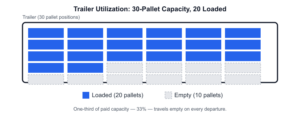
Now multiply. A network moving a few hundred shipments a month at that fill level pays for thousands of empty pallet positions a year — cost that never appears as a line item on any invoice, which is why it survives every budget review. No rate negotiation recovers it. Only better planning does.
Five Operational Problems That Create Unused Trailer Space
Empty trailer space is rarely one big failure. It is five small habits compounding.
Orders are released too early
When the warehouse releases orders the moment they are picked, each one tends to ship on the next available truck — alone. Consolidation opportunities that existed on paper disappear at the dock, and the network fills with half-empty departures.
Warehouse and transportation teams plan separately
Warehouse teams optimize for picking efficiency; transportation teams optimize for delivery dates. When neither sees the other’s plan, freight becomes whatever the dock happens to produce that day, and utilization becomes an accident rather than a decision.
Shipment consolidation rules are missing
Without defined rules — which orders can wait, for how long, and for what fill-rate gain — planners default to shipping everything immediately. Two LTL shipments to the same postal code on the same day is the predictable result.
Routes are planned manually
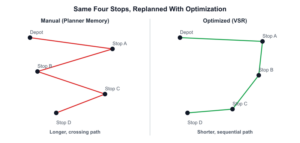
Routes built from planner memory age badly as demand shifts, and the cost goes beyond fuel: extra miles mean extra driver hours, detention risk, and missed delivery windows. The same four stops, replanned with optimization, routinely come back shorter in both distance and drive time.
Load planning prioritizes speed over utilization
Under daily pressure, planners build loads that ship fast rather than loads that ship full. Every quick decision is individually reasonable; collectively they lock in low fill rates as the operating standard nobody questions.
Manual Planning vs. Transportation Optimization
Set side by side, the two operating models are hard to confuse:
| Manual Planning | Optimized Planning |
|---|---|
| Relies on individual planner judgment | Algorithmic, AI-assisted load optimization |
| Multiple partially filled LTL loads | Consolidated, fuller shipments |
| Reactive, day-of adjustments | Predictive, plan-ahead scheduling |
| Hours of daily planning effort | Minutes with automated planning |
The SPACE Framework™
The SPACE Framework™ is SCM CHAMPS’ proprietary methodology for transportation diagnostics — named, fittingly, after the very thing this article is about. Five levers decide whether you ship freight or ship air. A system like SAP TM enforces the discipline on each lever; it does not replace it.
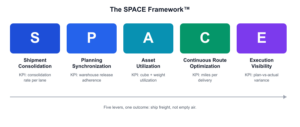
S — Shipment Consolidation. The classic mistake is consolidating too late, after orders are already assigned to shipments. The objective is simple to state but hard to execute: fill trailers without delaying customer orders. SAP TM moves that consolidation decision upstream through freight unit building and consolidation rules, and the KPI to watch is consolidation rate per lane.
Know the limits: don’t hold urgent customer orders, temperature-sensitive freight, shipments under contractual delivery windows, or items with high stockout risk. Consolidation that costs a customer isn’t savings.
P — Planning Synchronization. Walk any dock at four in the afternoon and you can watch this happen: trucks loading whatever is staged, because orders were released for picking convenience rather than the shipping schedule. The fix is tying warehouse releases to planned departures — SAP TM’s integration with SAP EWM does exactly that. The number that keeps both teams honest is warehouse release adherence.
A — Asset Utilization. Paid capacity has two dimensions, weight and cube, and many operations measure only the first — then wonder why trailers cube out well below legal payload. SAP TM’s load optimization lets planners work against whichever constraint binds on each lane, but only if both cube and weight utilization are tracked. Without both numbers, you’re guessing.
C — Continuous Route Optimization. Routes designed once drift out of alignment as demand, customers, and volumes change — usually within months. The honest scorecard is miles per delivery. SAP TM’s VSR optimizer (vehicle scheduling and routing) makes re-optimization routine instead of a special event, so that drift never gets a chance to set in.
E — Execution Visibility. Plans mean little if nobody checks them against reality. Many companies track total transportation cost closely while ignoring actual fill rates, detention hours, and plan-versus-actual variance. SAP TM’s event management and embedded analytics close that loop, turning every departure into feedback for the next plan.
Rate your organization on 1 to 5 on each SPACE dimension and total the score. The scores run from 5 to 25.. Below the midpoint of 15, significant hidden transportation waste; 15–20, clear optimization opportunities remain; above 20, you are running mature transportation planning — and probably already measuring most of what this article describes.
Worked Scenario — How a National FMCG Company Could Reduce Empty Trailer Space
A worked scenario, built on patterns common in FMCG logistics rather than a specific client engagement: a national consumer goods company runs 15 warehouses and dispatches thousands of deliveries a month. Trailer utilization is low, the same retail customers receive duplicate deliveries within the same week, and routing lives in planners’ heads.
Apply the framework. Consolidation rules hold compatible orders for a defined window. Routing moves to the VSR optimizer. Warehouse releases synchronize with transport plans.
In a network with these symptoms, realistic outcomes look like trailer utilization gains of 10–15 percentage points, transportation cost down 6–10%, fewer LTL shipments as orders combine, and better on-time delivery — because routes are finally built around delivery windows instead of departure convenience.
Where to Start — Implementation Roadmap
If this article describes your operation, this is the sequence that works:
- Measure current trailer utilization — by weight and cube, per lane.
- Identify consolidation opportunities sitting in your order data.
- Review routing logic: how old are the routes, and who maintains them?
- Align warehouse release schedules with transportation plans.
- Evaluate planning tools, such as SAP TM, against the gaps you found.
- Track KPIs and improve continuously — utilization is a habit, not a project.
Steps one through four typically take weeks, not quarters, and cost analysis time, not capital. Start there.
How SCM CHAMPS Helps
SCM CHAMPS is a supply chain consulting company specializing in SAP-driven logistics and transportation transformation, with a delivery track record spanning SAP TM implementations, warehouse–transportation integration, and optimization programs measured in reduced freight cost and improved operational visibility.
The problems in this article map directly to what we do:
| Challenge | How SCM CHAMPS Helps |
|---|---|
| Low trailer utilization | Transportation planning assessment and load optimization |
| Manual routing | SAP TM route optimization (VSR) |
| Weak shipment consolidation | Consolidation strategy and SAP TM configuration |
| Warehouse–transport disconnect | End-to-end SAP EWM–TM integration |
| Rising transportation costs | KPI-driven continuous improvement |
Frequently Asked Questions
What causes unused space in LTL shipments? Most commonly: orders released too early, missing consolidation rules, warehouse and transportation teams planning separately, manual routing, and load building that prioritizes speed over fill rate. The waste is operational, not commercial — which is why rate negotiations rarely fix it.
What is a good trailer utilization percentage? There is no universal benchmark; it depends on freight profile, whether cube or weight binds first, and network design. Measure your current baseline per lane, then improve against it — most manually planned networks have meaningful headroom.
Does SAP TM help reduce LTL transportation costs? Yes — through freight unit building and consolidation rules, load optimization against vehicle capacity, and the VSR optimizer for routing. The savings come from utilizing the full capacity of the carrier and choosing the shortest and optimal route.
Why do transportation costs rise even when freight rates remain flat? Because cost per shipment and cost per order delivered are not the same. If the vehicle capacity utilization is not maximum, order consolidation weakens even for orders that are going to the same location.
If the expedited freight demand creeps up, the total spend increases even if the freight rate remains the same.
.What is the SPACE Framework in transportation planning? SPACE is SCM CHAMPS’ proprietary methodology for eliminating wasted trailer capacity: Shipment Consolidation, Planning Synchronization, Asset Utilization, Continuous Route Optimization, and Execution Visibility. Each lever pairs an operational discipline with the SAP TM capability that supports it.
When should a business invest in transportation optimization software? When the basics are measured and the gaps are known — after you have baselined utilization and identified consolidation opportunities. Software amplifies a sound planning process; it does not substitute for one.
The Cost of Waiting
None of this waste pauses while a decision works its way through the calendar. Every week, partially filled trailers keep leaving the dock, duplicate deliveries keep running, and the gap compounds as volumes grow. Unlike a rate increase, this cost never announces itself — no invoice line, no alert, just quiet spend. Deferring the assessment is not a neutral act; it is a decision to keep paying for empty space. The only question is how long.
Not sure how much empty trailer space is costing you? Score your operation against the SPACE self-assessment above then request a transportation planning assessment from SCM CHAMPS and turn that score into a plan.