SAP S/4HANA
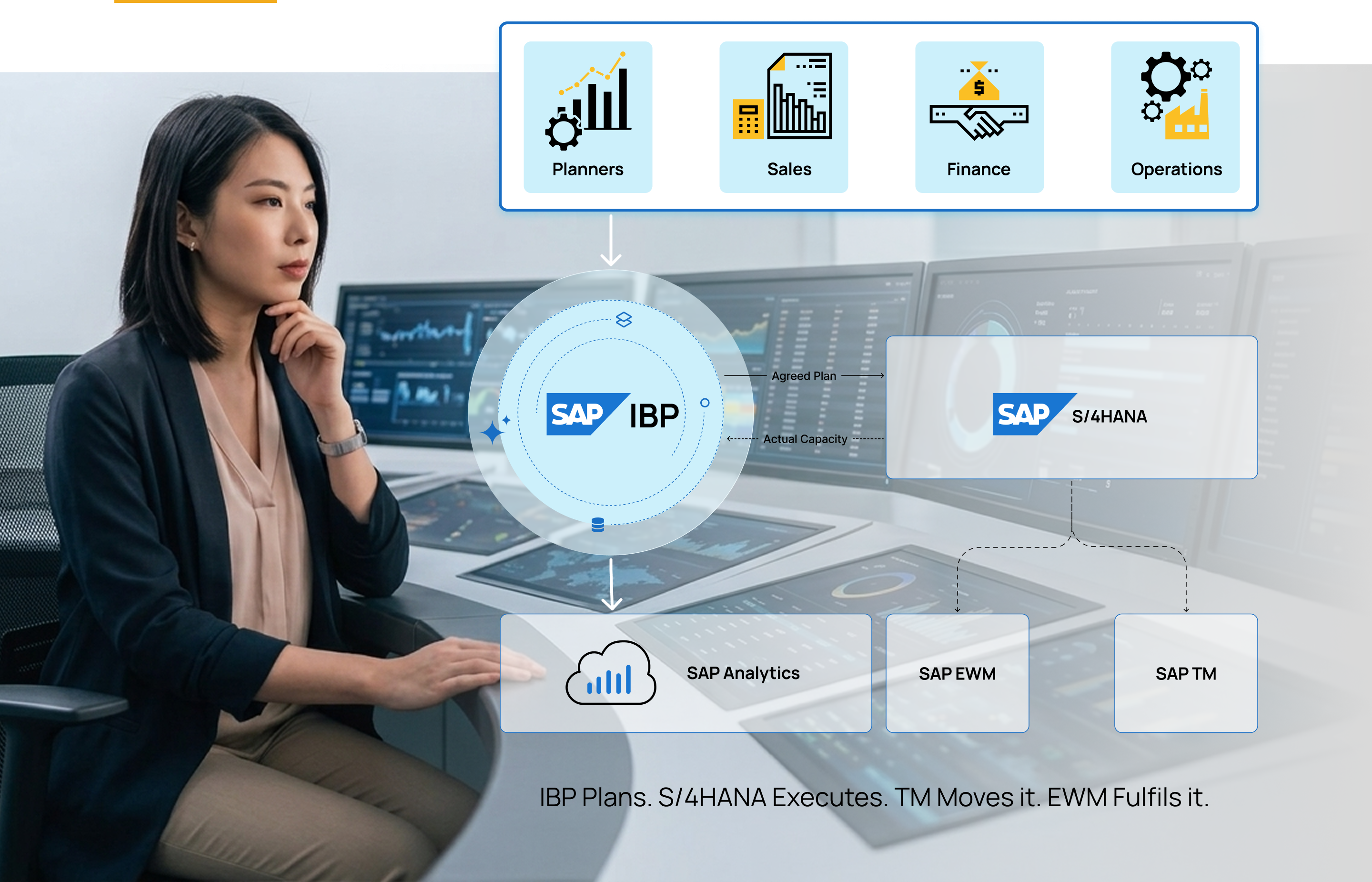
The main link. Real orders, stock and capacity flow into IBP, and the agreed plan flows back out.


Plan demand, supply, inventory and S&OP together, on one cloud platform.
Sales works from one forecast. Supply chain works from another. Finance isn’t sure which number to trust, and production just reacts to whatever shows up. SAP IBP brings demand, supply, inventory and S&OP into one planning process, so everyone works from the same plan. SCM Champs is an SAP IBP implementation partner in the USA. We help manufacturing, consumer goods, retail, automotive and life sciences companies from the first assessment to go-live and support.
Talk To An Expert→Stock keeps growing, but you still run out of what customers want. SAP IBP sets safety stock from real demand swings, lead times and your service targets, not old rules or gut feel.
Outcome: The right stock in the right place, with less cash stuck in the wrong items.
Often you only find out about a shortage when an order can’t be confirmed. SAP IBP checks the plan against real capacity and materials. You can test “what if” cases, like a late supplier or a machine going down, so shortages show up in the plan long before they hit an order.Outcome: You spot problems early and still have time to pick the best fix.
Every team brings its own spreadsheet, and the meeting goes to arguing over whose numbers are right. SAP IBP puts demand, supply and finance on one plan, so the meeting is about decisions, not data.Outcome: Shorter S&OP meetings that end with clear decisions.
Planning takes days because someone has to pull data, update files and fix numbers that don’t match. SAP IBP pulls the data together and does the math, so a plan that used to take days can be updated much faster.Outcome: Planners spend their time on the plan, not on building it.
Mainstream maintenance for SAP APO ends in 2027, and extended maintenance up to 2030 costs extra. SAP IBP is the natural next step, but it doesn’t replace APO one for one. Some functions, like detailed production scheduling, move into SAP S/4HANA instead.Outcome: A clear, step-by-step move off APO, without rushed decisions or gaps in planning.

Your planning now involves multiple functions, locations, constraints or scenarios.
SAP IBP Connects:
You already have a planning process, but teams still struggle to align.
SAP IBP Brings:
Products, locations, lead times and capacities are accurate enough to support planning.
SAP IBP Enables:
Demand changes, supplier delays and capacity constraints can quickly change the plan.
SAP IBP Helps You:
Sales, supply chain and finance each work from their own assumptions.
SAP IBP Creates:
You want to improve planning step by step rather than transform everything at once.
SAP IBP Connects:SAP IBP has six parts that work together. Most companies start with one or two and add more later.

Forecast Accuracy, Demand Consensus
→Demand Planning
Capacity And Material Constraints
→Supply & Response Planning
Too Much Stock, Wrong Stock, Wrong Place
→Inventory Optimisation
Sales, Operations & Finance Not Aligned
→Sales & Operations Planning
Allocating Short Supply Across Customers
→Response Planning
Seeing Plan Versus Actual Across The Network
→Supply Chain Control Tower
We look at how you plan today, how good your data is and how your systems fit together. Then we tell you honestly whether IBP is worth it and which part to start with. You get a findings report and a cost roadmap.
We design the planning process, the data model and how IBP connects to your other systems. You get a step-by-step roadmap built around your priorities, not a fixed template.
We set up SAP IBP and take it through go-live and hypercare, including planning areas, key figures, planning runs, dashboards and user training, so your team is ready to use it from day one.
SAP APO mainstream maintenance ends in 2027. We plan and run your move off APO: we map each APO function, decide what moves to IBP and what moves to S/4HANA, migrate your data and switch over in phases.
We connect SAP IBP to SAP S/4HANA and your non-SAP systems, set up the data flows and monitor them after go-live, so your plan is always built on real data.
After go-live, we support IBP, fine-tune the planning model and help you add new capabilities or regions as you grow.
The main link. Real orders, stock and capacity flow into IBP, and the agreed plan flows back out.
Transport lead times and capacity limits help shape a realistic plan, usually by way of S/4HANA. The plan then shows what needs to move and when.
Warehouse stock reaches IBP through S/4HANA, so inventory planning starts from current stock levels, not outdated spreadsheets.
Planning data sits alongside finance and sales data, so management reports show one consistent picture.
Brings planning data together with data from outside SAP, for reporting and analysis across the whole business.
Running more than one ERP? IBP can plan across all of them when the integration is set up for it.