


Three months after a smooth SAP EWM go-live, a distribution center I visited was picking 90 order lines per hour. Before the implementation, the same team consistently hit 120. The IT team insisted the system was configured correctly. They were right. The warehouse manager showed me dashboards I would have been proud of six months earlier. But his pickers were walking an extra four miles per shift, and nobody had noticed because the old system never measured travel time at all. The software did its job. It made the invisible visible. The operation just hadn’t responded to what became visible.
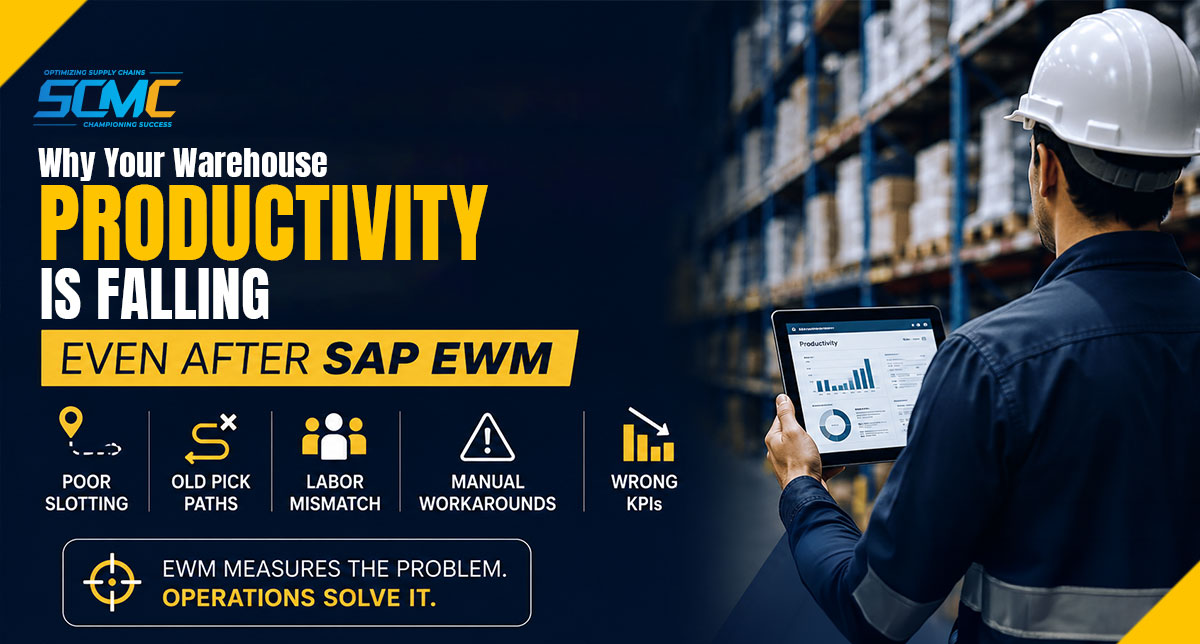
SAP EWM doesn’t improve productivity on its own. It exposes the problems that were always there—bad slotting, outdated pick paths, undisciplined processes—and now it measures them in real time. Before go-live, a picker walking 200 meters to retrieve a fast-moving SKU was just how things worked. Nobody tracked it. EWM tracks everything, and suddenly the data tells an uncomfortable story. Too many companies confuse “system live” with “operations improved,” then spend months blaming the software for reporting what their warehouse was actually doing all along.
Here are the five reasons productivity falls after go-live, and what each one actually costs.
Fast Movers Sitting in the Back Aisles
In one FMCG warehouse, the top 20 SKUs accounted for 60% of pick volume and sat in the three aisles farthest from the dispatch area. This configuration predated EWM by four years. Nobody questioned it because the old WMS only reported order completion, not travel distance. Once EWM illuminated the walking patterns, the math was straightforward: pickers were spending 55% of their shift just moving between locations. The cost showed up as an extra 22 labor hours per day that the pre-EWM staffing model never budgeted for. Quarterly slotting reviews would have surfaced this in week one of post-go-live analysis, but the operations team was still celebrating a clean cutover.
Digitizing the Old Workflow Instead of Redesigning It
I keep seeing the same pattern: a warehouse spends months mapping its physical processes into EWM exactly as they existed in the legacy system. The 2015 pick path gets digitized, not rethought. EWM executes it faster, but the route itself is still inefficient. The business case for EWM assumed a 25% pick-rate improvement. When the actual number landed at 7%, the steering committee blamed the software. The software ran the route it was given. The fix is unglamorous: walk the physical path with a stopwatch before configuring the system path. A supervisor can map a better route in two hours. That two hours is often the difference between hitting the business case and quietly abandoning it.
Labor Planning Frozen in Time
Workload distribution changes after EWM because tasks consolidate, priorities shift, and certain zones handle volume differently than before. One distribution center I reviewed was still staffing its picking and packing zones based on a 2019 spreadsheet. EWM data showed packing was overstaffed by three people after lunch while picking was short by four. The result: overtime in one zone, idle time thirty meters away, and a supervisor manually reallocating people by shouting across the floor. The fix is remarkably simple. EWM provides real-time workload visibility by work center. A monthly labor rebalance using actual task volumes closes this gap without any system change.
Exceptions That Become the Real Process
Operators bypass the system for “exceptions,” and slowly the exceptions become the norm. I watched a picker skip a system-directed putaway because the bin was full, write the location on a sticky note, and keep going. Three other pickers had done the same thing that morning. Nobody was tracking how often this happened. The cost: inventory accuracy drifted to 94% within eight weeks of go-live, triggering cycle counts that pulled experienced pickers off the floor for half a shift each week. Track exception frequency weekly. Every recurring exception is a broken process wearing a “one-time workaround” disguise. When the same exception appears three weeks running, it’s not an exception anymore.
Measuring the Wrong KPIs
Most post-go-live steering committee decks I see celebrate orders shipped and lines completed. Those are output metrics. Productivity metrics—travel time per order, touches per order line, lines picked per labor hour—tell a different story, and EWM reports them all. The cost of measuring the wrong thing is leadership seeing green dashboards while operating cost per order rises 12% in the background. One operation I reviewed hit every daily order target for six straight months while unit picking cost quietly increased because travel time never made it into the monthly review. Shifting KPI reviews from output to productivity metrics takes one meeting to decide and about four weeks of data to make permanent.
What High-Performing Warehouses Do Differently
What high-performing warehouses do differently isn’t complicated, and none of it requires another IT project. Their supervisors walk pick paths once a month with a stopwatch. Slotting gets reviewed every quarter against actual velocity data from EWM, not against someone’s memory of what sells. Exception logs are reviewed weekly and any exception recurring three times becomes a process redesign task. KPI decks include travel time and touches per order, not just orders completed. Labor gets rebalanced against task volume data every season. The warehouses that sustain their go-live gains treat EWM as an operational tool, not an IT asset. The ones that don’t keep wondering why the expensive new system “didn’t deliver.”
A Real Example: Three DCs, Zero Configuration Changes
A consumer goods company we worked with went live with EWM across three DCs in 2022. The implementation was technically clean. Six months in, pick rates were flat and overtime was 18% above plan. When our team walked the floor, we found slotting hadn’t been touched since cutover—seasonal volume shifts had pushed fast movers into upper racking while slow movers sat in gold-zone pick faces. Pick paths were the same routes the legacy system used. Operators had developed five different workarounds for an exception the system flagged correctly but nobody had fixed. Over four months we rebuilt the slotting logic against actual velocity data, redesigned pick paths based on physical walk measurement, and eliminated four of the five workarounds through process changes rather than system changes. Pick productivity improved roughly 18–20%. The interesting part: we made exactly zero EWM configuration changes. The system was working properly from day one. The operation just wasn’t aligned with what the system was now measuring.
Key Takeaways
Go-live is the starting line, not the finish line. Automation makes bad processes faster, not better. Productivity lives in slotting, paths, labor, and discipline—not in configuration. If KPIs are green but costs are rising, you’re measuring the wrong things.
About SCM Champs
SCM Champs is an official SAP partner focused on post-implementation performance. We work with organizations whose warehouse operations haven’t matched their technology investment resolving the full range of EWM related operational and process issues, from slotting and labor productivity to exception reduction and execution discipline. Our team has delivered major projects across North America and Europe. We don’t reimplement systems. We make the operation worthy of the one you already paid for.