


Texas is an economic powerhouse, but its vast opportunities come with complex supply chain challenges. From border logistics in El Paso to port congestion in Houston and the rapid growth of DFW’s e-commerce hubs, Texas businesses face unique pressures. Inefficient logistics, rising freight costs, and inventory imbalances can stifle your growth and eat into your profits. This is where a specialized supply chain consultant in Texas becomes your most valuable strategic partner.
These experts do more than just fix problems; they design resilient, scalable, and cost-effective supply chains that turn your operations into a competitive weapon. This guide will show you how a Texas-based supply chain consultant can identify hidden opportunities, implement data-driven solutions, and drive your business growth in the Lone Star State’s dynamic market.
What Does a Supply Chain Consultant in Texas Do?
A supply chain consultant is a strategic advisor and implementation expert who analyzes, designs, and optimizes the entire flow of goods, information, and finances from raw material to end customer. In Texas, this role requires a deep understanding of local geography, industries, and infrastructure.
Core Responsibilities:
-
End-to-End Analysis: Mapping your entire supply chain to identify bottlenecks, inefficiencies, and risks.
-
Strategic Planning: Developing a tailored supply chain strategy aligned with your business goals.
-
Process Optimization: Redesigning processes in procurement, manufacturing, logistics, and distribution for maximum efficiency.
-
Technology Integration: Recommending and implementing systems like ERP, WMS, and TMS.
-
Cost Management: Identifying and executing strategies to reduce transportation, inventory, and operational costs.
-
Change Management: Guiding your team through transformation and ensuring sustainable adoption of new processes.
In short: A Texas supply chain consultant provides the outside expertise and proven methodologies to transform your operations from a cost center into a growth engine.
Industry-Specific Expertise: A consultant specializing in Texas oil & gas will focus on rugged logistics and supplier risk, while one in Texas healthcare will master cold-chain logistics and FDA compliance.
Benefits of Hiring a Supply Chain Consultant in Texas
The investment in a consultant pays for itself—many times over. Here’s how:
-
Substantial Cost Reduction: Achieve 10-30% savings in logistics and inventory carrying costs through network optimization, carrier negotiations, and improved inventory policies.
-
Enhanced Efficiency: Streamline workflows to increase throughput, reduce order cycle times, and improve labor productivity.
-
Proactive Risk Mitigation: Build resilience against Texas-specific disruptions like hurricanes, border delays, and market volatility.
-
Local Market Advantage: Leverage insider knowledge of Texas ports (Houston, Corpus Christi), rail networks, and distribution corridors for a faster, cheaper supply chain.
-
Faster, Scalable Growth: Implement systems and processes that can scale with your business, preventing growing pains.
DIY vs. Consultant Approach:
| Factor | Internal DIY Approach | Consultant-Led Approach |
|---|---|---|
| Speed | Slow; work is done alongside daily tasks, causing delays. | Fast; consultants offer dedicated focus and structured execution. |
| Objectivity | Limited by internal biases, habits, and legacy thinking. | Unbiased, data-driven viewpoint with clear and independent insights. |
| Expertise | Restricted to your team’s existing experience and skills. | Deep cross-industry knowledge, best practices, frameworks, and tools. |
| Cost | Lower upfront cost, but often higher hidden cost due to delays & rework. | Higher initial investment but strong long-term ROI and operational gains. |
Key Industries Served in Texas
The Texas economy is diverse, and the best consultants have experience across its major sectors:
-
Manufacturing & Distribution: Optimizing complex production schedules and distribution networks across the state and into Mexico.
-
Oil & Energy Sector: Managing intricate, high-value supply chains for equipment, materials, and logistics from the Permian Basin to the Gulf Coast.
-
Healthcare & Pharmaceuticals: Ensuring compliance and integrity in cold-chain logistics, hospital inventory, and medical device distribution.
-
Retail & E-commerce: Meeting the demands of rapid fulfillment, last-mile delivery in sprawling metros, and omnichannel inventory management.
-
Food & Beverage: Managing perishable goods, cold storage, and efficient distribution to a massive and growing consumer base.
Top Supply Chain Challenges for Texas Businesses
-
Border Logistics & USMCA: Navigating cross-border trade with Mexico, including customs, documentation, and drayage, is a specialized skill.
-
Transportation & Freight Management: Fluctuating trucking rates, rail capacity, and congested urban areas like Dallas and Houston drive up costs.
-
Port Operations: While the Port of Houston is a massive asset, congestion and volatility can create delays.
-
Warehouse Space Constraints: Rapid growth has led to high demand and rising costs for industrial real estate.
-
Climate & Weather Disruptions: Hurricanes, floods, and freezes can shut down supply chains for weeks. A consultant helps build contingency plans.
How to Choose the Right Supply Chain Consultant in Texas
Selecting the right partner is critical. Here’s what to look for:
Credentials & Certifications: Look for CSCP (Certified Supply Chain Professional), CPIM (Certified in Production and Inventory Management), Six Sigma, and PMP (Project Management Professional).
Relevant Industry Experience: Ask for case studies specific to your sector—whether it’s oilfield services or consumer packaged goods.
Local Texas Knowledge: Do they understand the nuances of Laredo vs. Houston logistics? Do they have relationships with local carriers and warehouses?
Questions to Ask During Your Consultation:
-
Can you share a case study similar to my business?
-
What is your specific methodology for a project like ours?
-
Who from your team will be working on our account, and what are their credentials?
-
How do you measure success and ROI?
-
What is your experience with [specific technology, e.g., SAP, Blue Yonder]?
-
How do you handle change management with our team?
Red Flags to Avoid: Vague promises, no clear methodology, unwillingness to provide references, or a one-size-fits-all solution.
Our Process and Approach
We believe in a collaborative, transparent, and data-driven methodology to deliver lasting results.
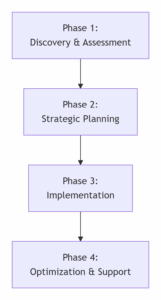
Phase 1: Discovery & Assessment (2-4 Weeks)
We immerse ourselves in your business. Through stakeholder interviews, data analysis, and process mapping, we diagnose the root causes of your challenges and establish a performance baseline.
Phase 2: Strategic Planning (2-3 Weeks)
We co-create a detailed roadmap with clear KPIs. This plan is your blueprint for transformation, outlining specific projects, resource needs, timelines, and expected ROI.
Phase 3: Implementation (4-12 Weeks)
Our team works side-by-side with yours to execute the plan. We manage the rollout, provide comprehensive training, and establish new SOPs to ensure a smooth transition.
Phase 4: Optimization & Continuous Improvement
Our partnership doesn’t end at go-live. We monitor KPIs, make data-driven adjustments, and provide ongoing support to ensure you continue to reap the benefits long after the project is complete.
Supply Chain Consulting Services Available in Texas
We offer a comprehensive suite of services to address every link in your supply chain:
-
Supply Chain Strategy & Network Design: Align your supply chain with your business goals and optimize the location of your facilities.
-
Logistics & Transportation Optimization: Reduce freight costs, improve carrier performance, and optimize routes across Texas and beyond.
-
Warehouse & Distribution Center Optimization: Maximize space utilization, improve picking efficiency, and evaluate automation opportunities.
-
Inventory Management & Optimization: Right-size your inventory levels, improve forecasting accuracy, and reduce carrying costs.
-
Supply Chain Technology Implementation: Select and implement the right WMS, TMS, or ERP systems to provide the visibility you need.
Cost of Supply Chain Consulting in Texas
Pricing Models:
-
Project-Based: A fixed fee for a defined scope of work. Ideal for specific, well-defined projects.
-
Hourly Rates: Typically range from $150 to $400+/hour, depending on the consultant’s seniority and specialization.
-
Retainer: Ongoing support for continuous improvement initiatives.
Factors Affecting Cost: Project complexity, industry, geographic scope, and timeline. A typical project for a mid-sized business can range from $50,000 to $200,000, with an ROI that often pays back the investment in 6-18 months through hard cost savings.
Major Texas Cities and Supply Chain Hubs
-
Houston: A global logistics hub dominated by energy, manufacturing, and the largest port in the U.S. by foreign tonnage.
-
Dallas-Fort Worth: A central inland hub for distribution, e-commerce, and air cargo, thanks to DFW Airport and its central U.S. location.
-
San Antonio: A key center for manufacturing (aerospace, automotive) and military logistics.
-
Austin: A booming high-tech and semiconductor manufacturing hub, driving needs for precision logistics.
-
El Paso: The epicenter of cross-border trade with Mexico, offering massive nearshoring opportunities.
Supply Chain Technology Trends in Texas
-
AI & Machine Learning: For predictive demand forecasting and dynamic route optimization.
-
Internet of Things (IoT): Providing real-time visibility into the location and condition of goods across Texas’s vast distances.
-
Warehouse Automation: Robotics and AGVs are being deployed to combat labor shortages and increase efficiency in DFW and Houston warehouses.
-
Predictive Analytics: Allowing businesses to model the impact of a hurricane or border delay and proactively adjust their plans.
Case Studies
Case Study 1: Houston-Based Industrial Manufacturer
-
Challenge: 28% of shipments were delayed, and freight costs were 18% above industry average.
-
Solution: We redesigned their distribution network, implemented a TMS, and re-negotiated carrier contracts.
-
Results: 22% reduction in freight costs, 95% on-time delivery rate, and $750k in annual savings.
Case Study 2: Austin E-Commerce Retailer
-
Challenge: Could not scale operations to meet 300% growth, leading to shipping errors and customer complaints.
-
Solution: Redesigned warehouse layout, implemented a new WMS, and optimized picking and packing processes.
-
Results: 40% increase in daily order throughput and a 60% reduction in shipping errors.
FAQ Section
How much does a supply chain consulting cost in Texas?
Costs vary by project scope and consultant expertise. Typical engagements range from $50,000 to $200,000. Many consultants offer a preliminary assessment for a fixed fee (e.g., $5,000-$15,000) to diagnose issues and define a full project scope with a clear ROI.
What qualifications should I look for?
Seek relevant certifications (CSCP, CPIM, Six Sigma), proven experience in your industry, and demonstrable local knowledge of Texas logistics hubs and challenges. Client testimonials and case studies are crucial.
How long does a typical project take?
Most transformative projects take 3 to 9 months from assessment to full implementation, depending on complexity. Quick-win projects can deliver value in as little as 4-6 weeks.
Do I need a local Texas consultant?
While remote work is possible, a consultant with a physical presence in Texas provides significant advantages. They understand local market conditions, have established relationships with Texas-based carriers and vendors, and can be on-site quickly when needed.
How do I measure ROI?
Key metrics include reduction in freight costs as a percentage of sales, inventory turnover ratio, order-to-cash cycle time, and on-time-in-full (OTIF) delivery rates. A good consultant will establish a baseline for these before the project begins.
Conclusion
In the competitive and complex Texas market, an optimized supply chain is no longer a luxury—it’s a necessity for growth. The challenges are significant, but the opportunities for improvement and cost savings are even greater.
Partnering with an expert supply chain consultant in Texas gives you the strategic advantage you need to navigate this landscape successfully. You gain more than just a project plan; you gain a partner dedicated to building a faster, cheaper, and more resilient operation that fuels your business growth for years to come.
Ready to transform your supply chain into a competitive advantage? Contact us today for a complimentary, no-obligation supply chain assessment. We’ll help you identify your greatest opportunities and build a roadmap to achieve them.