


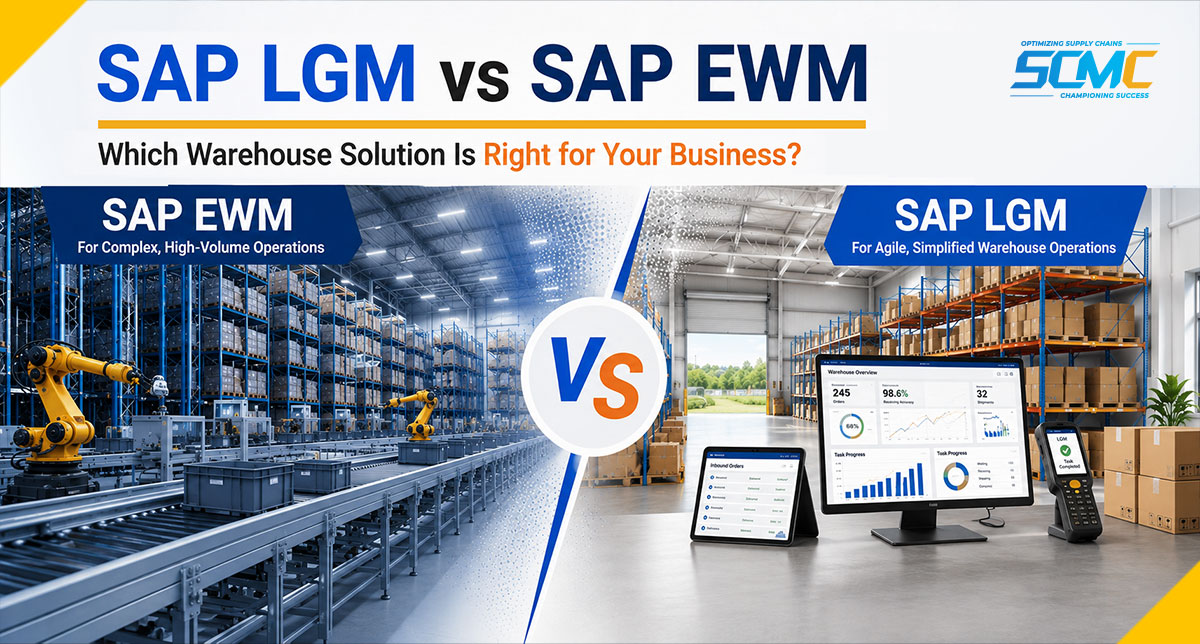
Introduction – Choosing the Right SAP Warehouse Solution Is No Longer Simple
Every S/4HANA programme has a site like this one. Four hundred lines a day, two people running it, stock sitting in a spreadsheet that one supervisor maintains from memory, and nobody hears about a shortage until the truck is already backed onto the dock.
It goes onto the SAP EWM roadmap anyway. The main plant is going to EWM, so it feels tidier to put everything in one place. Eight months later that little warehouse is still in blueprint workshops, arguing about slotting rules it will never switch on.
That is the SAP LGM vs EWM question in practice. Until October 2025 it barely existed, because EWM was simply what you used for warehouse management inside S/4HANA. Then SAP released SAP Logistics Management, and the default stopped being automatic.
The cost of getting this wrong shows up in two directions. Pick something too heavy and you pay for licences, consulting days and change management that the site never needed. Pick something too light and you hit a ceiling the first time the business adds automation. Nobody budgets for replacing a warehouse system four years after go-live, but it happens, and it is expensive.
Understanding SAP LGM and SAP EWM
Worth being clear on what each product actually is before putting them side by side.
SAP Logistics Management (SAP LGM)
SAP released LGM in October 2025. It runs as software-as-a-service on SAP Business Technology Platform.
What makes it different from most warehouse systems is scope. Warehouse software usually stops at the dock door. LGM keeps going, covering warehouse work and transportation work in the same solution, along with carrier collaboration through SAP Business Network for Logistics.
Core capabilities:
- Inbound, outbound and internal warehouse operations, covering goods receipt through putaway, picking, packing and goods issue
- Inventory management with real-time stock visibility
- Mobile execution through native Android and iOS apps
- Transportation execution: LTL and FTL shipping, parcel, rule-based carrier selection, consolidation and carrier tendering
- An Advanced Shipping and Receiving cockpit that puts inbound and outbound freight in one view
- Joule, SAP’s AI assistant, built in from the start
Deployment is cloud-native and API-first. Nothing to install, nothing to host. It connects to SAP S/4HANA from outside rather than living inside it.
The target profile is small and mid-sized sites. Regional distribution centres, satellite warehouses, production warehouses, smaller 3PL locations. Standard processes, limited automation, and a real need for visibility that spreadsheets stopped providing a while ago.
Do not think of it as EWM with features removed. It is a separate product built on separate architecture, and SAP positions it alongside EWM and TM rather than in place of them.
SAP Extended Warehouse Management (SAP EWM)
EWM is SAP’s warehouse platform for complex operations, and it has been the strategic product for years. That has not changed.
Core capabilities:
- Bin-level stock control with configurable putaway and picking strategies
- Warehouse tasks and warehouse orders, which let you direct and measure work at a granular level
- Wave management for grouping and releasing work across shifts
- Handling unit management, packing specifications, value-added services
- Yard management for trailers, dock doors and appointments
- Labour management with engineered standards and performance measurement
- Slotting and rearrangement, so stock sits where the pick data says it should
The capability that genuinely separates EWM from everything else is Material Flow System. MFS lets EWM talk directly to conveyors, sorters and automated storage, with no middleware layer in between. When a carton hits a divert point and something has to decide in milliseconds where it goes, that decision comes from EWM.
On deployment you have two options. Embedded EWM sits inside S/4HANA on the same client. Decentralised EWM runs on its own system, which is what large sites choose when the warehouse cannot stop working because ERP is down for a weekend.
You will find EWM in large distribution centres, high-volume fulfilment operations, automated warehouses, and plants where the warehouse and the production line depend on each other hour by hour.
SAP LGM vs SAP EWM: Complete Warehouse Management Comparison
Here is the SAP warehouse management comparison across the points that usually decide it.
| Comparison Area | SAP LGM | SAP EWM |
|---|---|---|
| Target Business | Small and mid-sized businesses; smaller sites inside large networks | Mid-size to large enterprises |
| Warehouse Size | Small to medium | Medium to very large |
| Deployment | SaaS on SAP BTP | Embedded in S/4HANA or decentralised |
| SAP S/4HANA Integration | Native integration from outside the core | Runs inside S/4HANA, or connected decentrally |
| Warehouse Complexity | Low to medium, standardised processes | Medium to very high |
| Automation Support | Limited; built for manual and mobile-assisted work | Extensive, including MFS for conveyors and robotics |
| Labour Management | Not a focus | Full engineered labour standards |
| Yard Management | Not a focus | Yes |
| Transportation Integration | Built in; warehouse and transport in one solution | Integrates with SAP TM as a separate solution |
| Reporting & Analytics | Cloud dashboards with real-time visibility | Deep operational reporting and warehouse KPIs |
| 3PL / Billing Support | Basic 3PL sites supported; billing depth limited | Supports 3PL scenarios and value-added service billing |
| Cost Model | Subscription | Licence-based; Basic included with S/4HANA, Advanced extra |
| Scalability | Scales across many small sites | Scales up to very high volume per site |
| Implementation Time | Weeks to a few months | Several months to over a year |
| Typical Users | Warehouse operators on mobile devices, site supervisors | Operators, supervisors, planners, industrial engineers |
| Best Fit | Standard processes, limited automation, fast rollout | Complex execution, automation, high throughput |
What actually matters in this table
Four rows do most of the work.
Transportation. EWM manages the warehouse and stops there; once goods leave the dock, transportation belongs to another system. LGM covers both. If your site loses an hour every afternoon because the picking team and the dispatch team are working in different tools and emailing each other, that one row may settle the whole decision.
Automation. MFS is the hard line. EWM drives conveyors and automated storage directly. LGM does not. If automation exists today, or there is a signed business case sitting with the CFO, this stops being a matter of preference.
Implementation time. The gap reflects design philosophy. LGM is quick because it hands you standard processes and expects you to adopt them. EWM takes longer because it will let you configure almost anything you can describe. You are choosing between speed and flexibility, and there is no version where you get both.
Scalability. The word means two different things here. LGM scales outward, across twenty small sites on one solution. EWM scales upward, one site absorbing enormous volume. Which direction is your business actually growing?
Embedded SAP EWM vs SAP LGM: What If You’re Already Using SAP S/4HANA?
This question comes up in almost every workshop, usually from someone in finance. If EWM already ships with S/4HANA, why would we buy something else?
What Embedded EWM is
Embedded EWM is SAP EWM running inside your S/4HANA system, on the same client, against the same master data. It has been available since S/4HANA 1610. There is no replication between ERP and the warehouse because there is only one system to replicate between.
Basic versus Advanced
Here is where a lot of budget conversations go sideways.
Basic and Advanced are not two versions of the software. They are two licensing models sitting on identical code.
Basic comes with your S/4HANA licence at no additional cost. Its functional scope maps roughly onto classic LE-WM from ECC: inbound, outbound, production integration, quality management integration.
Advanced requires a separate licence and unlocks what EWM is famous for. MFS, labour management, yard management, slotting, value-added services.
One rule that catches people out: the Basic and Advanced distinction only applies to embedded deployment. Decentralised EWM always requires Advanced, regardless of how simple the warehouse is.
When Embedded EWM Basic may be enough
Plenty of warehouses need bin-level control, RF scanning and clean inbound and outbound processes, and nothing beyond that. If yours is one of them, Basic Embedded EWM may already cover it at zero extra licence cost. Teams overlook this surprisingly often, then spend six weeks evaluating alternatives to something they were already entitled to use.
When organisations look at SAP LGM instead
Three situations account for most of it.
The site is not on S/4HANA, or sits on a different ERP entirely. LGM connects from outside, so the warehouse does not have to live inside your core system.
Transportation matters as much as storage. Embedded EWM Basic does nothing for carrier selection or tendering, and that is often the actual pain.
You are rolling out across many small sites. Every embedded EWM warehouse still needs configuration, testing and a transport into production ERP. Repeating that twenty times is a different proposition from deploying a cloud solution with standard processes twenty times.
None of this produces a universal answer. It depends on where your ERP sits, how much transportation hurts, and what your existing licence agreement already covers.
Common Warehouse Challenges Before Choosing a Solution
Get clear on what you are trying to fix before anyone demos anything. Most warehouse projects begin with some combination of these:
- Limited inventory visibility. Head office cannot see site stock without ringing someone and asking them to go and look.
- Spreadsheet-driven operations. Stock lives in Excel. One person maintains it. That person is a single point of failure who is also entitled to annual leave.
- Manual processes. Paper pick lists, confirmations keyed in hours later, errors surfacing the next morning.
- Growing order volumes. What worked at 100 lines a day starts breaking around 500.
- Multiple warehouse locations. Every site works its own way, so you cannot compare performance or move stock between them with any confidence.
- Poor inventory accuracy. Cycle counts keep finding differences and nobody can trace where they came from.
- Warehouse and transportation disconnected. Goods get picked and packed, then a separate conversation starts about how they will actually ship.
- Limited IT resources. One or two people support everything. A system that needs constant attention will not survive contact with that reality.
- Rising operational costs. Overtime and expedited freight climbing quarter on quarter with no clear explanation.
Write down which ones apply, and put an annual cost against each. That exercise will shape your decision more usefully than any feature comparison, including the one above.
When SAP LGM Is the Better Choice
SAP Logistics Management suits businesses whose warehouses are straightforward but whose problems are not. It fills a gap that has been badly served for years: sites too big for spreadsheets, too small to justify EWM. That is the space where an SAP warehouse solution for SMB operations has been missing.
The clearest fit is the site with genuinely standard processes. Goods arrive on pallets, go into racking, get picked by the case. There is nothing to optimise with a slotting algorithm. What that warehouse needs is accurate stock and a handheld that works, delivered before the end of the financial year.
Regional and satellite warehouses are the other common case, and usually the more interesting one. A manufacturer might run one large automated DC on EWM and still have six regional sites on spreadsheets, because nobody could justify an EWM project for a warehouse with nine staff. LGM changes that arithmetic. Those six sites get proper warehouse management without six proportionally sized implementations.
Beyond that, the pattern is consistent: limited operational complexity, no conveyors or robots, no multi-shift wave planning. A cloud-first IT strategy, where the direction of travel is away from managing servers. Implementation measured in weeks, which matters enormously when a site is losing money right now. And a small IT team, because there is less to support.
Transportation considerations
This one deserves its own space, because it is frequently what decides the outcome.
In a lot of mid-sized businesses the warehouse team and the dispatch team are the same three people. They pick the order, then work out how it ships: checking rates by email, booking a pickup by phone, ringing the customer to say a truck is coming Thursday.
LGM pulls that into a single flow. Carrier selection against rules you define, freight order creation, tendering through SAP Business Network for Logistics, and tracking, all running alongside the warehouse work rather than after it. LTL, FTL and parcel are covered.
For a company shipping domestically with reasonably simple requirements, this can remove the need for a separate transportation system entirely. Global, multimodal networks with complex rate structures are still SAP TM territory.
When SAP EWM Is the Better Choice
EWM earns its complexity in warehouses where execution is a competitive advantage rather than an overhead.
Large distribution centres. Once you are running hundreds of staff across shifts and thousands of orders a day, you need to control work at task level, direct people efficiently, and measure what they produce. Warehouse tasks, warehouse orders and wave management exist for exactly this.
High transaction volumes. At scale, small inefficiencies compound quietly. A picking strategy that saves eight seconds a line is worth real money across a million lines a year. EWM gives you the levers to go looking for those seconds.
Robotics, conveyors and automated storage. MFS communicates directly with the equipment. No lighter system approximates this, and attempting to bolt it on with custom development is a decision people regret.
Complex inbound and outbound processes. Cross-docking, deconsolidation, quality inspection inside the putaway flow, kitting before dispatch, customer-specific packing and labelling. In EWM these are configuration. Elsewhere they are a development backlog.
Labour management. If you set engineered standards and manage performance against them, EWM supports it natively. In warehouses where labour is the biggest controllable cost, this single capability often pays for the Advanced licence on its own.
Yard management. Sites juggling trailers, dock doors and appointment windows need to see what is sitting on the yard, not only what has made it inside the building.
Manufacturing integration. When the line needs components staged at a specific hour, the warehouse and production planning have to behave as one system. Embedded EWM works closely with SAP PP here, and the tightness of that link is difficult to replicate.
Multi-site enterprise operations. Where several large warehouses need one operating model and metrics you can actually compare, EWM has the depth to standardise properly.
The thread running through all of these is the same. EWM makes sense when your warehouse is complicated enough that how you execute shows up in your margin.
Cost Considerations: SAP LGM vs SAP EWM
Software licensing is usually the smallest line in a warehouse project. Teams that compare licence costs and stop there are answering a question that barely matters.
Licensing. LGM is a cloud subscription. EWM is licensed conventionally: Basic Embedded EWM comes with your S/4HANA licence, Advanced is priced separately, and decentralised deployment always requires Advanced. Check the metric as well as the number, because EWM licensing has historically been based on delivery item volume rather than users, which catches out anyone who budgeted per head.
Implementation effort. This is where budgets are won and lost. An EWM implementation means detailed process design, configuration, integration testing, data migration and training, and the consulting cost frequently exceeds the licence cost. LGM is faster because you are adopting standard processes instead of designing your own.
Infrastructure. LGM is SaaS, so there is nothing to host. Embedded EWM runs on infrastructure you already have. Decentralised EWM needs its own system, with the hosting, upgrade cycles and disaster recovery that come with it.
Support and maintenance. Ask an honest question: who is supporting this in year three? EWM generally needs someone who knows EWM. LGM needs less specialist skill because there is less to configure. For a company with two people in IT, that consideration outweighs most of what is on the licence schedule.
Total cost of ownership. Model five years, not one, and include the cost of migrating again if you outgrow the choice. A cheaper platform you have to replace in year four was never cheaper. An expensive platform running at twenty percent of its capability is money spent on nothing at all.
Common Mistakes Companies Make When Choosing Between SAP LGM and SAP EWM
Choosing EWM because it is familiar. The project team knows EWM, so EWM becomes the answer before anyone asks the question. A small site ends up on a platform designed for a facility ten times its size, carrying configuration nobody uses and support costs nobody forecast.
Choosing LGM on initial cost alone. LGM is cheaper to buy and quicker to deploy. Neither of those facts tells you whether it can run your operation in three years. Outgrow it in eighteen months and the saving disappears into a second migration.
Ignoring growth plans. Volumes get assessed exactly as they are today. Then a new product line doubles throughput and a system chosen for a simpler operation starts constraining the business it was supposed to support.
Underestimating automation. A conveyor system is planned for “two or three years out” and quietly left out of scope. The platform selected cannot support MFS. When automation finally arrives, the warehouse system has to be replaced before the project can begin, and one initiative becomes two.
Looking only at software licensing. The comparison covers licence cost and stops. Implementation, integration, training and ongoing support are almost always the larger figures.
Skipping the warehouse assessment. The decision gets made in a meeting room, based on how people describe their warehouse. Spend two days on site watching the work instead. It will change the requirements list, usually in ways nobody in the meeting predicted.
Not evaluating transportation. Warehouse scope gets defined carefully and transportation is parked for later. Then the business realises its real problem was always the gap between picking and shipping, which is precisely the gap LGM was built to close.
Quick Decision Checklist
SAP LGM may be the better fit if:
✔ Small to medium-sized warehouse operations ✔ Limited warehouse automation ✔ One or a few warehouse locations ✔ Mostly manual warehouse activities ✔ Faster implementation is important ✔ Cloud-first strategy ✔ Moderate warehouse complexity
SAP EWM may be the better fit if:
✔ Large distribution centres ✔ High-volume warehouse operations ✔ Robotics or conveyor systems ✔ Advanced warehouse automation ✔ Manufacturing integration ✔ Complex inbound and outbound processes ✔ Multi-site enterprise warehouse network
Very few companies tick every box on one side. If you find yourself split down the middle, weight automation plans and growth projections most heavily. Those are the two things you cannot easily change your mind about later.
Migrating from SAP WM: Which Path Should You Take?
If you are still running classic SAP Warehouse Management, this section matters more than the rest of the article, because your timeline is not open-ended.
Why SAP WM customers are being pushed to decide
The deadlines get misquoted constantly, often by people selling something, so they are worth separating properly.
On SAP S/4HANA on-premise, the compatibility scope for classic WM ended on 31 December 2025. That date has passed. WM is no longer a strategic option there.
RISE with SAP customers received extended use rights through to the end of 2030. See SAP Note 2269324.
If you are still on SAP ECC, classic WM falls under the ECC timeline: mainstream maintenance to the end of 2027, with optional extended maintenance running to 2030.
Three different dates, three different groups of customers. Confirm which one applies to you before you plan anything, because a lot of migration urgency is manufactured by quoting somebody else’s deadline.
What about Stock Room Management?
Stock Room Management, available from S/4HANA 1909, keeps part of classic WM alive for simple warehouses. Treat it as a bridge. SAP has frozen innovation there, it cannot operate as a decentralised warehouse system, and SAP has signalled that Stock Room Management will move toward LGM over time.
Before you assume anything about your own fit, run report STOCKROOM_COMPLIANCE_CHECK in your S/4HANA system. It checks your current processes against Stock Room Management’s restricted scope and gives you a straight answer for almost no effort.
Choosing your next step
The usual factors apply, plus one that only affects long-standing WM customers: be honest about what you actually use.
Many WM installations run on a fraction of their configuration, carrying settings that were switched on in 2009 for a customer who left in 2013. Before concluding that you need EWM because you have run WM for fifteen years, go and look at what the warehouse genuinely does today. Complexity that exists only in a configuration table is not complexity you need to pay to carry forward.
Small, manual, and transportation is as much of a headache as storage? LGM deserves a proper evaluation. Large, automated, or tightly coupled to production? EWM is the destination. Simple, and short on time? Stock Room Management may buy you a runway, but plan the next move while you are standing on it.
Conclusion
Neither of these is the better product. They are built for different warehouses.
EWM is a deeper platform, and that depth pays for itself when your operation is complex, automated and high-volume. In a nine-person regional warehouse the same depth becomes weight you carry without benefit. LGM deploys faster and runs with less overhead, which holds up nicely until the operation outgrows what the product was designed to do.
What decides it is warehouse size, operational complexity, automation requirements, transportation needs, the IT capacity you can realistically commit, and where the business is heading. Almost all of those are business questions that happen to have a technical answer.
Three things are worth doing before you shortlist anything. Spend time on the warehouse floor watching how the work actually happens, not how it is documented. Write down your volumes today and your honest volumes in five years. Then work out who is supporting this system once the implementation partner has gone home.
Answer those and the SAP warehouse management comparison gets considerably easier. Skip them and you are selecting a platform to suit a description of your warehouse.
Choosing the Right Warehouse Solution with SCM Champs
At SCM CHAMPS, we combine deep SAP logistics expertise with practical supply chain experience to help businesses successfully implement SAP LGM. Our team supports seamless integration with SAP EWM and SAP TM, builds proof-of-concept solutions to validate business scenarios, and provides end-to-end implementation and adoption support. By continuously investing in SAP knowledge and real-world execution capabilities, SCM CHAMPS helps organizations deploy SAP LGM with confidence and achieve lasting business value.
Our work starts on your warehouse floor. We look at how your sites actually run, then assess SAP LGM, SAP EWM and Embedded SAP EWM against what we find, including licence entitlements you may already hold and be paying for twice.
We support organisations through warehouse assessments, solution selection, implementation, integration, migration from SAP WM, and post-go-live support.
If you are planning an SAP S/4HANA transformation, or weighing up your warehouse options, we are glad to look at your landscape and talk it through.