


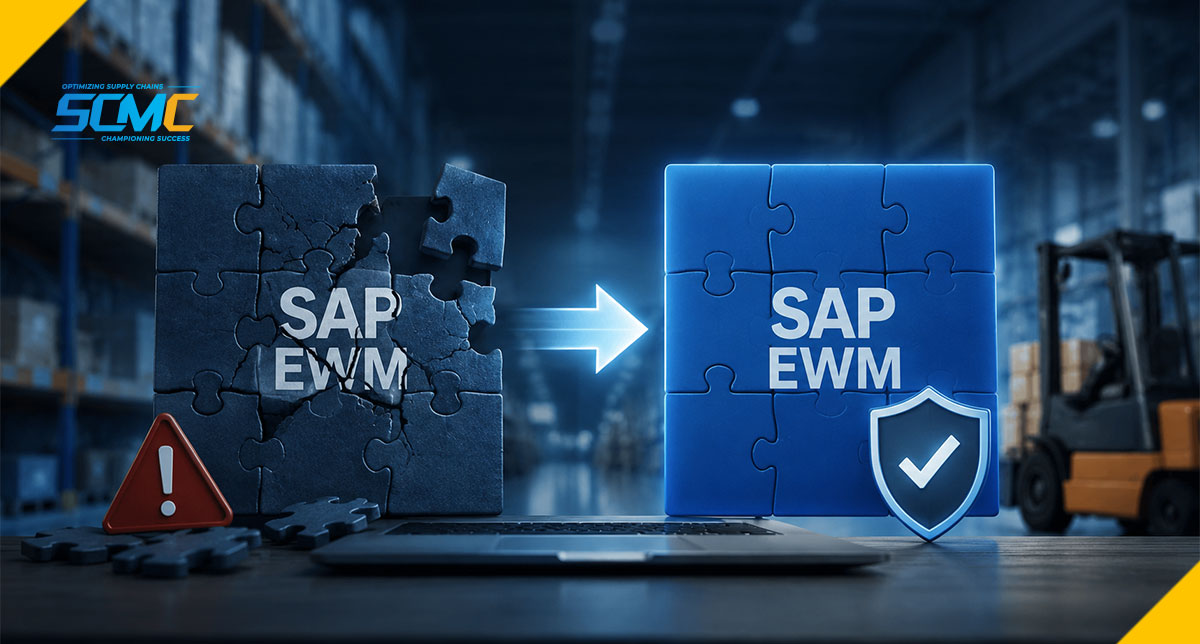
Yes — most failed SAP EWM projects can be recovered without starting over. The first step is finding which of five things broke: process design, master data, warehouse configuration, user adoption, or project governance. Once the root cause is clear, recovery is usually a matter of targeted correction, not reimplementation.
SCM Champs is a North America–based SAP partner with 25+ SAP EWM implementations across manufacturing, retail, and e-commerce, including recovery of projects started by other firms.
If your go-live is delayed, your warehouse is running worse than before EWM, or your team has stopped trusting the system, this page explains what recovery actually involves — including cost, timeline, and the cases where rescue isn’t the right answer.
Why SAP EWM Implementations Fail — and How to Tell If Yours Actually Has
A delayed go-live is not a failed project. Neither is a rough first month of hypercare. A project has genuinely failed when the warehouse performs worse than it did before EWM, and no one on the project can explain a credible path back. Struggling projects need course correction. Failed projects need diagnosis first — because fixing the wrong thing burns budget twice.
In the rescue projects we’ve taken over, failure almost always traces back to one of five root causes: master data quality, process design copied from the old warehouse instead of designed for EWM, over-customization, compressed testing and training, or governance gaps that let known problems reach go-live.
Master data deserves special mention. In a majority of the rescue projects we’ve completed, master data was a primary root cause. Bad product masters, wrong packaging specifications, and incomplete storage bin data will break an EWM implementation regardless of how well the system was configured. In our experience, the implementation partner gets blamed more often than they deserve bad master data kills more EWM projects than bad consultants do.
The second most common pattern: warehouses that lifted their old WM or paper-based processes directly into EWM. The system then automates a broken process faster.
Can a Failed EWM Project Be Recovered Without Reimplementing?
Usually, yes. Most of what was built survives — the infrastructure, the licenses, the integration layer, and typically a large share of the configuration. Recovery targets what’s actually broken rather than rebuilding what works.
Partial reimplementation becomes necessary when the process design itself is wrong — when the warehouse structure, storage types, or wave management logic were built around assumptions that don’t match how the operation runs. In those cases, specific areas get redesigned while the rest stays.
And sometimes the honest answer is that rescue isn’t viable — usually when the original scope was wrong from the start, or when master data problems run so deep that correction costs more than rebuilding. We’ll tell you that in week one of an assessment, not month six. A partner who can’t name the conditions where they’d recommend against their own services isn’t giving you an assessment; they’re giving you a sales process.
When Your Implementation Partner Can’t Deliver
The hardest question in a failing project: do we replace the partner?
Our honest answer — not always. Switching partners mid-project has real costs: knowledge transfer, contract exit, and typically a 6–10 week delay before the new team is fully productive. Sometimes the existing partner is capable and the failure sits in governance, data, or decisions the client side made. Firing them fixes nothing.
What we recommend instead is a second-opinion assessment. An independent review of the project’s technical state, delivered to your leadership, without requiring you to end the current engagement. A majority of our second-opinion assessments end with the original partner staying on, working from a corrected roadmap. The rest transition to us or to a hybrid model where we handle the areas that broke.
Either way, you make the partner decision with evidence instead of frustration.
What Happens During a Rescue Assessment
Here is the actual process, so you know what you’re agreeing to before any contract:
Weeks 1–2 — Health assessment. We review five areas: warehouse configuration against your real operational flows, master data quality (product masters, packaging specs, storage bins), process design decisions and where they diverge from how the floor actually works, user adoption data (workarounds are a diagnosis, not a discipline problem), and project governance — how decisions were made and where warnings got lost.
We do this on site and in the system. Not from a questionnaire.
Week 3 — Findings report. A written diagnosis: what broke, why, and in what order it needs fixing. Ranked by operational impact, not by technical interest.
Week 4 — Costed recovery roadmap. Two or three corrective options with real numbers and timelines against each — typically a minimal-fix path, a recommended path, and where relevant, a partial-reimplementation path. You choose with full visibility of the trade-offs.
The assessment is a standalone engagement. If you take the roadmap to another partner, or back to your original one, it works just as well. Several of our assessment clients have done exactly that.
How Much Does EWM Recovery Cost, and How Long Does It Take?
A typical SCM Champs rescue assessment takes 3–4 weeks and costs in the range of $25,000 to $60,000, depending on the number of warehouses, system complexity, and data volume. This is generally a small fraction (often 5–10%) of the original implementation budget.
Corrective work varies with the diagnosis:
Configuration and master data fixes: 4–10 weeks | $40,000–$150,000 — the most common scenario. Focused corrections to data structures, storage bins, packaging specs, and system configuration.
Process redesign in specific warehouse areas: 8–16 weeks | $120,000–$350,000 — targeted redesign of inbound, outbound, picking, or replenishment processes where the original design doesn’t match real operations.
Partial reimplementation: 3–6 months | $300,000–$800,000+ — the least common outcome, required only when foundational design assumptions are incorrect.
What moves cost up: number of warehouses, degree of custom development in the original build, master data volume, and whether the operation can support parallel testing.
What moves it down: a single site, standard SAP processes underneath the problems, and a warehouse team that’s still engaged.
One number worth knowing: recovery is consistently cheaper than the failed implementation was. You’re not paying for the system again — you’re paying to fix the specific decisions that broke it.
A Recovery Story: From 79% to 97% Inventory Accuracy
A mid-size pharmaceutical distributor came to us after a failed EWM go-live delivered by a larger systems integrator. Inventory accuracy stood at 79%. Picking errors were causing daily escalations, and the warehouse team had stopped trusting the system.
The original build wasn’t incompetent — it was configured for the warehouse described in the blueprint documents, not the one running on the floor. The assessment traced the failure to warehouse configuration misaligned with actual operational flows, combined with master data gaps.
Over the following 8 months, SCM Champs remediated the master data, reconfigured the system around how the operation actually ran, and stabilized outbound operations. No new hardware. Same warehouse team. Different system setup.
Inventory accuracy reached 97%. Picking errors dropped by more than 35%. The daily escalation calls stopped.
What a Typical E-commerce Recovery Looks Like
Recovery patterns repeat across industries. A common e-commerce scenario: a delayed go-live drops warehouse productivity 20% below pre-EWM levels while order backlogs climb. The usual culprits — inconsistent product master data, wave picking configured for assumed rather than actual order patterns, and floor staff bypassing RF transactions after rushed training.
The fix follows the same sequence: clean and standardize the master data, redesign wave logic around real order profiles, and retrain at floor level. In an engagement like this, productivity typically recovers to 95–98% of target within 12 weeks, with the backlog cleared in the first month. Actual results depend on system complexity and operational readiness.
Does Your Project Need Rescue?
Your project probably needs a structured assessment if two or more of these apply:
- Go-live has been delayed more than once
- Warehouse productivity is below pre-EWM levels
- Users are working around the system instead of in it
- Inventory accuracy is declining month over month
- Costs keep rising with no revised end date
- Your partner’s answers keep changing
If two or more of these apply, a structured assessment will tell you exactly what’s broken and what recovery costs before you commit to anything. That conversation takes 30 minutes and doesn’t obligate you to work with us.
Frequently Asked Questions
Can we recover our EWM project without firing our current partner? Yes. SCM Champs second-opinion assessments are designed to run alongside an existing engagement. A majority of them end with the original partner continuing, working from a corrected roadmap.
Do we need to reimplement everything? Usually no. Infrastructure, licenses, integrations, and most configuration typically survive. Recovery targets what’s broken — full reimplementation is the rare exception, and we’ll show evidence before recommending it.
How long does a rescue assessment take? Typically 3–4 weeks for a single-site operation, longer for multi-warehouse environments. You receive a written findings report and a costed recovery roadmap at the end.
Will warehouse operations stop during recovery? No. Corrective work runs alongside live operations — changes are tested in a separate environment and moved to production in controlled windows, usually weekend cutovers.
What if the assessment shows the project can’t be saved? We say so, in writing, with the evidence — and provide a rebuild plan with honest costs. That happens in a minority of cases, but pretending otherwise would waste your money twice.
SCM Champs is a North America–based Official SAP partner with 25+ SAP EWM implementations across manufacturing, retail, and e-commerce. If your EWM project is off track, contact us — the first conversation is 30 minutes and costs nothing.