


Every month they hired more people. Every month the labor bill went up. And every month the same problems turned up anyway: late shipments, annoyed customers, overtime nobody had budgeted for.
The operations manager wasn’t short of workers. What they’d run out of was ideas.
Here’s the thing about warehouse labor costs. They don’t spike. They leak — quietly, through processes that looked fine when you set them up and stopped being fine two years ago. Nobody notices a leak. They just notice the bill.
And hiring more people doesn’t fix a leak. It hides it.
Short answer: Fix your layout and slotting, cut travel time, automate the paperwork, plan labor from real order data, and use the visibility your WMS already gives you. Robotics comes last, and only where the repetitive work genuinely justifies it.
I’ll say the unpopular part early, because it shapes everything below:
Automation is not the first step. In most warehouses, it’s the most expensive mistake.
Most operations don’t have a labor problem at all. They have a process problem, and a large part of it is hiding inside an SAP EWM system that was configured once at go-live and never touched again.
Why Warehouse Labor Costs Keep Rising
Most people point at wages. Wages matter, but they’re rarely the main story.
Walk the floor and you’ll find the real culprits. Pickers spend most of the shift walking, not picking. Research puts travel at roughly half of a picker’s time, and in badly organised sites it runs to 40–60% of the shift. That’s not laziness. That’s layout.
Then there’s slotting. Fast movers end up at the back because that’s where there was space three years ago. Nobody planned it. It just accumulated.
Task assignment is another one. A supervisor hands work to whoever is standing nearby, not to whoever is closest to the job. Small thing, repeated four hundred times a day.
Add paper lists, manual confirmations, and inventory data that’s updated whenever someone gets around to it, and you have a warehouse where people are busy all day without being productive all day. There’s a difference, and it’s expensive.
How expensive? Order picking alone eats 50–65% of total warehouse operating costs. When that process is inefficient, you’re not losing a little money. You’re losing a lot, every hour, quietly.
Hiring more people treats the symptom. And hiring has its own price tag, most of which never shows up as a line item.
The Hidden Cost of Hiring More Workers
Adding ten people looks like ten salaries. It isn’t.
A new warehouse hire takes about six weeks to reach full speed. For those six weeks your experienced staff are covering the gap and training the newcomer at the same time. That’s overtime and lost productivity, running together.
Turnover is where it really hurts. Warehouse turnover sits near 49% a year, according to Bureau of Labor Statistics data. Roughly half your floor walks out annually. KPI Solutions puts the combined hard and soft cost of one departure at about $18,600. Run that across a team of forty and you’ll see why “just hire more” is such an expensive reflex.
New people also make more mistakes. Facilities with high turnover run about 17% higher error rates in picking, packing and shipping. Every one of those is a return, a credit note, and a phone call.
And there’s the quiet one nobody budgets for: supervision. Past a certain point, more pickers means another supervisor. You didn’t hire one picker. You hired 1.1.
The payroll line shows the wage. It shows none of the rest.
Before you sign off on the next batch of hires, it’s worth asking five questions.
Five Questions to Ask Before You Hire
Answer these honestly. Better still, go and watch the floor for an hour before you answer.
- Are your workers walking more than they’re picking?
- Are supervisors handing out tasks by hand?
- Are picking errors creating rework?
- Can you see your inventory in real time, or only at the end of a shift?
- Are people standing around waiting for the next job?
Two or three yeses and your problem isn’t headcount. It’s process. Adding staff to a slow process just gives you more people moving slowly.
In our own projects, warehouses that answer yes to several of these are typically carrying 15–25% hidden capacity — productivity they’ve already paid for and aren’t getting.
Supporting detail for the 15–25% hidden capacity claim (after the five questions section)
Based on operational assessments across 40+ warehouse projects between 2019 and 2025, we consistently measure a 15–25% uplift in picks per labour hour once fundamental process fixes and EWM optimisation are in place — before any automation is added. The range tightens depending on how much travel waste and manual task assignment the site started with.
The way out is fairly predictable:
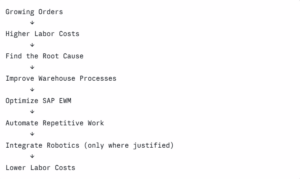
7 Practical Ways to Cut Warehouse Labor Costs
1. Fix the layout
Most layouts weren’t designed. They grew.
Products landed wherever there was room, and five years later nobody can explain why the top-selling SKU lives in the far corner. Meanwhile a picker crosses the whole building for a six-line order.
Put fast movers near packing and dispatch. Keep products that get ordered together stored together. Clear the aisles people use most, and stop treating them as overflow storage.
You’ll get more picks per hour from exactly the same team. No new technology needed.
2. Let SAP EWM run your slotting
If I could only fix one thing in a typical warehouse, it would be this.
Slotting usually gets set at go-live and then forgotten. But demand moves. The A-item from two years ago might be a C-item now, and it’s still sitting in the prime location while this year’s bestseller is on a top shelf at the back.
The manual version of this fix is a quarterly slotting review, and it helps. The better version is letting the system do it continuously. SAP EWM’s slotting engine reads actual movement data and repositions high-velocity stock into the most accessible locations — and it can run the reorganisation during off-peak hours, so your pickers arrive to a warehouse that’s already been optimised overnight.
Why does this matter more than the flashier fixes? Because it cuts travel on every order, forever. Not on peak days. Not on the orders someone remembers to optimise. All of them. Slotting done properly is usually where the largest single share of that hidden 15–25% is sitting.
3. Attack travel time
Half the shift is walking. In a poorly organised site, more than half.
Usually it’s the picking method. One picker, one order, one trip. Someone walks the length of the building for six items, comes back, and sets off again.
Batch orders so a single trip covers several. Use zones so each person works a smaller patch. Let SAP EWM sequence the route rather than leaving it to habit, because left alone, people walk snake patterns and double back constantly. And switch on task interleaving: when a picker finishes, EWM hands them a put-away on the way back instead of an empty walk.
Cut travel by a quarter and you free up hours per picker per week. Across a full team that’s the output of several new hires, without hiring anyone.
4. Automate the boring stuff
Not robots. Software.
Automatic label printing. System-triggered replenishment. Digital confirmations instead of signatures on paper. Cycle counts scheduled by the system instead of by someone’s memory.
None of it is exciting. All of it gives you back hours from experienced people who should be doing work that needs judgement.
5. Plan labor from data, not instinct
Monday is chaos. Thursday afternoon, half the team is idle. Sound familiar?
That’s what happens when staffing is based on last month’s feel rather than this week’s order profile. SAP EWM can forecast workload by shift and by area from your actual order data, then assign tasks automatically as they come up — so nobody waits for instructions and nobody walks past a job they could have picked up.
Of everything on this list, this is usually the fastest win. Most warehouses don’t need more people. They need the people they’ve got in the right place at the right hour.
6. Make inventory visible in real time
If your data updates at the end of a shift, you’re planning today with yesterday’s picture.
Real-time scanning through EWM fixes that. Less time hunting for stock, fewer surprises, and supervisors who catch a bottleneck at ten in the morning rather than hearing about it at six.
7. Robotics, but only where it earns its place
Some work genuinely can’t be optimised away. Pallets have to cross the building. Bins have to move. Replenishment runs have to happen, and none of it needs human judgement.
That’s your robotics shortlist. Only that. Sort out the first six items, see what repetitive physical work is still standing, and start there.
⚠️ Common Mistakes to Avoid
❌ Hiring more workers before fixing warehouse processes
❌ Buying robotics before optimizing SAP EWM
❌ Measuring labor by headcount instead of productivity
❌ Ignoring travel time inside the warehouse
❌ Automating inefficient processes
That second one is the expensive mistake I mentioned at the top. So when is robotics actually the right call?
When Robotics Becomes the Right Solution
There’s an order to this, and skipping steps costs money.
Step one: fix the processes. Layout, slotting, travel paths, task assignment. Plenty of warehouses recover a serious chunk of their labor cost right here, with no new technology at all. Cheapest step, often the biggest return.
Step two: get more out of SAP EWM. This is the step almost everyone skips, and it’s the one I’d argue hardest for. Most warehouses use a fraction of what they’ve already bought. Task interleaving, wave management, system-driven pick paths, workload forecasting, dynamic slotting, real-time visibility — all sitting there, usually configured once at go-live and never revisited. Switching it on costs far less than buying anything new. A proper SAP EWM implementation is where most of that hidden 15–25% actually lives.
Step three: bring in robotics, if repetitive work is still there. Once your processes are clean and the system is doing its job, look at what’s left. If people are still pushing pallets around all day, that’s a real case for automation, and you know precisely what it’s solving.
How do the two fit together? Simply, really.
SAP EWM is the brain. It knows where stock sits, which orders need picking, and what should happen next. The robotics is the body: moving pallets, shifting bins, assisting picks, handling replenishment. Connect them and EWM directs the machines in real time against live order priorities.
Buy the body without sorting out the brain and you’ve bought expensive hardware that executes bad decisions faster.
I’d add one thing automation vendors won’t. Plenty of warehouses never need step three. They get the savings they were after at steps one and two and stop, quite happily. Robotics earns its place when repetitive work, labor shortages or high volumes justify it. When they don’t, it’s an expensive way to move a pallet.
Here’s what the full sequence looks like when it’s done properly.
Case Study: Cutting Costs Without Adding Headcount
A US-based retail group was running two fulfillment centers under exactly the pressure described above. Volumes rising, labor costs rising with them, and the obvious temptation to solve it by hiring.
They went the other way.
The team put AI-driven dynamic slotting in place through SAP EWM, so high-velocity stock reorganises itself into the most accessible locations during off-peak hours. Pick paths were optimised continuously by the system rather than left to habit. Automation was then integrated with SAP EWM as the central command layer directing the physical work.
The results across the two sites:
- $3.2M in annual operational savings
- 55% increase in productivity
- 40% reduction in order cycle time
- 99.9% order accuracy
Note what isn’t in that list. They didn’t hire more people. They changed how work was assigned, sequenced and executed, in that order.
How SCM Champs Approaches These Projects
We start with your processes, not your purchase order.
The first job is separating work that’s genuinely repetitive from work that’s just badly configured. Those look identical from a distance and need completely different fixes. Once that’s clear, robotics gets integrated with SAP EWM rather than bolted on beside it, so tasks, inventory and robot movements run as one process instead of three.
A typical engagement runs like this:
- Study how the warehouse actually works today
- Optimize SAP EWM configuration and workflows
- Identify what automation opportunities are left
- Integrate robotics with SAP EWM where it’s justified
- Test, optimize, and stay involved after go-live
Sometimes it ends at step two. That’s a good outcome, not a lost sale.
Supporting detail for the 15–25% hidden capacity claim (after the five questions section)
Based on operational assessments across 40+ warehouse projects between 2019 and 2025, we consistently measure a 15–25% uplift in picks per labour hour once fundamental process fixes and EWM optimisation are in place — before any automation is added. The range tightens depending on how much travel waste and manual task assignment the site started with.
What You Can Expect to Get Out of It
Lower labor costs, because you’re paying for productive hours rather than walking hours.
More output from the same team, which means growth stops automatically meaning more headcount.
Fewer picking errors. Every one avoided is a return, a credit note and a complaint avoided too.
Less overtime, because the work fits inside the shift instead of spilling past it.
Calmer peaks. An efficient warehouse absorbs a surge. An inefficient one panics and hires temps.
A better return on SAP EWM. You’ve already paid for it. Using it properly is the cheapest improvement available to you.
Frequently Asked Questions
What’s the fastest way to reduce warehouse labor costs? Cut travel time and fix your slotting. Both attack unproductive hours directly, both can be driven by SAP EWM rather than manual effort, and neither needs new hardware. In our projects these two changes typically account for the largest share of a 15–25% productivity gain.
What’s the biggest driver of warehouse labor costs? Unproductive time, not wages. Walking, waiting and searching. In many warehouses travel alone takes 40–60% of a picker’s shift. Cut that and your cost per order falls without touching pay rates or headcount.
What are the hidden costs of hiring more warehouse workers? Overtime while new hires ramp up, supervisor time spent training, replacement costs as turnover climbs, more errors from inexperienced staff, and extra supervision. None of it appears on the payroll line, and together it can outweigh the wages.
Does SAP EWM reduce labor costs? Yes. Task interleaving, system-driven pick paths, dynamic slotting, workload forecasting and real-time visibility all cut unproductive time. For most warehouses that delivers measurable savings well before any robotics investment.
When does warehouse robotics make financial sense? After your processes and SAP EWM are sorted, and repetitive physical work is still there. Chronic labor shortages, multi-shift operations and heavy pallet movement are all good signs. If a process fix would solve it, fix the process.
Work Smarter Before You Hire More
Hiring solves today’s workload. It rarely solves tomorrow’s efficiency problem, and it adds costs that never show up where you’d look for them.
The companies that get this right follow the sequence. Processes first. SAP EWM second. Robotics only where it pays. They end up handling more volume without the labor bill climbing to match.
Find Out What Your Warehouse Is Losing
Most warehouses don’t need more labor. They need to find out where their productivity is going.
That’s the hard part. A leak doesn’t announce itself. It shows up as overtime, as missed cut-offs, as a headcount request — never as a line item saying “travel time.”
That’s what we look for.
At SCM Champs we assess your warehouse processes and your current SAP EWM setup to find the inefficiencies you can’t see from the floor, and the quick wins you can act on without a capital project.
Get a free warehouse efficiency assessment, and we’ll show you where the 15–25% is hiding in your operation.