


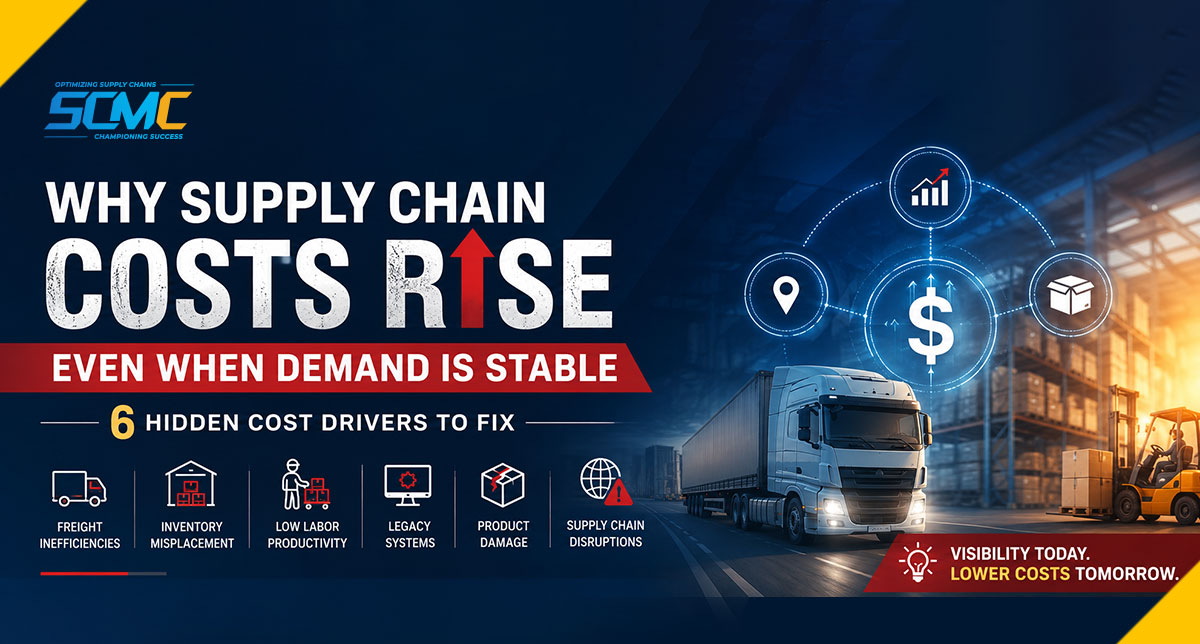
Quick Answer: Even when demand stays flat, supply chain costs can still go up. The reason is six hidden cost drivers: half-empty trucks, stock kept in the wrong place, idle time in the warehouse, old systems, product damage, and last-minute reactions to risks. The fix starts with one thing visibility. Tools like SAP EWM and SAP TM help you see exactly where the money is leaking.
Is demand steady but your supply chain costs still going up? Then the problem isn’t demand. It’s hiding somewhere in your daily operations.
Think about it. A truck leaves your warehouse half empty. A last-minute order goes out on costly express shipping. Stock sits in one warehouse while another runs out of the same item. A picker stands around waiting for stock to arrive. Each of these looks like a small thing. That’s exactly why nobody notices them until the freight bill, the labour cost, and the profit numbers start looking bad.
Here’s a common story. A company ships almost the same volume this quarter as the last one. But the transport bill keeps growing and deliveries keep slipping. Demand didn’t change. The way the operation runs did or rather, it was never fixed.
So if you want stable costs and a strong position in the market, these issues need serious attention. The good news? Better visibility across transport, inventory, and warehouse work helps you catch these leaks early. We’ll cover the exact SAP tools that help with this in the second half of this article.
Let’s look at the six hidden factors one by one, and what supply chain leaders can do about them.
What are the Hidden Cost Drivers that Increase Supply Chain Expenses?
Most companies find it hard to spot what’s really pushing their supply chain costs up. Why? Because there’s no single big problem. The cost is spread across many small leaks a half-filled truck here, an hour of waiting time there, a small penalty charge on one shipment. Alone, none of these looks serious. So nobody digs into them. And slowly, together, they eat into profits.
Finding where the cost starts is step one. Fixing it comes next. Let’s go through the key issues and how to handle them.
Freight Costs Keep Increasing Even Though Shipment Volumes Are Constant
Companies spend a lot of time negotiating freight rates. Still, transport costs keep rising. In most cases, the rate isn’t the problem. The problem is how shipments are planned and moved. Here’s what usually goes wrong:
- Half-empty trucks: When orders aren’t grouped together properly, trucks leave with empty space. You still pay for the full trip. So your cost per shipment goes up, even though the rate stayed the same.
- Last-minute orders: Orders that come in too late can’t be added to planned shipments. They go out on express or premium freight. One rushed shipment can cost several times more than a planned one.
- Carrier waiting time: If loading or unloading gets delayed at your dock, carriers charge waiting fees. And if this keeps happening, carriers may quietly raise your rates too.
- Poor route planning: Bad routes mean extra kilometres and extra driver hours on every trip. That means more fuel and higher carrier charges, again and again.
Notice something? None of this needs demand to rise. These leaks quietly grow your freight bill while your volumes stay flat.
Inventory Is Not Available On Time
When stock isn’t available at the right time and place, everything downstream suffers. Production gets delayed. Shipping dates get missed. Costs go up.
Here’s the key point: stock that exists on paper is not the same as stock you can actually use. Three common situations create this gap:
- The system shows stock that isn’t really there: Your ERP says the item is available, but the shelf is empty. Orders get promised, then delayed, then fixed at the last minute.
- One warehouse has too much, another has too little of the same product: You pay extra storage cost at one site and lose orders at the other. At the same time. For the same item.
- The stock exists, but far away: The product is in stock just in the wrong warehouse. So either the delivery takes longer, or you pay for a costly transfer between warehouses.
Every one of these ends the same way: late orders, broken plans, rushed shipments, and higher cost. So the real problem isn’t how much stock you have. It’s where the stock is, and whether you can see it.
Staff Productivity Drops Without Anyone Realising It
Your staff didn’t suddenly become lazy. What really happens is this: people spend more and more of their paid hours waiting, searching, and fixing mistakes. And none of that wasted time shows up in any report. Some real examples:
- A picker searches for stock in the wrong location because the system data is wrong. Fewer picks per hour means a higher labour cost per order.
- Pickers wait because stock isn’t refilled on time. They stand there fully paid, doing nothing.
- Too much paperwork slows down goods coming in and going out. Staff wait. Trucks wait.
- Fast-moving items are stored in hard-to-reach spots. Pickers walk longer for every order, so fewer orders get done per shift.
- The warehouse system and the automation tools don’t talk to each other properly. Queues build up. Machines or people sit idle.
Each of these wastes a few minutes. But multiply those minutes by every worker, every shift, every day and it becomes a big chunk of your labour cost. And if nobody is measuring where the working hours actually go, these leaks stay invisible.
Legacy Systems Maintenance Isn’t Solving Modern Supply Chain Challenges
An old system isn’t automatically a bad system. If it’s well maintained, it may still handle basic warehouse work just fine. The real question is different: can it give you the visibility, the connections, and the decision support that today’s supply chain needs? On that question, a few things become clear quickly:
- It can’t show you the full supply chain. So leaders end up making decisions with only half the picture.
- Delaying the upgrade has its own cost. Every quarter you postpone it, the slow system keeps holding back your planning and daily work.
- Old systems don’t connect well with each other. So staff type the same data again and again, and fix mismatches by hand — time that should go into thinking and deciding.
So the real problem with legacy systems isn’t just old technology. It’s the delayed decisions around it.
Product Damage Quietly Impacts Profit Margins
How much damage you face depends on what you ship and how you ship it. There’s a simple rule here: the more times goods are touched and moved, the higher the damage risk.
- Truckload shipping: Goods are loaded once and unloaded once. Fewer touches, lower damage risk.
- Less-than-truckload (LTL): Goods pass through terminals and get handled many times on the way. More touches, higher damage risk.
- Intermodal shipping: The risk depends on how many times goods move between truck, rail, or ship. Every transfer is one more chance for damage.
And here’s something many people miss: a big part of damage doesn’t happen on the road at all. It happens inside your own warehouse. Common causes:
- Rough handling and wrong placement
- Wrong packaging, especially for fragile items
- Poor storage conditions
- Careless forklift operation
Now, the damaged product itself is only part of the loss. Once an item is damaged, someone has to catch it before it gets shipped or put back on the shelf. It has to be checked, separated, and then repaired, scrapped, or returned and every step takes labour, space, and time. Add the replacement shipment, the customer complaint, and the return journey, and the real cost of one damaged item becomes several times its price.
The lesson? Better packaging alone won’t fix this. You need visibility over damaged goods through the whole process.
Climate and Geopolitical Risks Disrupt Supply Chains
You can’t control the weather. You can’t control global politics. But you can control how much they cost you. The best-run operations aren’t the ones that avoid disruptions nobody can. They’re the ones that see trouble coming and change their plans before shipments get hit.
In practice, that means using forecasts and risk alerts to:
- Move shipments away from routes that may get blocked
- Switch carriers or transport modes before space runs out
- Move stock closer to customers before the trouble starts
- Change shipment timing to avoid risky days
- Line up backup suppliers for risky sources
For example: if a major transport route is expected to face trouble, planners can book other routes, carriers, or modes while prices are still normal instead of paying panic prices after the disruption hits.
Warning Signs that Your Supply Chain Costs Are Getting Out of Control
Supply chain costs never jump overnight. They creep up slowly, through small inefficiencies that nobody notices for months. Watch out for these three warning signs.
Network Fragmentation
When your warehouses, distribution centres, suppliers, and transport partners all work in their own silos, coordination breaks down. A common example: the warehouse team, the transport team, and the purchasing team each use a different system with different data. So before anyone can act, someone has to match the numbers by hand. The results:
- The same data entered twice
- Slower deliveries
- Higher transport costs
- Nobody sees the full picture
When the network is broken into pieces like this, controlling total cost becomes almost impossible — and expenses keep climbing.
Inconsistent Freight Costs
Is your freight bill rising while your shipment volume is not? Then check these four areas first:
- Trucks going out half empty
- Poor route planning
- Weak transport planning overall
- Poor management of carriers
A transportation management system gives planners shipment-level visibility, so they can quickly find which of these is causing the increase. We cover the exact SAP tool in the next section.
Lack of Advanced Technology Integration
When your supplier, warehouse, transport, and inventory systems don’t talk to each other, data gets trapped in silos. And then people are forced to do a machine’s job: typing data again, matching numbers, chasing information. Every decision that depends on that data gets delayed. Companies stuck in this situation usually struggle with:
- Slow decisions
- Wrong reports
- The same work done again and again
- No clear view of the supply chain
All of this quietly adds to your operating costs.
Field Note: How a Swedish Manufacturer Cut Outbound Freight Spend by 18%
Some time back, our team visited a manufacturing company in Sweden that runs 10 warehouses. Their story matched everything described above: demand was flat, but logistics costs kept climbing. And the waste was nowhere in their reports it was hiding in daily operations.
On the warehouse floor, two things caught our eye straight away. First, trucks were regularly leaving only about 60% full, because orders weren’t being grouped before dispatch. Second, pickers were losing time every shift searching the wrong bins the stock locations were badly planned. Neither problem appeared in any cost report. But together, they were quietly draining the freight and labour budget every single month.
The fix took four months, from blueprint to go-live. In SAP Transportation Management (SAP TM), we set up freight consolidation rules and dynamic route planning. In SAP Extended Warehouse Management (SAP EWM), we brought in bin-level inventory visibility and a proper process for handling damaged goods.
The result? An 18% drop in outbound freight spend within the first full quarter after go-live. Demand never changed. Visibility did.
Seeing a similar pattern in your own operation? Talk to our team for a free supply chain cost assessment.
Practical Strategies to Reduce Supply Chain Costs
With the right plan — and the right experts guiding you — supply chain costs can come down in a big way.
If you’re still running on traditional systems, moving to a modern SCM setup gives you real-time monitoring, better visibility, and smoother warehouse operations. For every strategy below, the logic stays the same: a clear problem, a clear action, the SAP tool that supports it, and the saving you can expect.
Real-Time Logistics and Transportation Management System
The problem: half-empty trucks, bad routes, and last-minute express shipments keep pushing up your cost per shipment. The action: group shipments together, look at intermodal transport options, and plan the best route for every trip. SAP Transportation Management (SAP TM) supports all of this planning, consolidation, carrier selection, routing, freight execution, and shipment tracking. The result: fuller trucks, fewer express shipments, and a lower cost per delivery.
Integration of Predictive Analytical Tools
Predictive analytics is only useful when you know what you’re predicting. In supply chain planning, the questions that matter are: Will demand or supply shift? Could a supplier fail? Will transport capacity get tight? Is stock piling up in one place and running out in another? SAP Integrated Business Planning (SAP IBP) helps answer these questions early — so you can move stock, adjust orders, or book transport before a small problem becomes an expensive one.
Handle Damaged Goods with End-to-End Visibility
SAP Extended Warehouse Management (SAP EWM) gives you a clean process for damaged goods: find them, track them, and separate them without disturbing normal warehouse work. Damaged items go through quality inspection and, based on how bad the damage is, they move to a dedicated storage area and then to the right next step — repair, scrap, or return. Because the system tracks them the whole way, a damaged item can never be shipped by mistake or counted as sellable stock. That saves both money and effort.
Manage Return Orders
SAP EWM also handles returns, right down to the exact storage bin. A quality check is built into the process, so every returned item gets inspected and moved on quickly. Returns stop piling up in a corner, and your space and money stop getting stuck with them.
If you noticed two or more of the warning signs above in your own operation, the next step is simple: find out where the money is leaking. That’s exactly what the SCM Champs team does — we help you fix warehouse operations, transport, inventory, and procurement using intelligent SAP supply chain solutions.
How SCM Champs Helps Businesses Reduce Supply Chain Costs
At SCM Champs, our experienced SAP supply chain professionals help companies use SAP EWM, SAP TM, SAP IBP, and SAP Business Network to remove exactly the kind of waste described in this article — and build a supply chain that’s strong, resilient, and cost-efficient.
With SAP EWM solutions we help you:
- Manage inventory better
- Use warehouse space better
- Cut picking and putaway mistakes
- Get more output from your workforce
Together, these fix the inventory visibility and warehouse productivity problems we discussed — cutting storage costs while making order fulfilment faster and more accurate.
Using SAP TM, we help you:
- Plan transport better
- Automate freight management
- Work more smoothly with carriers
- Track every shipment in real time
This attacks the freight cost drivers head-on — half-empty trucks, bad routes, and express shipments — so deliveries improve and transport costs come down.
Through SAP Integrated Business Planning and SAP Business Network, you can:
- Work more closely with suppliers
- See your procurement clearly
- Reduce disruptions
This means faster, better decisions across your whole supply chain — including the risk-based decisions we discussed in the climate and geopolitical section.
With the right SAP SCM partner, rising supply chain costs can be brought under control — and efficiency goes up.
Conclusion
Stable demand does not mean stable cost. As we’ve seen, supply chain costs can leak from six directions at once: half-empty trucks, wrongly placed stock, wasted warehouse hours, disconnected systems, product damage, and last-minute reactions to outside risks.
The first step is not buying new software. The first step is finding out exactly where the money is leaking in your operation. Once those gaps are clear, SAP EWM, SAP TM, SAP IBP, and SAP Business Network can support the changes needed to close them — less waste, better shipment planning, and a supply chain that stays strong even when things go wrong.
Don’t let poor visibility, manual work, and weak planning eat into your profits. Connect with our SCM Champs experts, and let’s talk about how to fix every stage of your supply chain.