


The Honest Quick Answer
Here’s the truth nobody in this industry likes to put in writing: there is no single best SAP EWM implementation partner for everyone. Anyone who tells you otherwise is selling you something. What actually exists is the best partner for your project, and that depends on three things: the scope of what you’re implementing, how complex your warehouses really are, and whether you need breadth (a full S/4HANA transformation) or depth (warehouse execution done right). Sounds unsatisfying? It’s the answer that saves companies from seven-figure mistakes. And one pattern we’ll stand behind: for complex manufacturing and distribution warehouses, specialised EWM firms often outperform generalist system integrator. That’s the honest answer.
Why “Best” Is the Wrong Question
We’ve watched buyers burn serious money on this exact mistake. A partner that’s brilliant at running a global pharma transformation across 40 countries can be completely wrong for an FMCG distributor with three DCs and a conveyor project. Different animal, different skills.
Think about it. The global rollout needs program governance, template management, and an army. The food and beverage warehouse fighting expiry dates and batch recalls needs someone who knows why a wave template kills pick density, and who’ll actually stand on the floor during go-live week. The cold storage operator needs someone who understands that every extra minute at the pick face costs energy and product.
Same software. Totally different jobs. So the right question isn’t “who’s the best?” It’s “who’s the best for my warehouse network?”
And here’s the thing we’ve learned the hard way: good SAP EWM projects don’t begin when configuration starts. They begin when the right partner is selected. Everything after that decision is just the consequence of it.
The Three Types of SAP EWM Partners
Every firm pitching you EWM falls into one of three buckets. Each one is genuinely right for somebody. Here they are, with the good and the bad.
- Global System Integrators. The Accentures and Deloittes of the world. The pros are real: massive scale, global rollout muscle, and the ability to run EWM as one workstream inside a full S/4HANA transformation. If you’re an automotive group rolling out to plants on three continents, this is that partner. The cons are just as real: EWM is one module among hundreds they cover, the senior people you meet in the sales cycle aren’t always the people who show up to deliver, and you’ll pay transformation prices even for warehouse-sized work.
- Regional SAP Partners. Local firms covering several SAP modules. Pros: friendlier pricing, proximity, and relationships that often go back years. Cons: EWM is usually a side skill sitting next to five other modules, and when your retail DC project suddenly involves a shuttle system or put-walls, the bench gets thin fast.
- EWM Specialists. Firms that do warehouse management and nothing else. Pros: depth, dedicated EWM consultants, hands-on MFS and automation fluency, and a much shorter ramp-up because they’ve seen your problem before, whether it’s a 3PL running twelve clients under one roof or an FMCG site drowning in seasonal peaks. And yes, specialists have downsides too. Here they are: smaller teams, limited geographic spread, and they’re the wrong choice if you need a full ERP transformation running at the same time.
| Global SI | Regional Partner | EWM Specialist | |
| EWM depth | Module among many | Side skill | Core business |
| Team | Large, mixed seniority | Small, generalist | Dedicated EWM consultants |
| Automation/MFS | Varies by team | Often limited | Hands-on |
| Best for | Full transformations | Budget projects | Complex warehouse execution |
| Watch out for | Junior delivery teams | Thin EWM bench | Narrow scope beyond warehouse |
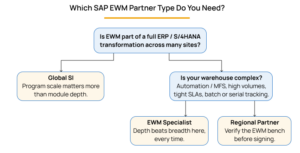
Which Type Do You Need? A 30-Second Decision Flow
Answer two questions and you’re most of the way there:
Question 1: Is EWM part of a full ERP/S/4HANA transformation across many sites and countries? → Yes: You need a Global SI. EWM will be one workstream among many, and program scale matters more than module depth. → No: Go to question 2.
Question 2: Is your warehouse genuinely complex — automation, MFS, high volumes, tight SLAs, batch or serial tracking? → Yes: You need an EWM Specialist. Depth beats breadth here, every time. → No: A Regional Partner may serve you well at a fair price. Just verify their EWM bench before signing.
The 7-Point Scorecard: How to Actually Judge a Partner
Forget the sales deck. Every vendor’s sales deck is beautiful. Take this list into your next vendor meeting instead, and watch what happens.
- EWM project count. Ask: “How many EWM go-lives have you had in the last three years?” A bad answer talks about SAP projects generally, or “our global practice.” You asked about EWM. Count the dodge.
- Named consultants. Ask: “Who exactly will be on my project, and can I interview them before signing?” The classic bad answer: “We’ll staff it after contract signature.” That sentence has ruined more projects than bad software ever has.
- Industry match. Ask: “Show me a warehouse like mine that you’ve implemented.” A cold storage site, an automotive sequencing operation, an e-commerce DC — whatever yours is. If all they have are generic case studies with no volumes and no specifics, keep asking. Real projects come with real details.
- Automation/MFS experience. Only if automation is in your scope, but then it’s non-negotiable. Bad answer: “We partner with someone for that.” You’re not buying a partnership diagram. You’re buying people who’ve talked to a PLC before.
- Testing philosophy. Ask: “How do you test with messy, real-world data?” If the answer only covers happy paths and standard scripts, remember this: your warehouse doesn’t run on happy paths. Neither will your go-live.
- Hypercare model. Ask: “What exactly happens in the six weeks after go-live, and can I have it in writing?” Vague reassurance here means you’ll be alone on the floor in week two.
- Ask for two clients who went live more than a year ago. Fresh go-lives always look good in a reference call. Year-old ones tell you the truth about stabilization, support, and whether the promised benefits ever arrived.
Any partner who handles all seven without flinching deserves your shortlist. Any partner who gets defensive on two or more just answered a different question for you.
When a Specialist Beats a Global SI (and When It Doesn’t)
Both models win, just in different games. Here’s the honest split.
Choose an EWM specialist when:
- Your warehouse operations are genuinely complex — a retail DC with automation, a food and beverage site with batch and expiry control, a 3PL juggling multiple clients — and EWM is the project, not a line item in a bigger program.
- Automation or MFS integration is in scope.
- You want senior consultants actually on your floor, not reviewing status decks from three time zones away.
- Your budget is mid-size, the kind a global SI would burn through in the discovery phase alone.
Choose a global SI when:
- EWM is one workstream inside a full S/4HANA transformation.
- You need one accountable partner across a dozen or more countries.
- Your procurement process realistically requires a mega-vendor on the contract.
Different tools for different jobs. No shame in either choice, only in making it for the wrong reasons.
Where SCM Champs Fits
You’ve probably guessed which bucket we sit in. SCM Champs is a North American SAP partner with 10+ SAP EWM implementations, working with manufacturing, retail, and e-commerce companies — delivering embedded and decentralized EWM, MFS and automation integration, WM-to-EWM migrations, and structured hypercare.
The projects that land on our desk tend to look the same way: a distribution operation that has outgrown its legacy WMS, picking errors creeping up, an automation investment on the horizon, and a leadership team that wants senior EWM people on the floor rather than a program office. Multi-site FMCG networks. Retail DCs heading into automation. E-commerce operations where the peak season is the whole business case. That’s our lane, and we’ve stayed in it deliberately.
One recent project gives you the picture. An FMCG manufacturer and distributor running four manufacturing plants and seven regional distribution centers had outgrown its legacy warehouse processes — no standardized way of running the floors, and automation on the roadmap. Over eight months, our team delivered the SAP EWM implementation end to end in a phased rollout: solution design, configuration, ERP integration, testing, training for warehouse users across every site, go-live, and structured hypercare. Operations were running at full volume within weeks of go-live, with picking accuracy improving from 97.5% to 99.8%, consistent processes across every site, and a platform ready for the automation phase. No drama at go-live. That’s the whole goal.
Frequently Asked Questions
- Who is the best SAP EWM implementation partner?There’s no universal best. Global SIs fit full S/4HANA transformations; EWM specialists fit complex warehouse execution. For manufacturing and distribution-focused projects, specialists like SCM Champs typically bring deeper EWM expertise per consultant than generalist firms.
- Should I choose a big consulting firm or an EWM specialist?Depends on scope. If EWM is one workstream in a company-wide transformation, a big firm makes sense. If the warehouse is the project, a specialist usually delivers more depth, faster, with fewer people.
- How do I evaluate an SAP EWM implementation partner?Use a scorecard: EWM-specific project count, named consultants you can interview, a reference warehouse like yours, automation experience, testing approach, a written hypercare plan, and references from clients live for over a year.
- What questions should I ask an EWM vendor before signing?Start with these: How many EWM go-lives in three years? Who exactly staffs my project? Show me a similar warehouse. How do you test with real data? What does hypercare look like, in writing?
- How much does the partner choice affect project success?More than the software does. EWM is proven technology; implementations fail on design decisions, data, and delivery discipline. The same product, in different hands, produces completely different outcomes. Choose the hands carefully.
- What’s the biggest red flag when selecting an SAP EWM partner?The bait-and-switch. Senior experts run the sales meetings, then a junior team shows up for delivery. Protect yourself by naming the project team in the contract and interviewing them first.
- Do EWM specialists cost more than general SAP partners?Day rates are sometimes higher, yes. Total project cost is often lower: fewer people, shorter ramp-up, less rework. A small team that’s done it 25 times beats a large team learning on your budget.
Conclusion
“Best partner” is the wrong question. “Best partner for my warehouse network” is the right one, and you now have the scorecard to answer it yourself. Because the project doesn’t really start at configuration — it starts the day you pick who’s doing it. Want a second opinion on your shortlist? Talk to an EWM specialist. Even if we’re not on that list, we’ll tell you what we see.