



This post walks you through why SAP warehouse solutions matter and how they power better inventory management and logistics for businesses. You’ll see the triggers that push companies to invest, the nuts and bolts of SAP warehouse modules, advice on which one fits your operation, plus a look at costs, RO, and why SCM CHAMPS should be your partner in digital transformation.
Strategic Business Triggers That Demand SAP Warehouse Solutions
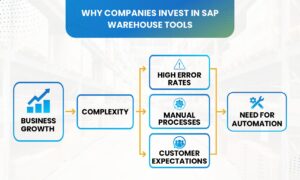
These are the real-world signals that prompt a shift to SAP warehouse tools:
Rapid business growth is creating complexity in inventory and order volume
High error rates or mismatches in stock data
Manual or outdated warehouse processes are causing slowdowns
Customer demands for rapid fulfillment and more transparency
Better integration with manufacturing, procurement or transport
Preparation for automation, robotics, or RFID integration
When these issues start eating margins, you need warehouse software that scales, adapts, and integrates intelligently.
Core Components of SAP Warehouse Solutions and Their Roles
SAP EWM (Extended Warehouse Management)
Overview: The most advanced SAP warehouse module, part of SAP SCM. It replaces the older WM module and offers comprehensive control over complex warehouse environments
Use Cases: Ideal for large-scale distribution centers, multi-activity zones, automated warehouses, and operations using RF/mobile devices, handling units, and fine-grained process flows.
Key Features:
Real‑time inventory tracking and bin-level visibility
Advanced picking/put‑away strategies and work center definitions
Handling‑unit management, cross‑docking, labor/resource planning
Integration with automated systems and mobile devices
Designed for high-throughput, dynamic environments
SAP WM (Warehouse Management)
Overview: The legacy SAP warehouse module is integrated into ERP’s Materials Management. Supported for now but being phased out in favor of EWM.
Use Cases: Works for simpler warehouse setups, like low-complexity bin tracking, fewer movement types, and limited automation. Good fit if your operation is small to medium scale and doesn’t require advanced automation or labor tracking.
Key Features:
Bin management with inbound/outbound logistics
Basic replenishment and transfer order functions
Standard integration with SAP MM and shipping
Less flexible when scaling or automating
SAP SRM (Supplier Relationship Management)
Overview: Traditionally, a purchase-centric module; it is relevant when your warehouse depends on supplier-managed inventory, seller collaboration, and JIT or VMI use cases.
Use Cases: When suppliers are heavily involved in ordering, stocking, or replenishment (e.g, vendors managing inventory on your floor, direct store delivery, or constantly changing delivery schedules).
Key Features:
Streamlined supplier collaboration and catalog management
Automated requirement and approval workflows
Integration between procurement, logistics, and warehouse operations
Visibility into supplier performance and delivery reliability
-
Which SAP Component to Use Based on Specific Warehouse Conditions
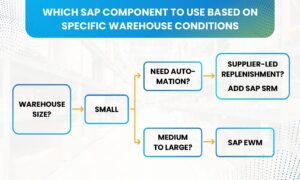
Here’s how to match SAP tools to your warehouse reality:
Small, simple warehouse with limited movement types → SAP WM: Quick to deploy, lower cost, handles basic bin tracking and order fulfillment. Most companies will eventually outgrow it.
Medium-sized operations pushing automation or multi-step workflows → SAP EWM (Basic or Advanced): Basic EWM works if you want an entry into EWM features with lower overhead; Advanced EWM gives full capability (cross-docking, labor management, cluster picking). It handles growth and complexity.
Supplier-managed or vendor-involved environments → Add SAP SRM: If vendors manage your replenishment or you’re operating JIT/VMI models, SRM integrates procurement planning with warehouse execution.
What this means is:
SAP WM can work well at first, but if you expand, bring in automation, or require detailed labor/resource planning, SAP EWM gives the flexibility and efficiency you need. And when supplier collaboration is critical, SRM brings tighter integration across the supply chain.
Costing & ROI Considerations
Early costs include: licensing (EWM costs more than WM), implementation counseling, integration, user training, and potential infrastructure upgrade.
Ongoing costs: support, maintenance, future scaling, license renewal.
Benefits you’ll see:
Fewer picking and handling errors
Faster workflows, lower labor cost through optimized routing
Better inventory accuracy and reduced stock-outs or overstocks
Reduced idle time, improved throughput
Visibility across bins, orders, and supplier lead times
Organizations implementing EWM typically observe improvements in productivity, order accuracy, and inventory turns, with payback often within 12–24 months
When making the decision, weigh your warehousing complexity, staff efficiency, automation potential, and integration demands. ROI isn’t just cost savings, it’s tighter control, greater reliability, and readiness for future scale.
Why Choose SCM CHAMPS for SAP Warehouse Solutions?
Our Unique Value Proposition
SCM CHAMPS combines deep SAP expertise in EWM, WM, and SRM with hands‑on supply chain industry experience. We don’t just implement software, we reform processes. We align your needs with the right SAP module, configure it to your environment, and train your team to operate it efficiently.
What We Offer That Others Don’t
Experience in integrating automation (RF, conveyors, robotics, SAP S/4HANA compatibility)
Flexible staffing model and on-demand SAP expertise across geographies
Template-driven implementation accelerators and proven best practices
Continuous improvement support beyond go‑live: we help you evolve with business needs
Success Stories and Case Studies
Case Study: Global Pharma Distributor Streamlines Inventory with SAP EWM
A leading pharmaceutical distributor operating across 9 countries struggled with fragmented inventory visibility and compliance-heavy warehouse processes. SCM Champs implemented SAP Advanced EWM with batch management, handling unit tracking, and RF integration across their central distribution hubs.
Results:
Inventory accuracy improved from 82% to 5%
Cold chain handling times reduced by 35%
Regulatory compliance reporting automated, saving 500+ man-hours annually
Enabled 24-hour order processing SLA without increasing headcount
Case Study: Automotive Spare Parts Manufacturer Scales Up with SAP WM to EWM Migration
A Tier-1 automotive parts supplier had been using SAP WM for over a decade, but as demand rose and global suppliers were added, their legacy setup couldn’t keep up. SCM Champs led a phased migration to SAP EWM, tailored to their high SKU turnover and JIT delivery models.
Results:
Picking accuracy increased by 47%
Warehouse throughput improved by 60% post go-live
Cut delivery delays by 70% through better dock appointment scheduling
Seamless integration with SAP TM and SRM modules boosted overall supply chain synchronisation
Case Study: Electronics Retail Giant Unlocks Real-Time Visibility with SAP EWM + SRM Integration
A major electronics retailer with over 200 stores across India faced challenges with supplier coordination, delayed replenishments, and a lack of visibility across regional warehouses. SCM Champs implemented SAP EWM integrated with SAP SRM to create a connected ecosystem from supplier to shelf.
Results:
Replenishment lead time reduced by 50%
Supplier fill rates increased from 76% to 95%
Real-time insights into supplier-managed inventory
Automated PO generation based on stock thresholds and seasonal demand
Case Study: FMCG Company Accelerates Order Fulfillment with Automated Warehouse and SAP EWM
A fast-growing FMCG brand in Southeast Asia needed to scale up fulfillment speed without increasing labor costs. SCM Champs deployed SAP Advanced EWM integrated with their automated storage and retrieval system (ASRS) and conveyor-based picking zones.
Results:
Order processing capacity increased by 3x
Labor productivity improved by 42%
Integrated ASRS reduced picking time per order by 70%
End-to-end tracking of 100,000+ SKUs across 3 DCs
Conclusion
SAP warehouse solutions are not optional; they’re a strategic necessity if you want efficiency, accuracy, and flexibility as your business grows. SAP WM may be fine at the start, but EWM is built for scale, precision, and automation. SRM brings supplier-driven models into the fold.
Ready for a warehouse that adapts to your business, not the other way around? Partner with SCM CHAMPS. We bring the SAP expertise and process vision to transform your operations. Let’s talk about your digital warehouse transformation.