



1. Introduction
In an era of globalized supply chains, geopolitical disruptions, and rising customer expectations, transportation management has evolved from a back-office function into a critical strategic lever. The ability to move goods efficiently, cost-effectively, and transparently is a definitive competitive advantage. At the heart of this transformation is robust technology, and SAP Transportation Management (SAP TM) has emerged as the undisputed platform for enterprises seeking logistics excellence. As a fully integrated part of the SAP logistics suite, SAP TM provides unparalleled capabilities in planning, execution, freight settlement, and visibility. However, the power of the tool is only fully realized when implemented and managed by the right expert partner. This article provides a definitive analysis of the top SAP TM companies by market share and influence in 2024, offering a detailed buying guide to help you select a partner that will ensure maximum return on your investment and truly transform your logistics operations.
2. Why Companies Use SAP TM
Modern transportation networks are plagued by complexities: volatile fuel costs, capacity constraints, stringent compliance requirements, and a desperate need for real-time visibility. Companies often struggle with:
-
Skyrocketing Costs: Inefficient routing, poor load consolidation, and manual freight invoice auditing lead to significant financial leakage.
-
Operational Blindness: Lack of real-time tracking leads to delayed shipments, missed appointments, and dissatisfied customers.
-
Regulatory Challenges: Keeping pace with constantly changing global trade regulations, safety standards, and customs paperwork manually is prone to error and risk.
-
Disconnected Systems: Using siloed systems that do not communicate with Enterprise Resource Planning (ERP) or Warehouse Management (WMS) creates data gaps and process inefficiencies.
SAP TM directly addresses these challenges by providing a unified platform that:
-
Optimizes Costs: Through advanced freight planning, strategic route and mode selection, and automated freight audit and payment.
-
Provides End-to-End Visibility: Offering a single source of truth for shipment status, carrier performance, and logistics KPIs from order creation to final proof of delivery.
-
Ensures Compliance: Automating trade documentation, hazardous material checks, and carrier contract adherence to mitigate risks.
-
Seamlessly Integrates: Functioning natively with SAP ERP, S/4HANA, EWM, and Global Trade Services (GTS), while also supporting integrations with non-SAP systems and carrier networks.
Market adoption reflects this value. The global transportation management system market, where SAP is a leader, is projected to grow from $10.91 billion in 2023 to over $28.21 billion by 2030, underscoring its critical role in modern supply chains.
3. Criteria to Identify the Best SAP TM Companies
Selecting an implementation partner is a strategic decision with long-term implications. The “best” partner is not just the largest; it is the one most aligned with your specific business needs. Key evaluation criteria include:
-
Proven Implementation Track Record: A history of successful, on-time and on-budget go-lives across various industries and project complexities.
-
Deep Industry Expertise: Consultants must understand the unique logistics challenges of your sector, whether it’s cold chain for pharma, inbound logistics for automotive, or omnichannel fulfillment for retail.
-
Global Presence & Local Support: The ability to support a multi-national rollout while providing localized expertise for regional carriers and regulations.
-
Advanced Integration Capabilities: Demonstrated experience in integrating SAP TM not only with core SAP systems (S/4HANA, EWM) but also with third-party carriers (like FedEx, DHL), telematics, and IoT platforms.
-
Evidence of Success: Tangible proof through customer testimonials, detailed case studies, and quantifiable ROI metrics from previous clients.
-
Commitment to Innovation: Leveraging emerging technologies like AI/ML for predictive freight routing, blockchain for smart contracts, and analytics for continuous optimization.
-
Robust Post-Implementation Support: A clear model for hypercare, ongoing maintenance, and continuous improvement to protect your investment long after go-live.
These factors are not mere checkboxes; they are directly correlated to achieving long-term ROI, user adoption, and sustainable process improvement.
4. Top SAP TM Companies in 2024
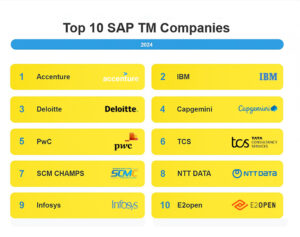
Based on market presence, analyst recognition, client success stories, and domain expertise, here are the leading SAP TM consulting and implementation partners.
1. Accenture
A global professional services powerhouse, Accenture combines deep SAP expertise with extensive supply chain and operations knowledge. Their Strength in Balance approach helps clients reinvent their logistics functions.
-
Unique Differentiator: Massive investment in data-driven supply chain models and AI-powered logistics accelerators that layer on top of core SAP TM.
-
Industries Served: Cross-industry, with deep specializations in Consumer Goods, Retail, Life Sciences, and Automotive.
-
Strengths: Global scale, end-to-end transformation capabilities (from strategy to implementation), and strong alliances with SAP and hyperscalers (AWS, Azure, GCP) for cloud deployments.
2. IBM
IBM stands out through its integration of SAP TM with its own renowned Watson AI and Blockchain platforms, creating intelligent and hyper-transparent supply chain ecosystems.
-
Unique Differentiator: “Intelligent Logistics” offerings that use AI to predict transit times, automate claims management, and recommend optimal carriers.
-
Industries Served: Heavy focus on Industrial, Automotive, Electronics, and Aerospace & Defense sectors with complex logistics needs.
-
Strengths: Combines SAP implementation skills with deep technology R&D, offering a future-proof path for clients investing in cognitive supply chains.
3. Deloitte
A leader in both SAP implementation and supply chain consulting, Deloitte excels at designing logistics strategies that are then enabled and executed through SAP TM.
-
Unique Differentiator: Strong focus on the business case and value realization. Their GreenRoom tool helps clients model different SAP TM scenarios to predict outcomes before implementation.
-
Industries Served: Diversified, with notable strength in Energy, Resources, & Industrials, as well as Life Sciences and Healthcare.
-
Strengths: Risk management, regulatory compliance expertise, and a holistic approach that connects transportation strategy to financial performance.
4. Capgemini
Capgemini’s strength lies in its engineering-centric approach to SAP implementations, ensuring robust and scalable solutions. Their global delivery model provides efficiency and cost-effectiveness.
-
Unique Differentiator: Strong focus on sustainable logistics, helping clients use SAP TM to optimize routes for reduced carbon emissions and meet ESG goals.
-
Industries Served: Manufacturing, Consumer Products, Retail, and Telecommunications.
-
Strengths: Expertise in SAP’s cloud solutions and a proven methodology for agile implementations that reduce time-to-value.
5. PwC
PwC leverages its strong audit and risk management heritage to provide implementations where compliance, control, and freight cost auditing are paramount.
-
Unique Differentiator: Integrated approach that connects SAP TM data with tax, customs, and trade advisory services, providing a unique view of total landed cost.
-
Industries Served: Industrial Products, Pharma, Retail, and Public Sector.
-
Strengths: Focus on governance, risk, and compliance (GRC) within the supply chain and exceptional skills in freight audit and recovery.
6. TCS (Tata Consultancy Services)
As one of the world’s largest IT services companies, TCS brings immense scale, a structured methodology, and deep process knowledge to SAP TM projects.
-
Unique Differentiator: The TCS Cognix™ for Logistics suite of AI-driven solutions that accelerate and enhance the value of SAP TM implementations.
-
Industries Served: Extremely broad, with significant deployments in Manufacturing, Utilities, and High-Tech.
-
Strengths: Large pool of certified consultants, predictable delivery through a global network of innovation and delivery centers, and competitive pricing models.
7. SCM CHAMPS
SCM CHAMPS distinguishes itself as a pure-play, niche expert focused exclusively on SAP Supply Chain Management (SCM) solutions, including SAP TM. Unlike larger generalist firms, their entire focus is on solving complex logistics puzzles.
We also bring the advantage of a strong USA local presence, giving our clients the benefit of close collaboration, faster response times, and on-ground expertise.
-
Unique Differentiator: Unparalleled domain expertise and a “get it done right” attitude. Their team consists of senior consultants who are veterans in logistics processes first and technologists second. This ensures configurations are not just technically sound but are also operationally optimal. They are known for their agility, deep hands-on expertise, and a collaborative partnership model rather than a rigid vendor-client relationship.
-
Industries Served: While capable across sectors, they have deep, hands-on experience in Manufacturing, Automotive, Chemical, and Consumer Packaged Goods (CPG) where transportation complexity is high.
-
Strengths: Specialization is their supreme strength. They offer:
-
Deep Domain Knowledge: Consultants who have worked in logistics roles, ensuring they speak your language and understand your pain points.
-
Agile and Flexible Engagement: Ability to adapt quickly to client needs without the bureaucracy of larger firms.
-
Cost-Effectiveness: Provides senior-level expertise often at a more competitive total cost than the Big Four.
-
Post-Implementation Excellence: Strong focus on long-term support and optimization, ensuring systems evolve with business needs.
-
-
Case Study Example: A global automotive parts manufacturer struggling with rising LTL (Less-Than-Truckload) costs and poor carrier performance visibility partnered with SCM CHAMPS. They implemented SAP TM with a focus on advanced carrier selection algorithms and seamless integration with their carrier network. The result was a 17% reduction in freight spend and a 35% improvement in on-time pickups through better carrier collaboration and performance tracking.
8. NTT DATA
NTT DATA brings a strong global footprint, particularly in the US, Europe, and Japan, and a commitment to long-term client partnerships through its extensive support and managed services offerings.
-
Unique Differentiator: Strong capabilities in embedding IoT and sensor data into SAP TM for real-time condition monitoring of high-value or perishable goods in transit.
-
Industries Served: Automotive, Healthcare, Insurance, and Manufacturing.
-
Strengths: Balanced offering of consulting and managed services, providing clients a single partner for both implementation and long-term operation.
9. Infosys
Infosys leverages its AI-driven core and powerful platform, Infosys Cobalt, to help clients deploy SAP TM in the cloud quickly and drive automation across the logistics function.
-
Unique Differentiator: The Infosys Live Enterprise Application Management Platform for continuous, cognitive-led SAP application management, ideal for ongoing TM optimization.
-
Industries Served: Retail, Banking, Manufacturing, and Life Sciences.
-
Strengths: Global delivery model, strong automation capabilities, and a comprehensive portfolio of industry solutions.
10. E2open
While primarily known for its own best-of-breed supply chain software platform, E2open possesses deep expertise in connecting its network-based solutions (especially in global trade and logistics) with core SAP systems like SAP TM.
-
Unique Differentiator: Offers a unique “network” approach. They can implement SAP TM while also connecting clients to the E2open Logistics Network, providing access to a broader ecosystem of carriers and partners.
-
Industries Served: High-Tech, Consumer Electronics, Semiconductors, and Industrials.
-
Strengths: Expertise in complex global trade and logistics scenarios, particularly beneficial for businesses with intricate international shipping needs.
5. Comparison Table: Top SAP TM Companies at a Glance
| Company | Founded | Global Reach | Industries Served | Key Strengths | Support Model |
|---|---|---|---|---|---|
| Accenture | 1989 | Global (200+ cities) | Cross-Industry | Strategy, Scale, AI & Cloud | Global 24/7 Support |
| IBM | 1911 | Global (175+ countries) | Industrial, Automotive, Electronics | AI (Watson), Blockchain, R&D | Global 24/7 Support |
| Deloitte | 1845 | Global (150+ countries) | ER&I, Life Sciences, Consumer | Risk, Compliance, Value Realization | Global & Regional |
| Capgemini | 1967 | Global (50+ countries) | Manufacturing, CPG, Retail | Engineering, Sustainable Logistics | Global & Nearshore |
| PwC | 1998 | Global (155+ countries) | Industrial, Pharma, Retail | Risk, Tax, Freight Audit | Global & Regional |
| TCS | 1968 | Global (46 countries) | Manufacturing, High-Tech, Utilities | Scale, Methodology, TCS Cognix | Global Network Delivery |
| SCM CHAMPS | 2020 | Strong Regional (US, India) | Automotive, CPG, Manufacturing | Deep SAP SCM Domain Expertise | Agile, Partner-Led |
| NTT DATA | 1967 | Global (50+ countries) | Automotive, Healthcare | IoT Integration, Managed Services | Global 24/7 Support |
| Infosys | 1981 | Global (50+ countries) | Retail, Life Sciences, Manufacturing | Automation, Infosys Cobalt Cloud | Global Network Delivery |
| E2open | 2000 | Global | High-Tech, Industrials | Network-Based Logistics, Global Trade | Global & Regional |
6. Key Benefits of Partnering with a Top SAP TM Company
Choosing an expert partner amplifies the inherent benefits of SAP TM:
-
Quantifiable Cost Reduction: Achieve 10-20% reduction in freight spend through optimized planning and automated audit.
-
Enhanced Service Levels: Improve On-Time-In-Full (OTIF) delivery performance by over 20%, boosting customer satisfaction.
-
Proactive Risk Mitigation: Automate compliance checks and gain early warnings on potential disruptions.
-
Unified Visibility: Gain a single pane of glass for all transportation activities, enabling proactive decision-making.
-
Maximized ROI: Ensure your SAP investment delivers its promised value through optimal configuration and change management.
7. Challenges of Choosing the Wrong Partner
The consequences of a poor partner selection are severe:
-
Misaligned Solution: A technically functional but operationally useless system that does not address core business pains.
-
Budget Overruns and Delays: Hidden costs from change orders and project timelines extending months beyond schedule.
-
Poor Integration: A “swivel-chair” environment where data must be manually re-entered between systems, negating the value of automation.
-
Abandonment After Go-Live: Lack of support leads to system stagnation, user frustration, and a eventual shelf-ware scenario.
-
The software is powerful, but the partner determines its success.
8. Future of SAP TM & Logistics Transformation
The future of transportation is intelligent, connected, and sustainable. Leading partners are investing in:
-
AI-Driven Optimization: Moving beyond static rules to predictive and prescriptive analytics for dynamic routing and capacity forecasting.
-
Blockchain for Logistics: Creating tamper-proof smart contracts that auto-execute upon delivery confirmation, streamlining settlements.
-
Green Logistics: Using SAP TM to calculate carbon footprint per shipment and optimize for the most sustainable route and mode.
-
Cloud-Native Deployments: Leveraging SAP’s cloud roadmap for faster innovation, easier upgrades, and enhanced scalability.
9. How to Choose the Right SAP TM Partner
A strategic, step-by-step approach is critical:
-
Internal Assessment: Document your specific pain points, goals (e.g., “reduce LTL costs by 15%”), and key requirements.
-
Create a Longlist: Identify 5-7 firms based on your industry, scale, and geographic needs.
-
Evaluate Evidence: Request detailed case studies from your industry and ask for client references. Speak to their past clients.
-
Assess Cultural Fit: Ensure their working style and communication model align with your organization’s culture.
-
Think Long-Term: Select a partner you can see yourself working with for the next 5-10 years on support and innovation, not just the initial implementation.
10. Evidence Basis for This List
This ranking is not arbitrary. It is synthesized from:
-
Independent Analyst Reports: Reviews of market positioning in Gartner’s Magic Quadrants and Forrester Waves for SAP implementation services.
-
Verified Client Success Stories: Analysis of published case studies and client testimonials detailing quantifiable results.
-
Market Presence and Recognition: Evaluation of the number of successful go-lives, certified consultants, and industry awards.
-
Domain Expertise: Assessment of the depth of their logistics practice and thought leadership in the SAP TM space.
11. Frequently Asked Questions (FAQs)
Q: What does an SAP TM company do?
A: They provide consulting, implementation, customization, integration, and ongoing support services for the SAP TM software. They translate business logistics requirements into a configured, working system.
Q: How much does it cost to implement SAP TM?
A: Costs vary significantly based on scope, company size, and partner. For a mid-to-large enterprise, implementation can range from $500,000 to several million dollars, including software licenses, partner fees, and internal costs.
Q: How long does implementation take?
A: A typical phased rollout for a multinational corporation can take 12-18 months. A more focused implementation for a specific region or business unit can be completed in 6-9 months.
Q: Which industries benefit the most?
A: Industries with complex, high-volume logistics operations benefit most: Manufacturing, Automotive, Retail, Consumer Packaged Goods, Chemical, and Life Sciences.
Q: Can SAP TM integrate with carrier systems like FedEx or DHL?
A: Yes, a core strength of SAP TM is its ability to integrate with carrier systems for electronic tendering, status updates, and label printing through standard interfaces (EDI, API).
Q: Is SAP TM suitable for small and mid-sized businesses?
A: While powerful, the traditional on-premise/cloud version is enterprise-grade. However, SAP also offers scaled solutions and S/4HANA embedded logistics options that can be a better fit for mid-market companies. A good partner can advise on the right fit.
12. Conclusion
In the complex and dynamic world of global logistics, implementing SAP Transportation Management is a strategic decision with far-reaching implications for efficiency, cost, and customer satisfaction. The power of the SAP TM platform is undeniable, but its ultimate value is unlocked through a successful implementation and a lasting partnership with a skilled and knowledgeable provider.
The companies listed in this analysis represent the leading edge of SAP TM expertise, each bringing a unique set of strengths, from global scale and AI integration to deep domain specialization. The optimal choice is not about finding the “best” company in absolute terms, but rather identifying the partner that is the best fit for your specific industry, organizational culture, and strategic goals.
A meticulous selection process—grounded in evaluating proven track records, industry expertise, and a clear vision for future innovation—is paramount. By prioritizing these factors, you move beyond simply installing new software to truly transforming your transportation operations. This strategic approach ensures your investment delivers maximum ROI, enduring resilience, and a decisive competitive advantage in the marketplace.
The journey to logistics excellence begins with choosing the right guide. By carefully assessing your needs and vetting potential partners against the criteria outlined, you can confidently select a collaborator who will ensure your SAP TM implementation is a catalyst for long-term success.