



SAP Went Live. So Why Is the Business Still Underperforming?
The project board signed off. The steering committee celebrated. The implementation partner shook hands and moved on. Your team completed training, data was migrated, and SAP went live on schedule and within budget. By every project metric, the implementation was a success.
That was twelve months ago.
Today, inventory is higher than it was before go-live. Service levels have not improved — in some areas they have declined. Your planning team is still running Excel files alongside SAP, and leadership is quietly asking whether the investment was worth it. Expediting costs are up. Confidence in SAP data is low. The business results that justified the business case have not arrived.
This situation is more common than most organizations are willing to admit publicly. The gap between a successful SAP go-live and actual business performance improvement is one of the most persistent and costly challenges in enterprise operations today. At SCM Champs, this is one of the most common conversations we have with supply chain leaders after go-live.
If SAP went live successfully, why is the business still underperforming?
What Is the SAP Value Gap?
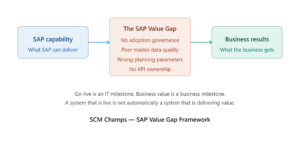
The SAP Value Gap is the measurable difference between what SAP is capable of delivering and what the business is actually experiencing after go-live.
This distinction matters more than most organizations realize. Go-live is an IT milestone. It marks the moment the system is technically operational. Business value is a different milestone entirely — one that requires process discipline, data integrity, user adoption, and operational governance to achieve. A system that is live is not automatically a system that is delivering value.
Industry research and ERP implementation studies consistently indicate that a significant proportion of organizations do not achieve their expected business outcomes within the first two to three years of an ERP implementation. The investment is made. The system is running. But the performance improvements — reduced inventory, better service levels, improved forecast accuracy — remain unrealized.
The SAP Value Gap is not a system failure. It is a business performance failure. And that distinction changes everything about how it should be addressed.
What Is This Gap Costing Your Business?
Most post-go-live conversations focus on system issues — transaction errors, configuration gaps, missing reports. The more important conversation is financial. The SAP Value Gap has a direct and measurable cost, and in most organizations that cost is significantly larger than the investment required to close it.
| Business Issue | Potential Business Impact |
|---|---|
| Excess Inventory | Higher working capital requirements and increased carrying costs |
| Stockouts | Lost revenue, missed orders, and customer attrition |
| Poor Forecast Accuracy | Excess inventory buffers, increased waste, and reactive procurement |
| Manual Reporting | Productivity loss, decision-making delays, and data inconsistency |
| Expediting Costs | Increased logistics spend and unplanned procurement premiums |
Excess inventory consumes working capital that could be deployed elsewhere in the business. Every percentage point of unnecessary stock carries a cost — warehousing, insurance, obsolescence risk, and tied-up cash. Stockouts create a different but equally damaging problem: lost sales, broken customer commitments, and long-term erosion of service reputation. Poor forecast accuracy sits at the root of both problems, driving organizations to hold more inventory than necessary while still failing to have the right product in the right place at the right time.
Manual reporting outside SAP is a symptom that is easy to dismiss but expensive in practice. When planning teams build their own spreadsheet models to compensate for low SAP confidence, the organization effectively runs two parallel systems — one official, one real. Decision-making slows. Data integrity erodes. And the investment in SAP continues to depreciate.
At SCM Champs, we frequently find that the ongoing cost of these inefficiencies exceeds the investment required to address them.
How Do You Know If Your Organization Has an SAP Value Gap?
Answer the following questions honestly.
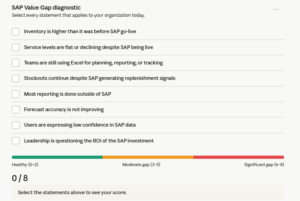
If you scored three or above, the next section explains exactly why this is happening in your organization.
Why Does the SAP Value Gap Happen?
Why Do Teams Return to Excel After SAP Go-Live?
Teams return to Excel because SAP has not yet earned their trust, and because no governance structure exists to require anything different. This is not a technology problem. It is a process adoption and governance problem.
Habit is powerful. Planners and analysts who have managed supply chains in Excel for years have a high degree of personal confidence in their own models. SAP, particularly in the months immediately after go-live, often produces outputs that differ from what those teams expect — not always incorrectly, but differently. Without guidance on how to interpret and act on SAP outputs, users default to what they know.
The absence of governance compounds the problem. If there is no policy requiring transactions to be processed in SAP, no consequence for working outside the system, and no leadership visibility into SAP utilization rates, Excel use becomes normalized. ERP adoption studies consistently observe that user behavior change is the most frequently underestimated challenge in enterprise system implementations. Training on how to navigate SAP transactions is not the same as training on how to run a supply chain using SAP outputs. Most implementations deliver the former and assume the latter follows naturally. It rarely does.
SAP cannot enforce its own adoption. Only leadership can.
Why Does Inventory Increase After SAP Implementation?
Inventory increases after SAP go-live primarily because MRP planning parameters are set incorrectly during implementation and are never corrected afterward. This is one of the most searched and least understood post-go-live challenges in SAP environments.
During implementation, MRP parameters — safety stock levels, reorder points, lot sizes, lead times, and planning horizons — are configured based on assumptions that often do not reflect actual operational reality. Safety stock calculations may use historical data that does not represent current demand variability. Lead times may be estimated rather than measured. When MRP runs on these parameters, it generates replenishment signals that planners immediately recognize as incorrect. Their response is predictable: they override the system and manage inventory manually, typically building additional buffer to compensate for their distrust of SAP signals.
The result is a compounding effect. Parameters that were never corrected continue to generate signals that are never trusted. Planners continue to manage around the system. Inventory accumulates above plan. And because no one owns the parameter correction process after go-live, the situation persists for months or years.
Cross-functional misalignment between supply chain, finance, and operations on inventory targets makes this worse. Without shared KPI ownership, each function optimizes locally, and total inventory increases as a systemic consequence.
Inventory increases after SAP go-live are almost always caused by parameter errors and distrust of system outputs — not by any fundamental limitation of SAP itself.
How Does Poor Master Data Quality Undermine SAP Performance?
Poor master data quality undermines SAP performance immediately and compounds over time. SAP is a rules-based planning and execution system — it plans with the data it is given, and if that data is wrong, every output it produces is wrong.
The most common master data failures in post-go-live environments involve Bills of Materials with incorrect component quantities or outdated structures, material master records with lead times that do not reflect actual supplier performance, vendor master data that has not been aligned with current sourcing agreements, and inventory records that have not been reconciled after go-live stock take processes.
Each failure has a direct operational consequence. An incorrect BOM drives incorrect production orders and component requirements. An overstated lead time causes SAP to generate early replenishment signals, building unnecessary inventory. An understated lead time causes late signals, creating stockouts. The compounding effect of multiple master data errors across hundreds or thousands of material records produces planning outputs that no experienced planner will trust.
Master data is not a one-time implementation task. It is an ongoing operational discipline. Organizations that treat master data governance as a post-go-live priority consistently outperform those that treat it as an implementation deliverable that was completed at go-live.
Why Are Service Levels Not Improving After SAP Go-Live?
Service levels do not improve after SAP go-live because the operational disciplines required to drive service improvement are not embedded alongside the system. SAP can make service level problems visible. It cannot resolve them without process and people alignment.
Forecasting is the most common root cause. If demand planning inputs — customer history, promotional calendars, new product introductions, seasonality adjustments — are not being maintained within SAP IBP, the demand signal driving MRP is unreliable. Planners compensating with manual adjustments outside the system introduce additional variability rather than reducing it.
Warehouse execution presents a parallel challenge. SAP Extended Warehouse Management and SAP Warehouse Management provide sophisticated tools for pick, pack, and dispatch optimization. But those tools only deliver value when warehouse processes are aligned with SAP transaction sequences. Organizations that go live with SAP EWM but continue running warehouse operations on paper-based or legacy processes see no improvement in pick accuracy or dispatch performance.
Supplier performance data that is not flowing correctly into SAP — delivery confirmations, goods receipts, vendor evaluation data — creates blind spots in supply chain visibility that translate directly into service failures.
Service level improvement requires operational discipline, not just system capability. SAP can show the problem. It cannot fix it.
What Should Executives Review 90 Days After SAP Go-Live?
The goal is not to evaluate whether SAP is working. The goal is to evaluate whether the business is improving.
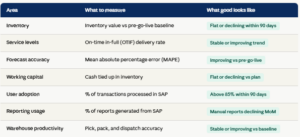
These metrics should be reviewed in a structured monthly governance forum with cross-functional leadership — supply chain, finance, operations, and IT represented at the same table. The conversation should not be about system performance. It should be about business performance, with SAP utilization as one of the enabling indicators.
If these metrics are not being reviewed, the organization is flying blind on its SAP investment.
Real-World Example: How One Manufacturer Closed the SAP Value Gap
A mid-size discrete manufacturer in North America completed an S/4HANA implementation and went live on schedule. Eighteen months later, the business results told a different story.
Inventory had increased 22 percent since go-live. OTIF had declined from 87 percent to 79 percent. The planning team was operating primarily in Excel, with SAP used largely for transaction recording rather than planning execution. Leadership had lost confidence in the data SAP was producing and was questioning whether the platform was fit for purpose.
A structured assessment identified three root causes. Safety stock parameters had been set during implementation using pre-migration averages that did not reflect actual demand variability. Master data — particularly vendor lead times and BOM structures — had not been reviewed or corrected after go-live. And no governance process existed for SAP transaction compliance, meaning planners faced no consequence and received no support for working outside the system.
The remediation program addressed all three areas in parallel. Planning parameters were reviewed and corrected across all active SKUs. A master data cleansing program was initiated with named ownership across supply chain, procurement, and operations. Weekly SAP compliance reviews were introduced, chaired by the COO, with department-level adoption metrics reviewed as a standing agenda item.
Within nine months: inventory reduced by 18 percent. OTIF improved from 79 percent to 88 percent. Forecast accuracy improved by 15 percentage points. Excel-based reporting reduced by over 70 percent.
The system had not failed. The business realization process had simply stopped at go-live.
Frequently Asked Questions
Why do SAP projects fail to deliver ROI after go-live?
SAP ROI requires process adoption, data governance, and operational discipline — not just a functioning system. Most implementations are declared complete at technical go-live, at which point structured improvement activity stops. The business performance phase — parameter tuning, master data governance, adoption management, and KPI accountability — is rarely planned or resourced with the same rigor as the implementation itself. Without it, the gap between system capability and business performance persists indefinitely.
Why does inventory increase after SAP implementation?
Inventory typically increases after SAP go-live because MRP planning parameters — safety stock, reorder points, lot sizes, and lead times — are configured during implementation on assumptions that do not reflect operational reality. When planners do not trust the signals SAP produces, they override the system and build manual buffers. The compounding effect of untrusted parameters and manual intervention is almost always higher inventory than planned. This is correctable without reimplementation through a focused parameter review and governance program.
Why do companies still use Excel after SAP go-live?
Excel use persists after go-live because SAP adoption requires more than training — it requires governance. When no policy mandates SAP-based planning and reporting, and when no leadership accountability exists for utilization rates, experienced users default to familiar tools. The solution is not better SAP training alone. It is a leadership-driven adoption framework with visible accountability, clear process standards, and regular compliance monitoring.
How long does it take to realize SAP business value?
With focused intervention on planning parameters, master data quality, and user adoption governance, meaningful and measurable business improvement is typically visible within six to nine months of beginning a structured value realization program. Without deliberate intervention, the SAP Value Gap does not close on its own — it tends to widen as workarounds become embedded in operational culture and confidence in the system continues to erode.
How can organizations improve SAP ROI without reimplementing SAP?
Reimplementation is almost never the answer to a post-go-live performance gap. The causes of underperformance — parameter errors, master data quality, adoption failures, and absent governance — are all addressable within the existing system landscape. A structured SAP value realization program, of the kind SCM Champs delivers, identifies the specific gaps in a client’s environment and builds a practical, sequenced roadmap for closing them. Results are measurable within a single financial quarter.
Go-Live Was the Beginning. Business Value Is the Destination.
Technology alone does not create supply chain performance. SAP provides the platform, the data structure, and the process framework. But business transformation requires process discipline, people accountability, governance structures, and a leadership commitment to continuous improvement that extends well beyond the go-live date.
Companies rarely lose money because SAP failed. They lose money because business transformation stopped at go-live.
Is Your SAP Environment Delivering Business Value — or Just Running Successfully?
If your organization has completed an SAP implementation but expected improvements in inventory, service levels, forecasting accuracy, or supply chain performance have not materialized, it may be time to evaluate the gap between system capability and business outcomes.
SCM Champs helps organizations identify that gap and create practical roadmaps for realizing measurable value from SAP investments.
[Schedule a Supply Chain Value Assessment]