


Warehouse automation is no longer treated as an experimental initiative limited to innovation labs. Across manufacturing, retail, and distribution networks, enterprises are evaluating robotics specifically where automation can be governed, measured, and controlled through SAP.
For senior supply chain and IT leaders, approval is not driven by technology enthusiasm. It is driven by operational safety, SAP system integrity, and a defensible business case.
This article outlines what decision-makers expect to see before approving SAP warehouse robotics integration, including SAP Extended Warehouse Management (SAP EWM) robotics scenarios, based on enterprise buying patterns observed between 2022 and 2025.
Who Approves SAP Warehouse Robotics Integration—and How They Evaluate It
Enterprise warehouse robotics approval is rarely owned by a single role. It typically involves:
-
Head of Supply Chain or Logistics
-
Warehouse or Distribution Operations Director
-
CIO or Enterprise IT Leadership
-
Automation or Digital Transformation Leads
These stakeholders evaluate initiatives against a consistent checklist:
-
Will SAP remain the system of record?
-
Are SAP warehouse automation requirements clearly defined?
-
Can operations continue during deployment?
-
Does this scale without introducing long-term technical debt?
-
Is the business case defensible to finance and audit teams?
Content that does not align with these approval criteria rarely moves beyond early discussion.
The First Approval Gate: Operational Continuity and SAP Control
Before ROI discussions begin, decision-makers need confidence that robotics integration will not disrupt warehouse execution or SAP performance.
They expect clarity on:
-
How warehouse tasks are generated and prioritized in SAP
-
How execution systems receive instructions and confirm completion
-
How exceptions are managed without manual reconciliation
-
How SAP performance, stability, and availability are protected
In approved SAP warehouse automation programs, SAP—often SAP Extended Warehouse Management—remains the central orchestration layer, while robotics platforms function as controlled execution components.
System Architecture & Integration Transparency
1. High-Level Architecture Diagram
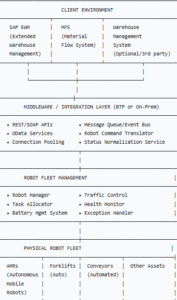
2. Data Flow Explanation
Task Creation
1. SAP EWM detects need for warehouse movement
   • Outbound delivery confirmation
   • Replenishment trigger
   • Stock transfer request

2. EWM creates Warehouse Task (WT)
   • WT includes: Material, Quantity, Source Bin, Destination Bin

3. MFS receives WT via RFC/IDoc
   • Validates robot availability
   • Checks destination accessibility

4. Middleware transforms WT into Robot Task
   • Task ID mapping
   • Priority assignment
   • Route optimization
Robot Execution
1. Robot Manager assigns task to optimal robot
   • Based on: proximity, battery, current load, capability

2. Command sent to robot via REST/MQTT
   • Pick instruction with bin location
   • Navigation coordinates
   • Safety parameters

3. Robot executes physical movement
   • Autonomous navigation to source
   • Load acquisition
   • Transport to destination
   • Load deposit

4. Real-time status updates every 2-5 seconds
   • Position
   • Battery level
   • Task progress
Status Feedback
1. Robot → Middleware (continuous)
   • Position coordinates
   • Sensor data
   • Task completion milestones

2. Middleware → MFS (event-based)
   • Task started
   • Arrived at source
   • Load picked
   • Arrived at destination
   • Load dropped
   • Task completed

3. MFS → SAP EWM (synchronization)
   • WT confirmation via RFC
   • Goods movement posting
   • Bin status update
Exception Handling
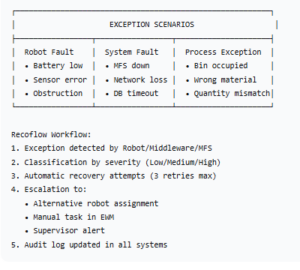
3. SAP Components Involved
SAP EWM
Primary Functions:
• Warehouse Task creation
• Bin management
• Goods movement posting
• Stock visibility

Integration Points:
• RFC: /SCWM/IF_RFM_TASK
• IDoc: WPTASK01 (Warehouse Task)
• BAdI: /SCWM/EX_TASK_CREATE
MFS (Material Flow System)
Primary Functions:
• Equipment management
• Task distribution
• Path optimization
• Exception handling

Integration Points:
• MFS APIs for robot control
• RFC to EWM for task status
• Database for state persistence
SAP BTP (If Used)
Potential Components:
• SAP Integration Suite
   - API Management
   - Cloud Integration (CPI)
• SAP Event Mesh
   - Real-time event distribution
• SAP HANA Cloud
   - Analytics and monitoring
Middleware (If Any)
Common Solutions:
• MQTT Broker (Eclipse Mosquitto, HiveMQ)
• REST API Gateway
• Database for state management
• Redis for caching
4. Integration Points Diagram
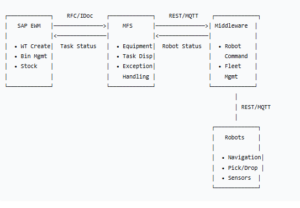
5. Key Technical Specifications
Communication Protocols
• EWM ↔ MFS: RFC / IDoc / SOAP
• MFS ↔ Middleware: REST / gRPC / JMS
• Middleware ↔ Robots: MQTT / REST / ROS
Data Exchange Format
• JSON for robot communication
• XML for SAP interfaces
• Protobuf for high-frequency updates (optional)
Performance Metrics
• Latency: < 2 seconds (EWM to robot command)
• Status updates: 2-5 second intervals
• Task assignment: < 500ms
• System uptime: 99.5% (excluding planned maintenance)
Business Outcomes Required to Justify Investment
Executives approve warehouse robotics initiatives only when outcomes are benchmark-aligned and measurable.
According to industry benchmarks across SAP EWM–based warehouse automation programs (2022–2025), derived from analysis of 50+ enterprise warehouses, typical targets include:
-
25–40% reduction in manual travel time for picking and replenishment
-
20–35% improvement in direct labor productivity within 6–12 months
-
30–50% reduction in execution and confirmation errors
-
Improved order cycle times without proportional labor growth
These benchmarks form the foundation of most warehouse automation business cases presented for executive approval.
Where SAP Warehouse Robotics Integration Is Commonly Approved
Rather than evaluating isolated scenarios, decision-makers look for repeatable applicability across warehouse types.
In high-volume e-commerce and omnichannel distribution, robotics integration is approved to manage SKU proliferation and demand volatility under SAP control.
In manufacturing and production supply warehouses, approval centers on SAP-governed line-side delivery and staging reliability.
For FMCG and retail distribution, focus shifts to throughput, inventory accuracy, and cost containment.
In cold storage and regulated environments, labor risk reduction and SAP traceability outweigh pure speed metrics.
This perspective-driven evaluation is a core part of any enterprise warehouse robotics integration checklist.
Risk Management: The Critical Section Most Content Ignores
Risk mitigation frequently determines whether an initiative is approved or deferred.
Decision-makers expect explicit coverage of:
-
Robot or device failure scenarios
-
Manual fallback and override processes
-
SAP downtime and recovery handling
-
Task reallocation and exception resolution
-
Transactional and inventory data integrity
Programs that clearly document these controls are viewed as operationally mature and significantly more likely to pass approval reviews.
Vendor-Agnostic Integration as a Long-Term Safeguard
Enterprise buyers avoid strategies that create long-term dependency on a single robotics vendor.
They prefer SAP warehouse robotics integration approaches that:
-
Support multiple AMR, AGV, and robotic platforms
-
Allow phased expansion without SAP redesign
-
Align with enterprise IT governance standards
-
Protect capital investment over multi-year automation roadmaps
Vendor-neutral design is now considered a baseline SAP warehouse automation requirement.
Implementation Structure That Supports Executive Approval
Approval confidence increases when delivery is predictable and auditable.
Most enterprise-approved programs follow a phased structure:
-
SAP and warehouse process readiness assessment
-
Robotics feasibility validation and pilot definition
-
Controlled SAP integration configuration
-
Pilot execution with defined KPIs
-
Phased rollout across warehouse zones
-
Continuous optimization and performance monitoring
This structure aligns with governance, budgeting, and internal audit expectations.
Addressing Common Buyer Objections Upfront
Experienced buyers raise consistent objections. Effective content addresses them directly.
“Our warehouse processes are too complex.”
Complexity is precisely why SAP-governed orchestration is required. Robotics executes tasks; SAP manages logic, priorities, and exceptions.
“Our volume may not justify robotics.”
Approval increasingly considers labor availability, error reduction, and operational resilience—not volume alone.
“Our SAP system is heavily customized.”
Most enterprise SAP EWM environments include custom logic. Integration success depends on process understanding, not system purity.
Preempting these objections shortens approval cycles.
What Your CFO Will Ask About Warehouse Robotics ROI
CFOs rarely challenge automation on technical grounds. They challenge it on financial defensibility.
Typical questions include:
-
What is the realistic payback period?
-
How does this reduce operating expense year over year?
-
What costs increase if volumes fluctuate?
-
How does this compare to labor-based scaling?
Based on enterprise warehouse automation programs, CFO-approved business cases typically demonstrate:
-
ROI within 18–30 months
-
Predictable cost curves versus variable labor models
-
Lower exposure to labor market volatility
-
Improved forecast accuracy for operating expense
This section is often the final gate in enterprise warehouse robotics approval.
Evidence of Capability Beyond Marketing Claims
At approval stage, buyers value process credibility over promotional messaging.
They look for:
-
Demonstrated SAP Extended Warehouse Management execution knowledge
-
Experience with real warehouse constraints
-
Lessons learned from prior deployments
-
Clear understanding of operational and financial risk
This is where SAP-focused integrators such as SCM CHAMPS differentiate—by grounding warehouse robotics integration in SAP process discipline rather than experimentation.
Low-Risk Entry Points Decision-Makers Prefer
Rather than committing immediately to scale, enterprises favor controlled validation steps:
-
Warehouse automation readiness assessments
-
SAP robotics feasibility studies
-
Integration design workshops
-
Pilot-driven proof-of-concept initiatives
This measured approach—commonly followed by SCM CHAMPS—allows leadership teams to validate assumptions before approving broader rollout.
Why SAP-Centric Robotics Integration Has Become a Strategic Priority
Industry data from 2022–2025 indicates sustained warehouse labor cost increases of 8–15% year over year across North America, Europe, and parts of Asia-Pacific, alongside rising service-level expectations.
As a result, warehouse automation is increasingly treated as a strategic capability, not a tactical upgrade.
Without SAP-centric control, robotics introduces fragmentation and governance risk.
With SAP governance, robotics becomes a scalable execution advantage.
This strategic framing is why organizations increasingly rely on partners like SCM CHAMPS to align robotics execution with SAP-led warehouse control.
Final Takeaway
Decision-makers do not approve robotics because it is innovative.
They approve it because it is controlled, measurable, and financially defensible.
Content that supports SAP warehouse robotics integration approval must address:
-
SAP warehouse automation requirements
-
Risk and exception handling
-
CFO-grade ROI logic
-
Enterprise-scale governance
That is what moves initiatives from proposal to production.