


Somewhere right now, a procurement director is staring at a shipment status that hasn’t updated in two days. The supplier isn’t answering. Production needs that material by Friday. And nobody in the building can say, with confidence, what happens if it doesn’t arrive.
That moment — the not knowing — is what supply chain risk actually feels like. Not a heat map in a board deck. A Tuesday.
This article looks at how SAP reduces supply chain risk in practice: what the tools actually do, what changes on the ground when they’re implemented well, and — just as honestly — why some companies own the licenses and still fly blind.
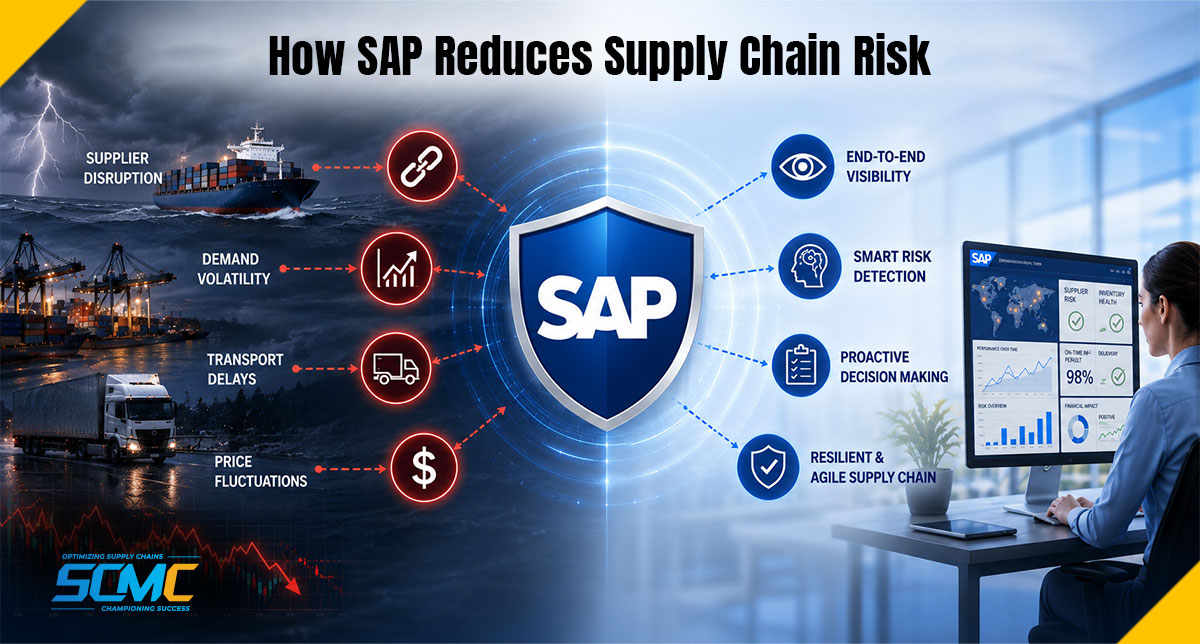
In one line: SAP cuts supply chain risk by letting you see problems weeks earlier and act on them in hours — but only when the system is implemented around your real risk profile.
Why Supply Chain Risk Became a Boardroom Problem
If you run operations in the US, the last few years have been a rolling stress test. Tariff policy shifts faster than sourcing contracts can. Nearshoring sounds great until you price it. Port congestion turned “estimated arrival” into a polite fiction.
In Europe, the pressure wears a regulatory face. Germany’s Supply Chain Due Diligence Act (LkSG) already requires companies to prove they know what’s happening deep in their supplier base, and the EU’s broader due diligence direction points the same way. Add energy cost volatility and geopolitical exposure, and “we didn’t know” stopped being an acceptable answer.
Here’s the shift that matters: risk is no longer an operations problem. It’s a revenue problem, a compliance problem, and a reputation problem. That’s why the C-suite owns it now — and why supply chain risk mitigation with SAP shows up on board agendas, not just IT roadmaps.
The Five Risks Decision-Makers Actually Lose Sleep Over
Strip away the frameworks, and most supply chain risk comes down to five things.
Supplier risk. Your tier-2 supplier misses a shipment, and you find out two weeks later from a production planner — not a system. Or a key vendor quietly slides toward insolvency while your contracts assume business as usual. Most supplier risk management still runs on annual audits and hope.
Demand volatility. The forecast said one thing; the market did another. Now cash is trapped in inventory nobody wants, while the product customers do want is out of stock in the wrong region.
Logistics and disruption risk. A port closes, a carrier fails, a chokepoint chokes. The goods exist — they’re just not where you need them, and every day of delay compounds downstream.
Compliance and regulatory risk. A sanctions list updates overnight. A due diligence law demands supplier transparency you’ve never had to produce. For European operators especially, this one carries legal teeth, not just cost.
Visibility risk. The quiet killer. Decisions made on last week’s spreadsheet, exported from three systems that don’t agree with each other. Real supply chain visibility doesn’t exist — and nobody notices until something breaks.
Notice what these five have in common: the damage is rarely the event itself. It’s how late you found out.
How SAP Supply Chain Risk Management Works in Practice
Map those five risks against SAP supply chain solutions, and the logic gets clear quickly. This is where it stops being abstract.
Supplier Risk: SAP Ariba and the SAP Business Network
SAP Ariba monitors supplier financial health, quality history, and compliance signals, and turns them into risk scores you can act on. The outcome in plain terms: you learn a supplier is wobbling before they miss a shipment, not after.
The SAP Business Network adds a second layer. Your suppliers confirm orders, flag delays, and collaborate in one shared workspace instead of buried email threads. And when a vendor does fail, you’re not starting a sourcing search from zero — qualified alternatives are already visible in the network.
Demand Volatility: SAP IBP
SAP Integrated Business Planning does two things that matter here.
Demand sensing. It picks up real demand shifts weeks earlier than a monthly forecasting cycle, so you’re rebalancing inventory before the shortage — not apologizing for it after.
Scenario planning. You can model “what if demand jumps 20% in Q3” or “what if this plant goes down” and see the inventory, capacity, and cost consequences before committing. Planning cycles that took weeks compress into days, and demand forecasting with SAP stops being an educated guess.
Disruption Risk: SAP Business Network and Transportation Management
For goods in motion, SAP Transportation Management combined with the Business Network gives you live shipment visibility and early warnings on delays.
The practical difference: when a port backs up, you know which orders are affected the same day — and rerouting becomes a decision made in hours, not a post-mortem written in weeks. Exceptions surface automatically, so your team works the ten shipments actually in trouble instead of babysitting the thousand that aren’t.
Compliance Risk: SAP Global Trade Services
SAP Global Trade Services automates the checks humans can’t do at scale — sanctions screening on every partner, trade compliance validation on every cross-border transaction, and an audit trail that exists by default.
For European companies facing due diligence obligations, that last part is the quiet win. When a regulator asks how you monitor your supplier base, the answer is a report, not a scramble. Compliance shifts from a periodic panic to a background process.
Visibility Risk: SAP S/4HANA as the Single Source of Truth
Underneath everything sits SAP S/4HANA — one live data core across procurement, production, inventory, and finance. The outcome sounds simple and changes everything: leadership looks at the same numbers, in real time, instead of debating whose spreadsheet is right.
This is also the honest answer to “why SAP over alternatives?” Most point tools solve one risk each, stitched together with integrations that break. Supply chain visibility with SAP comes from the risks living on one connected data core — so when the data is trusted, every response above gets faster.
The shift, in one glance:
Before SAP: Reactive — you learn about problems late. Siloed spreadsheets, conflicting numbers. Decisions in weeks.
After SAP: Predictive — you see them coming. One live source of truth. Decisions in hours.
What This Looks Like in Real Operations
Theory is cheap. Here’s what it looks like when the risk event actually happens — two composite scenarios drawn from patterns that repeat across industries.
A US industrial manufacturer, heavily sourced from a single region, gets hit with a tariff change threatening landed costs across its top product lines. Before, answering “what does this cost us?” meant three weeks of spreadsheet archaeology. With scenario planning in SAP IBP, the team modeled three alternative sourcing mixes in days, priced each against capacity and lead times, and shifted volume before the tariff took effect.
A European pharmaceutical company faces new supplier due diligence requirements. Historically, proving supplier transparency meant a three-month audit scramble — questionnaires, chasing responses, assembling binders. With supplier risk data already flowing through SAP Ariba, exposure across several hundred suppliers was visible in one view, and the regulatory submission became a reporting exercise. Better still, the risk picture stayed current year-round.
One honest caveat: neither outcome was automatic. In both cases, the difference-maker was implementation — the system was configured around the company’s actual risk profile rather than a generic template. That’s the kind of work specialist partners like SCM CHAMPS do, and it’s why two companies with identical licenses can get wildly different results.
The Honest Part: SAP Alone Doesn’t Reduce Risk. Implementation Does.
Here’s what a sales deck won’t tell you: plenty of companies own SAP licenses and still run their supply chain on spreadsheets. The system went live years ago as an IT project, the configuration never matched how the business actually buys, makes, and ships — and a tool configured wrong doesn’t fail quietly. It gives you confident-looking wrong answers.
Real risk reduction starts with your risk map, not the software. Where is supplier concentration dangerous? Which lanes have no alternatives? What regulatory footprint do you actually carry? Then the system gets built around those answers.
This is where SCM CHAMPS earns its place in this article — a specialized SAP implementation partner for businesses across the USA and Europe, with deep supply chain consulting expertise. They live deep in the supply chain stack (IBP, Ariba, S/4HANA, Business Network, TM, EWM) rather than operating as a generalist IT shop. Their approach is risk-first: map the client’s actual exposure, then configure the system to match it, with compliance designed in from day one for both US and European regulatory environments. And they stay past go-live — because supply chains change, and a system that stops matching the business becomes a risk of its own.
A Quick Self-Check
Before any conversation about tools, try answering these honestly:
- Can you see tier-2 supplier risk today, or only tier-1?
- How fast could you model a tariff change across your sourcing mix — days or weeks?
- If a port closed tomorrow, would you know which orders are affected by lunchtime?
- Could you produce a supplier due diligence report this month without launching a special project?
- Do your executives look at the same supply chain numbers — or their own versions?
If you answered “no” or “not sure” more than twice, your risk isn’t hypothetical. It’s just invisible.
The Bottom Line on SAP Supply Chain Risk Management
Supply chain risk isn’t going away. The tariffs, the regulations, the disruptions — that’s the operating environment now. The companies handling it best aren’t luckier. They see problems earlier and act faster, and that’s precisely how SAP reduces supply chain risk when it’s implemented around the way your business actually runs.
If you’re not sure where your current setup leaves you exposed, book a supply chain risk assessment with SCM CHAMPS. In one working session, with your real data, you’ll identify exactly where your supply chain is exposed today — and what to fix first. It’s the fastest way to find out what you currently can’t see.