



Introduction
Supply chains rely on transportation systems to function as their fundamental structure. The delivery of raw materials and semi-finished goods and finished products to their destinations depends on effective geographical transportation systems for timely delivery. The management of transportation operations has always presented significant challenges. The combination of unstable fuel prices and delayed port operations and insufficient workforce creates major disruptions to all industrial operations. The normal expectation of next-day delivery from customers has elevated the pressure on supply chain operations to unprecedented levels.
Companies used Transportation Management Systems (TMS) and conventional optimisation models for decades to maintain their operations. The tools operated with delayed responses to events and failed to manage immediate disruptions effectively. Logistics operations in the future need more than basic reporting systems. The future of logistics demands predictive intelligence which adapts to situations and learns from experience.
Artificial Intelligence (AI) and SAP Transportation Management (SAP TM) enter the scene to address these challenges. The combination of AI technology with SAP Transportation Management (SAP TM) enables transportation management to analyse vast data sets while predicting upcoming problems and creating innovative solutions for cost reduction and risk mitigation. This isn’t hype anymore it’s happening in real operations, and the companies that embrace AI early are seeing measurable competitive advantages.
Generative AI in Transportation Management
Generative AI goes beyond traditional analytics. Instead of simply showing trends, it creates options, models scenarios, and suggests new strategies. Think of it as a partner that not only spots the problem but also drafts the solution.
Here’s how it works in practice:
(A) Dynamic routing in real time: AI systems analyse traffic conditions and weather along with shipment urgency to create optimal delivery routes in real-time rather than using predetermined routes. The system performs automatic route recalculation when major highways become blocked by accidents to reduce delivery time.
(B) Carrier and mode selection: Generative AI can evaluate carriers’ past performance, real-time availability, and cost trends. It can suggest whether to send a shipment by road, air, or sea, balancing speed, cost, and sustainability.
(C) Simulation of disruptions: Companies can run “what if” scenarios what if fuel prices rise by 20%? What if a strike shuts down a port? AI creates various transportation plans which enable managers to develop proactive strategies instead of experiencing panic.
(D) End-to-end visibility: AI achieves end-to-end visibility through the integration of data from IoT sensors and ERP systems and partner networks which creates an actionable supply chain overview for managers.
Generative AI’s strength is its ability to learn. Every shipment, every disruption, every outcome adds to its intelligence, making recommendations sharper over time.
AI Copilot for Logistics Teams
Managing transportation isn’t just technical it’s human. Teams handle multiple responsibilities which include carrier management and customer complaints and customs documentation and financial planning on a daily basis. AI copilots function as digital assistants which provide support to planners and managers through their work.
A logistics manager would ask the AI copilot to identify which shipment faces the highest risk of delay during the current day. The AI system retrieves information from GPS tracking systems and port congestion reports and carrier schedule data to answer: “Your shipment from Rotterdam to Mumbai faces an 18-hour delay because of port congestion. Re booking via Jebel Ali with carrier X reduces the delay to 6 hours.”
Instead of scrolling through dashboards or making a dozen phone calls, managers get answers in seconds.
Copilots also proactively nudge teams:
(1) Alerting when trucks are overbooked.
(2)Suggesting alternate carriers when contracted ones under perform.
(3)The identification of compliance risks at an early stage prevents them from developing into costly penalties.
The transition enables logistics personnel to move away from emergency response duties so they can concentrate on strategic planning and customer service and business negotiations. AI copilots transform human workers from operational roles into strategic decision makers.
Data Contextualization for Intelligent Decisions
The logistics world suffers from information overload. Trucks send telemetry, warehouses track inventories by the minute, and carriers share ETA updates. The problem isn’t lack of data it’s making sense of it.
AI contextualizes this flood of information into business meaning:
(A) Operational view: A delayed truck isn’t just late; it threatens a downstream production line that needs those components by tomorrow.
(B) Financial view: Rising spot market freight rates aren’t just numbers; they indicate tightening supply and a need to renegotiate contracts.
(C) Customer view: A failed delivery isn’t just a missed ETA; it’s a risk to customer loyalty in a competitive market.
By layering context, AI turns raw feeds into actionable intelligence. Leaders can make decisions not just faster, but smarter balancing cost, service, and sustainability in one shot.
Joule and Other Generative AI Platforms in Action
SAP’s Joule is a prime example of how generative AI copilots are being built for enterprise use. In SAP Transportation Management, Joule connects directly with systems to provide conversational insights. A planner doesn’t need to dig through transaction codes they simply ask Joule: “Which routes had the most penalties last quarter?” Joule delivers the answer, often with suggestions to improve.
Other players are making waves too:
(A) Microsoft Copilot connects with supply chain planning suites, generating reports and optimizing schedules.
(B) Google Vertex AI powers predictive models that help companies anticipate demand spikes or logistics bottlenecks.
(C) Custom AI copilots from solution providers like SCM Champs blend the best of these platforms with domain expertise. The systems operate as specialised versions of chat bots because they receive training for handling transportation-specific requirements which include fuel surcharges and cold chain tracking and regulatory needs.
The system delivers instant results because tasks which needed days to complete now finish within minutes. The system enables managers to dedicate their time to decision-making rather than data collection.
Business Benefits of AI in Transportation Management
Let’s spell out the real-world gains companies are seeing:
1. Cost savings
AI optimization systems help companies achieve 10–15% savings in their transportation expenses. The combination of load consolidation with reduced empty miles and intelligent carrier selection enables businesses to save millions of dollars each year.
2. Resilience
AI enables businesses to redirect shipments and arrange substitute transportation methods when global disruptions such as Suez Canal blockages or pandemic-related port shutdowns occur.
3. Speed and reliability
Optimized delivery routes together with predictive maintenance for fleets enables faster delivery services and reduced vehicle failures which produces better customer satisfaction.
4. Sustainability
Transportation is a major emissions contributor. AI minimizes fuel consumption and suggests greener modes, helping companies hit ESG goals.
5. Customer trust
When deliveries are consistent and transparent, customers stay loyal. Real-time tracking and accurate ETAs build confidence.
For organizations using SAP TM or integrating SAP EWM with transportation functions, these benefits aren’t incremental they’re trans formative.
How SCM Champs Implements AI-Driven Transportation Solutions
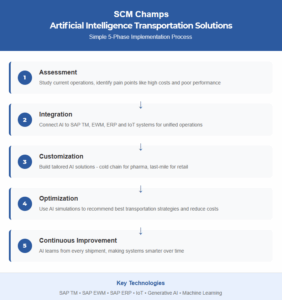
SCM Champs has made AI central to its transportation projects. Their method combines structure with adaptability to integrate AI into business operations naturally.
(A) Assessment phase: The Assessment phase involves consultants studying current transportation operations together with their expenses and performance data. Pain points like high demurrage fees or inconsistent carrier performance are identified.
(B) Integration phase: AI capabilities are embedded into SAP TM and connected to other systems such as SAP EWM, ERP, and IoT platforms. This creates a seamless digital backbone.
(C) Customization phase: SCM Champs develops copilots, dashboards, and predictive models tailored to client needs. For example, a pharma company may need AI models tuned for cold chain monitoring, while a retailer may need AI for last-mile optimisation.
(D) Optimization phase: Generative AI operates through simulation-based strategy recommendation to help users find optimal lane mode changes that minimise expenses.
(E) Continuous improvement: AI models are never static. SCM Champs ensures they learn from every shipment, making systems smarter with each cycle.
This end-to-end methodology ensures that clients don’t just adopt AI they get measurable results.
Costing & ROI for AI-Powered Transportation
Let’s talk numbers, because ROI often decides whether projects get greenlit.
(A) Investment range: Integrating AI into SAP TM typically involves software licenses, data model training, and change management. Costs vary by scale but often range in the low-to-mid six figures for large enterprises.
(B) Payback period: Most companies recover their investment within 12–18 months. For high-volume shippers, savings can come even sooner.
(C) Savings breakdown: 1. 5–7% from better carrier selection.
2. 3–5% from reduced empty miles.
3. 2–4% from fewer penalties and fines.
4. The company will achieve additional benefits through better customer retention and reduced environmental impact.
Executives now place more importance on business resilience than on direct return on investment. Avoiding one major disruption like a shipment of high-value goods spoiled in transit can offset months of investment.
What Makes SCM Champs Different
In a crowded field, why choose SCM Champs as your SAP consulting partner?
(A) Proven SAP mastery: As a trusted SAP partner, SCM Champs knows the ins and outs of SAP TM, SAP EWM, and S/4HANA better than most.
(B)Industry focus: They don’t push cookie-cutter solutions. Whether it’s automotive, pharmaceuticals, or retail, the AI models are tuned to industry realities.
(C) Human + AI mindset: SCM Champs emphasises empowering teams, not replacing them. Their copilots are designed to amplify human decision-making.
(D)End-to-end expertise: The team handles system integration and change management to achieve seamless and enduring technology adoption.
(E)Track record: The multiple worldwide deployments of SCM Champs have proven that AI-based transportation systems exist in the present world rather than being theoretical concepts.
This mix of technical depth, practical implementation, and client-centric customization makes SCM Champs a standout in AI-driven logistics consulting.
Conclusion
The modern transportation industry has evolved beyond basic movement of goods because it now focuses on intelligent transportation systems. AI enables businesses to break free from crisis response mode so they can construct networks that predict and operate with maximum efficiency.
The logistics industry experiences transformation through Generative AI and copilot systems and platforms including Joule which change how teams operate in logistics. The teams now use data insights to make strategic decisions instead of being overwhelmed by information. The benefits of this approach include reduced expenses and accelerated delivery times and enhanced customer service.
The real challenge for businesses is timing. The earlier companies embed AI into transportation with the right SAP consulting partner, the faster they’ll reap competitive advantages. SCM Champs is already guiding enterprises through this transition, ensuring AI is not just an add-on but a cornerstone of modern supply chain strategy.
The road ahead is AI-powered. The only question is: will you lead that journey or follow it later?
Frequently Asked Questions
It improves logistics operations by:
• Route Optimization: AI analyzes traffic, weather, and delivery schedules to select the fastest and most cost-effective routes.
• Real-Time Tracking: Provides live updates on shipments, improving visibility and customer satisfaction.
• Demand Forecasting: Predicts shipping needs and inventory levels, reducing delays and overstocking.
• Cost Reduction: Minimizes fuel usage, empty miles, and manual errors, leading to lower transportation costs.
• Automation: Streamlines tasks like scheduling, load planning, and documentation, saving time and resources.
• Risk Management: Identifies potential disruptions (like delays or equipment breakdowns) and suggests preventive actions.
In short, AI makes transportation smarter by increasing efficiency, reducing costs, and ensuring timely, reliable deliveries.
It improves decision-making by:
• Analyzing live traffic and weather to suggest faster, safer routes.
• Comparing multiple carriers based on cost, reliability, and availability.
• Balancing loads and capacity to minimize empty miles and delays.
• Adapting instantly when conditions change, like road closures or fuel price spikes.
• Reducing costs and emissions while ensuring on-time deliveries.
In short, generative AI helps logistics teams choose the right carrier and best route instantly, improving speed, reliability, and efficiency.
• Cost Savings: AI reduces fuel consumption, minimizes empty miles, and automates manual tasks, cutting overall transportation expenses.
• Faster Deliveries: Smart route planning and real-time adjustments shorten transit times and improve delivery accuracy.
• Sustainability: AI helps reduce emissions by optimizing vehicle loads, choosing eco-friendly routes, and lowering fuel waste.
• Higher Efficiency: Automated scheduling and predictive insights streamline operations and improve fleet utilization.
• Better Reliability: Continuous monitoring ensures on-time performance while minimizing delays and disruptions.
In short, AI makes transportation management cheaper, faster, and greener, while boosting overall efficiency.
Key ways AI works with SAP TM include:
• Predictive Planning: AI forecasts demand, shipment volumes, and potential delays to improve transport planning.
• Smart Route Optimization: Combines SAP TM data with AI to select faster, lower-cost, and more sustainable routes.
• Carrier Selection: AI evaluates carriers based on cost, capacity, and reliability, helping choose the best option in real time.
• Freight Cost Optimization: Uses machine learning to analyze fuel prices, lane history, and contracts to suggest cost savings.
• Real-Time Visibility: AI processes live IoT and GPS data within SAP TM for proactive alerts and disruption management.
• Automation: Streamlines tasks like load building, scheduling, and invoice matching, reducing manual effort.
In short, AI makes SAP TM more intelligent by turning transportation data into actionable insights that drive efficiency, speed, and cost savings.
It helps by:
• Automating routine tasks like route planning, load building, and scheduling.
• Providing real-time insights on traffic, carrier performance, and shipment status.
• Recommending best options for carriers, routes, and capacity utilization.
• Forecasting demand and disruptions so managers can act proactively.
• Improving decision speed with instant data-driven suggestions.
• Enhancing collaboration by sharing clear, AI-backed recommendations across teams.
In short, an AI copilot reduces manual workload, improves accuracy, and enables logistics managers to focus on strategy instead of repetitive tasks.
Key ROI drivers include:
• Cost Reduction: AI lowers fuel use, labor hours, and empty miles, cutting transport spend by up to 15–20%.
• Efficiency Gains: Automated scheduling and predictive planning save time and increase fleet utilization.
• Faster Deliveries: Smart routing and real-time adjustments improve delivery speed and reliability.
• Customer Satisfaction: Better on-time performance and visibility lead to stronger customer trust and retention.
• Sustainability Impact: Optimized loads and routes reduce emissions, helping meet ESG goals while saving money.
In short, AI-powered TMS delivers a strong ROI by reducing costs, speeding up logistics, and improving both customer experience and sustainability.