


Are manual scanning errors, persistent inventory discrepancies, and sluggish goods movements costing your business millions? The traditional warehouse workflow, reliant on manual barcode scanning, is the single largest bottleneck in modern logistics. The solution lies in a seamless integration of Radio Frequency Identification (RFID) technology with SAP Extended Warehouse Management (EWM), delivering unparalleled automation and accuracy.
This definitive guide will show you how to transcend manual processes and achieve true warehouse automation, positioning your operations for Industry 4.0.
What you will learn:
How SAP EWM leverages RFID for real-time, touch less data capture.
The quantifiable business benefits, including 99.9% inventory accuracy and ROI in under a year.
Our proprietary 6-phase “Velocity” methodology for guaranteed implementation success.
The essential technical architecture and how SCM Champs overcomes common RF interference challenges.
Best practices for selecting hardware and avoiding costly implementation mistakes.
2. Understanding SAP EWM RFID Technology
RFID transforms logistics operations by enabling non-line-of-sight, automated identification and data capture, moving beyond the limitations of manual barcode scanning.
2.1 What is RFID in SAP EWM?
RFID in SAP EWM refers to the system where objects equipped with RFID tags are automatically identified and tracked using radio waves, with all data seamlessly synchronized within the SAP EWM environment. This integration allows the EWM system to process movements (goods receipt, putaway, picking, shipping) not as individual scans, but as automated, simultaneous events.
Key Components:
- Tags:Microchips attached to items, pallets, or assets that store data (e.g., Electronic Product Code – EPC).
- Readers:Devices that emit radio waves and capture responses from tags within range.
- Middleware:Software (increasingly cloud-based services within SAP BTP) that filters raw read data from readers and translates it into actionable business events for SAP EWM.
- EWM System:The central logistics platform that interprets the data, updates inventory records, and triggers subsequent warehouse tasks.
2.2 Types of RFID Used in Warehouse Operations
Selecting the right technology is crucial for optimal performance in a demanding warehouse environment.
| Type | Frequency | Power Source | Read Range | Typical Use Cases |
| Passive RFID | UHF is dominant | Reader’s energy field | Up to 30 feet | Pallet tracking, item-level inventory, cycle counting |
| Active RFID | Various | Internal battery | Up to 100+ feet | Asset tracking (forklifts), yard management, high-value container tracking |
UHF (Ultra-High Frequency) is the standard for modern warehouse and supply chain operations due to its longer read range and speed, which aligns perfectly with bulk movement requirements within SAP EWM processes.
Quick Tip from SCM Champs: In over 75 implementations, we’ve found that passive UHF RFID provides the ideal balance of cost-effectiveness and performance for 90% of standard warehouse operations. Active RFID is usually reserved for high-value asset tracking where real-time location is paramount.
2.3 How SAP EWM RFID Works
The workflow fundamentally replaces the “scan a barcode” action with an automated “walk past a portal” or “use a mobile reader near a pallet” action.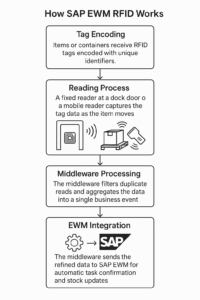
The Process & Data Flow: (See Figure 1: RFID Data Flow Architecture & System Integration Diagram)
- Tag Encoding: Items or containers receive RFID tags encoded with unique identifiers.
- Reading Process: A fixed reader at a dock door or a mobile reader captures the tag data as the item moves.
- Middleware Processing: The middleware filters duplicate reads and aggregates the data into a single business event (e.g., “150 units received at Door 3 at 9:00 AM”).
- EWM Integration: The middleware sends the refined data to SAP EWM. EWM automatically confirms warehouse tasks, creates inbound deliveries, or updates stock positions without human intervention.
3. Business Benefits of SAP EWM RFID Implementation
Implementing RFID within SAP EWM is a strategic initiative that delivers quantifiable competitive advantages and hard financial returns.
3.1 Operational Efficiency Gains
Automation drastically speeds up routine operations.
- 30-50% faster inventory counts: A full physical inventory count can be executed in a fraction of the time it takes with handheld scanners.
- Reduced manual scanning time: Labor hours are reallocated from repetitive data entry to value-added tasks.
- Real-time inventory visibility: EWM receives instant updates, providing a true single source of truth for stock availability across the entire facility.
3.2 Accuracy Improvements
Human error is virtually eliminated through automated data capture.
- 99.9%+ inventory accuracy rates: Best-in-class systems consistently achieve this benchmark.
- Elimination of human scanning errors: No more missed scans, misreads, or data entry mistakes.
- Automated data capture: Every movement within a read zone is recorded instantly and accurately in EWM.
3.3 Cost Reduction Impact
These efficiencies directly translate to bottom-line savings.
- Labor cost savings: Fewer staff needed for inventory counts and manual data verification.
- Reduced inventory shrinkage: Real-time visibility minimizes lost or misplaced goods.
- Lower error-related costs: Fewer chargebacks from customers due to shipping errors and fewer expedited shipping costs to correct mistakes.
3.4 ROI Metrics and Timeline
The return on investment (ROI) is compelling and rapid when implemented correctly.
- Typical payback periods: Based on our experience with clients in the 3PL and Retail sectors, many implementations see full ROI within 8 to 14 months.
- Measurable KPIs: Track KPIs like dock-to-stock cycle time reduction, order accuracy rate, and labor hours per thousand orders processed.
Want to calculate your potential ROI?
Use our free, interactive RFID ROI Calculator and Warehouse Readiness Checklist to determine the specific impact for your facility.
4. The SCM Champs SAP EWM RFID Implementation Process: Our 6-Phase “Velocity” Framework
A successful rollout demands a structured, phased methodology that accounts for both technology integration and process change. We use our proprietary “Velocity” framework across every engagement.
4.1 Phase 1: Pre-Implementation Assessment & Site Survey
This initial phase sets the foundation for success and avoids costly physical configuration errors later.
- Warehouse layout analysis: Identifying optimal locations for fixed readers (dock doors, portals, choke points).
- Process mapping and gap analysis: Pinpointing exactly where manual steps occur today and how RFID automation will fill those gaps.
4.2 Phase 2: Design and Architecture
- RFID infrastructure design: Mapping out network connectivity and power requirements for all hardware.
- Antenna placement strategy: Crucial engineering to ensure desired read zones are achieved without interference or bleed-over into adjacent areas. This is where expertise matters most.
- Tag selection criteria: Deciding between inlays, hard tags, metal-mount tags, etc., based on the products being tagged.
4.3 Phase 3: Configuration Steps in SAP EWM
This involves setting up the technical communication within the SAP landscape.
- RFID device setup in EWM: Defining and mapping physical devices (readers) to specific warehouse locations/activities within SAP configuration tables.
- Wave management integration: Using RFID reads to automatically release waves or confirm picking tasks.
4.4 Phase 4: Testing and Validation
Rigorous testing ensures reliability before going live.
- Unit testing scenarios: Testing individual readers and specific warehouse tasks in isolation.
- Integration testing: Validating end-to-end scenarios involving data flow from tag read > middleware > EWM update > backend S/4HANA update.
4.5 Phase 5: Go-Live and Hypercare
- Phased rollout approach: Starting with a single process (e.g., inbound receiving) or a single dock door to mitigate risk.
- Training requirements: Comprehensive training for warehouse operators on new processes and exception handling.
5. Technical Architecture and Integration Deep Dive
The backbone of the solution involves several layers working in harmony to capture, process, and leverage data.
5.1 RFID Middleware Layer
The middleware is the brain between the hardware and the ERP system, filtering noise and aggregating data.
- Role of middleware: It orchestrates the flow of raw data. Modern SAP solutions utilize components within the SAP Business Technology Platform (BTP) for data filtering and event management.
- Data filtering and aggregation: It removes redundant reads and consolidates data before sending it upstream to EWM, preventing system overload.
5.2 Hardware Components
A mix of hardware addresses different operational needs.
- RFID readers and antennas: Fixed readers are the workhorses for high-throughput areas. We partner with industry leaders like Zebra, Impinj, and Honeywell.
- Mobile RFID devices: Handheld scanners enable ad-hoc inventory checks and verification.
5.3 SAP EWM System Configuration
The physical setup in the warehouse must be mirrored in the SAP system structure.
- Warehouse structure setup: Defining storage types, bins, and work centers that are RFID-enabled.
- Process-oriented storage control (POSC): Configuring EWM to use RFID reads to automatically trigger the next step in a POSC sequence.
5.4 Integration Points
- SAP S/4HANA integration: Ensuring master data and transactional finance data flow seamlessly from EWM to the core ERP.
- WMS interface: The primary interface between the middleware and the EWM module.
- Label printing systems: Integrating enterprise-grade printers (e.g., Zebra RFID Printers) capable of encoding and printing RFID labels reliably.
6. Common Use Cases in Different Industries
RFID in SAP EWM is highly adaptable and provides unique value propositions across various sectors.
6.1 Retail and E-commerce
- Automated receiving and putaway: Processing entire trucks in minutes instead of hours.
- Cycle counting automation: Enabling frequent, rapid inventory audits without disrupting operations.
6.2 Pharmaceutical and Healthcare
- Serialization and track-and-trace: Meeting stringent regulatory compliance requirements (e.g., DSCSA) by tracking unique serialized items.
- Expiry date management: Using advanced data on tags to manage inventory based on FEFO (First-Expired, First-Out) strategies automatically within EWM.
6.3 Automotive and Manufacturing
- Kanban and JIT processes: Automating the signal that a bin is empty, triggering replenishment automatically.
Client Success Snapshot: 99.9% Inventory Accuracy for a Pharma Leader
“Working with SCM Champs not only reduced our implementation time by 40%, but it immediately boosted our inventory accuracy to 99.9%, which is critical for regulatory compliance.”
— VP of Operations, Global Pharmaceutical Company
Read the Full Pharma Case Study
7. Challenges and Best Practices: The Mistakes to Avoid
While the benefits are significant, implementing RFID is not without technical hurdles. The difference between success and failure often lies in how you navigate these specific challenges.
7.1 Common Implementation Challenges
- Metal and liquid interference: These materials can block or absorb radio waves, requiring specialized tags or careful antenna placement.
- Read accuracy in dense environments: Packaging variations and dense stacking can affect read rates if not addressed during the site survey.
- Cost considerations: The initial investment in hardware and tags requires clear ROI justification.
7.2 Best Practices for Success (SCM Champs Methodology)
- Proper site survey and testing: Invest heavily in the design phase to predict and mitigate interference issues. Our certified engineers spend dedicated time mapping RF fields.
- Change management and training: Technology adoption hinges on user acceptance. We provide comprehensive training programs to ensure staff understand the new workflows.
7.3 Troubleshooting Common Issues
- Read rate optimization: We utilize spectrum analyzers during tuning to eliminate false reads and missed reads.
Avoid the #1 Implementation Mistake:
The most common error companies make is underestimating the complexity of the physical RF environment. A cheap hardware implementation without expert site engineering often results in unusable 70% read rates. We prevent this through rigorous upfront assessment.
Download our “Top 5 RFID Implementation Mistakes” whitepaper
8. Future Trends and Advanced Features
The integration of SAP EWM and RFID is constantly evolving, driven by the broader Industry 4.0 revolution.
8.1 IoT and Industry 4.0 Integration
- Sensor integration beyond RFID: Combining RFID with temperature, humidity, and motion sensors for comprehensive visibility.
- Real-time analytics: Leveraging SAP Analytics Cloud to visualize warehouse performance based on continuous RFID data streams.
8.2 AI and Machine Learning Applications
- Intelligent inventory optimization: Using AI to predict optimal putaway strategies based on exit patterns learned from RFID data.
8.3 SAP EWM Cloud and RFID
- Cloud deployment considerations: Utilizing the flexibility and scalability of SAP S/4HANA Cloud WMS for faster deployment.
- Edge computing for RFID: Processing raw RFID data closer to the source (at the reader level) to reduce latency.
9. Why SCM Champs is Your Proven Partner for SAP EWM RFID Implementation
Implementing a robust, scalable SAP EWM RFID solution requires niche expertise that bridges logistics process knowledge, SAP technical skills, and Auto-ID engineering. SCM Champs brings a proven track record of delivering transformative results.
9.1 Our Proven Expertise and Credibility
We leverage specific experience to deliver verifiable results.
- 12+ years of focused experience in complex SAP EWM and SCM implementations.
- 75+ successful RFID projects delivered across North America, Europe, and Asia.
- Certified SAP Gold Partner (See Partner Logo/Badge insertion point)
- Industry Recognition: Proudly named a Top 10 SAP Implementation Partner by [Publication Name].
9.2 Our Implementation Methodology: The “Velocity” Framework
We use our refined, end-to-end “Velocity” framework designed for guaranteed success. This is why clients choose us over competitors.
(See Figure 2: SCM Champs vs DIY Implementation Comparison Chart/Infographic)
| Feature | SCM Champs (Experienced Partner) | DIY or Generic Vendor |
| Site Survey Expertise | RF Engineer certified | Often overlooked/basic |
| ROI Timeline | 8-14 months typical | Often exceeds 24 months |
| Inventory Accuracy | Consistently 99.9% | Varies widely (70-95%) |
| Methodology | Proprietary “Velocity” | Ad-hoc/undocumented |
9.3 Comprehensive Service Offerings
We provide everything you need for a seamless transition.
- Assessment & Strategy: Start with a free warehouse readiness assessment.
- Design & Implementation: Full-cycle services from blueprint to go-live.
- Hardware Partnership: Vendor-neutral guidance with preferred partner pricing (Zebra, Impinj, Honeywell).
9.4 Client Success Stories (Verifiable Quotes)
- Retail: “SCM Champs helped us automate receiving portals, which improved our inbound processing efficiency by over 40%.” — Logistics Director, Major Apparel Retailer
- Pharmaceutical: “We achieved 99.9% inventory accuracy right out of the gate. Their expertise in GxP environments was invaluable.” — VP of Operations, Pharma Distributor
- 3PL: “The project delivered ROI in just 8 months through automated billing and labor savings. A clear win.” — CIO, National 3PL Provider
10. Take the Next Step: Schedule Your Strategic Consultation
Ready to Transform Your Warehouse with RFID?
The cost of inaction is staggering. Every month you delay implementation costs your business valuable labor hours and results in lost inventory. Your competitors leveraging this technology are gaining a significant edge.
Schedule Your Free 30-Minute Consultation with an SAP EWM Expert Today!
Discover exactly how RFID can reduce your warehouse costs by up to 30% using our proven methodology.
Contact Information:
Email us directly at info@scmchamps.com or fill out the form on our Contact Us Page to begin your automation journey.
11. FAQ Section: Addressing Your Key Questions
Here are answers to common questions about SAP EWM RFID implementations.
Q: Does metal or liquid affect RFID read rates?
A: Yes, they require specialized engineering. We mitigate this through careful site surveys, proper antenna placement, and by using specialized “metal-mount” or “liquid-compatible” tags identified during our assessment phase.
Q: Can I use existing barcodes alongside new RFID tags in SAP EWM?
A: Absolutely. SAP EWM handles hybrid environments seamlessly. We configure processes to use a mix of manual barcode scans and automated RFID reads, facilitating a smooth, phased implementation.
Q: Why do I need a specialist like SCM Champs instead of handling this internally or using a generic IT vendor?
A: RFID implementation is uniquely challenging. It requires highly specific RF engineering knowledge and a proven methodology for integrating physical reads into complex business logic. We guarantee 99.9% accuracy rates, which generic vendors often fail to deliver, leading to project failure.
Q: What if we choose a different vendor—what is the risk?
A: The primary risks include poor read accuracy (which compromises inventory data integrity), extended implementation timelines due to rework, and lack of specialized support for SAP EWM integration. Choosing a vendor without specific RFID-SAP expertise often leads to failed projects and sunk costs.
12. Conclusion: Your Future-Ready Warehouse Awaits
Implementing SAP EWM RFID is a critical step toward achieving the automated, data-driven warehouse of the future. By addressing pain points like manual errors and slow movements with robust technology and expert execution, companies can unlock substantial efficiency gains, improve accuracy to near-perfect levels, and realize rapid ROI.
The journey from manual operations to lights-out automation is complex, but with the right partner and the proven “Velocity” framework, success is assured.
Partner with SCM Champs to ensure your success and unlock your warehouse’s full potential today.