



The Modern Warehouse New Voice
1.1. The Rising Tide of E-Commerce and Logistics Demands
The logistics landscape has changed dramatically in recent years. The rise of e-commerce, omnichannel retailing, and same-day delivery expectations has put immense pressure on warehouses. Customers demand faster order fulfillment, near-perfect accuracy, and full transparency at every stage of the supply chain. For businesses, this means that even small inefficiencies like mis-picks, delays, or human errors translate into higher costs, more returns, and dissatisfied customers.
1.2. Beyond Paper and Scanners: The Need for a Hands-Free, Eyes-Free Solution
Traditionally, warehouses relied on paper-based picking lists or handheld RF scanners. While these methods improved accuracy compared to manual processes, they also introduced new challenges. Workers constantly shift between holding scanners, checking screens, and handling goods. This creates distractions, adds physical strain, and slows down order picking. As warehouses scale, these inefficiencies accumulate into major bottlenecks.
This is where voice technology steps in. A hands-free, eyes-free solution allows associates to focus fully on their tasks while the system guides them with real-time verbal instructions. The result: safer, faster, and more accurate order fulfillment.
1.3. What is Pick-by-Voice? A Quick Definition
Pick-by-Voice, or voice picking, is a warehouse automation technology that uses speech recognition and voice synthesis to guide workers through order picking tasks. Associates wear a lightweight headset connected to a wearable or mobile computer. Instead of reading instructions on a screen, they receive spoken instructions. Workers respond verbally confirming locations, quantities, or exceptions. The system processes these commands instantly, ensuring seamless integration with the warehouse management system (WMS), such as SAP Extended Warehouse Management (EWM).
In short: voice replaces paper and screens, creating a faster and more ergonomic workflow.
How Does Pick-by-Voice Work? A Step-by-Step Breakdown
2.1. The Core Components of the System
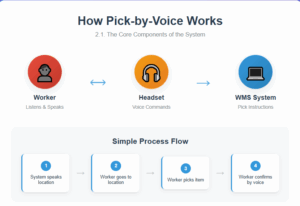
To understand voice picking, it’s useful to look at the building blocks:
The Wearable Device: A headset with a microphone, paired with a small wearable computer or smartphone, worn on the belt or pocket.
The Software Platform: The application that integrates with the WMS/ERP, distributes tasks, and records confirmations in real-time.
The Voice Recognition Engine: Advanced algorithms that accurately interpret spoken responses across different accents, dialects, and noise levels in the warehouse.
2.2. The Picker’s Journey: A Typical Workflow
Here’s what a day in the life of a picker using Pick-by-Voice looks like:
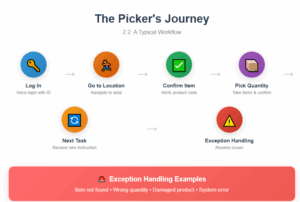
Logging In & Receiving Tasks
The associate logs into the system, puts on the headset, and immediately receives the first picking instruction.
Navigation & Location Verification
The system verbally directs the worker to a location e.g., “Aisle 12, Bin 4.” To confirm arrival, the worker speaks a unique check-digit printed on the bin.
Item Confirmation & Quantity Picking
The system instructs, “Pick 5 units of product ABC.” The worker confirms verbally by stating the quantity or product code.
Task Completion & Next Instruction
Once confirmed, the system provides the next instruction such as placing the item in a tote or proceeding to the packing station.
Exception Handling
If something goes wrong such as missing stock or damaged goods—the picker simply reports it verbally. The system records the exception instantly and adjusts the workflow accordingly.
2.3. Behind the Scenes: System Integration with WMS/ERP
Voice picking isn’t a standalone tool; its power comes from deep integration with warehouse management systems like SAP EWM. Real-time data exchange ensures that:
Inventory is updated immediately.
Exceptions are logged for corrective action.
Managers can track performance and make decisions with live data.
This seamless integration turns voice picking into a powerful extension of digital warehouse management.
Why Companies Need Pick-by-Voice: Addressing Critical Pain Points
3.1. The High Cost of Errors
Mis-picks, mis-ships, and returns are costly. A single picking error can lead to customer dissatisfaction, added reverse logistics costs, and reputational damage. With Pick-by-Voice, error rates can drop dramatically often achieving 99.99% accuracy.
3.2. Inefficiency and Lagging Productivity
Paper-based and scanner based picking require constant hand movements and screen checks. Voice picking eliminates those extra steps, enabling workers to move continuously. Studies show 15–35% faster picking speeds compared to traditional methods.
3.3. Safety Concerns and Ergonomic Challenges
Workers juggling devices and goods are more prone to accidents. Voice technology keeps hands and eyes free, reducing workplace incidents and improving ergonomics especially in cold storage or environments requiring gloves.
3.4. Scalability and Training Difficulties
Seasonal peaks and high turnover mean warehouses must onboard new workers quickly. Voice systems are intuitive most workers become productive in hours, not weeks.
3.5. Lack of Real-Time Data and Visibility
In traditional systems, managers often receive updates with delays. Voice systems integrated with SAP EWM provide live dashboards, enabling faster decisions and better resource allocation.
How SCM Champs Delivers the Optimal Pick-by-Voice Solution
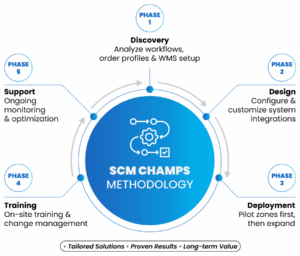
4.1. Our Proven Implementation Methodology
At SCM Champs, we know that one-size-fits-all solutions don’t work. Our five-phase methodology ensures tailored results:
Phase 1: Discovery & Needs Analysis
We analyze workflows, order profiles, and your WMS setup to define requirements.
Phase 2: System Design & Customization
We configure location check-digits, customize speech models, and tailor integrations to your environment.
Phase 3: Phased Deployment & Testing
We roll out voice picking in pilot zones first, fine-tune performance, then expand.
Phase 4: Comprehensive Training & Change Management
On-site training ensures adoption, while change management reduces resistance.
Phase 5: Ongoing Support & Optimization
Continuous monitoring and reporting ensure your system delivers long-term value.
4.2. Our Technological Edge
Seamless Integration with SAP, Oracle, Manhattan, and Blue Yonder WMS platforms.
Advanced Voice Engine with noise cancelling technology for noisy warehouses.
Robust Hardware Partnerships with leading wearable device manufacturers, ensuring durability and reliability.
Investment and Return: Understanding Cost and Tangible Benefits
5.1. Breaking Down the Cost Structure
Implementing voice technology involves several components:
Software Licensing: SaaS subscription or perpetual license models.
Hardware Investment: Headsets, wearable computers, chargers, and spares.
Implementation & Services: Consulting, customization, and project management.
At SCM Champs, our solutions focus on delivering superior Total Cost of Ownership (TCO) and faster ROI compared to generic solutions.
5.2. Quantifiable Benefits and ROI
Voice picking isn’t just about speed it’s about measurable outcomes:
Productivity Increase: 15–35% faster picking.
Accuracy Improvement: Achieve up to 99.99% order accuracy.
Training Time Reduction: New staff onboard in hours.
Safety and Ergonomics: Lower injury rates and worker fatigue.
Real-Time Visibility: Managers gain live operational insights to optimise decisions.
The Future of Voice Technology in the Warehouse
6.1. Beyond Picking
Voice technology is expanding beyond order picking into receiving, put-away, replenishment, and cycle counting creating an end-to-end voice-enabled warehouse.
6.2. Integration with Other Technologies
Voice works hand-in-hand with Augmented Reality (AR), wearables, and autonomous mobile robots (AMRs), creating hybrid workflows for maximum efficiency.
6.3. Artificial Intelligence (AI) and Predictive Analytics
AI will make voice systems smarter automatically assigning tasks, dynamically routing workers, and predicting potential bottlenecks.
6.4. Multi-Language and Real-Time Translation
Modern warehouses employ diverse workforces. Future voice systems will support instant translation, ensuring all workers receive clear instructions regardless of language.
Conclusion
Voice picking is no longer just an innovation it’s a proven driver of warehouse efficiency, accuracy, and scalability. By eliminating unnecessary movements, reducing errors, and enabling real-time visibility, Pick-by-Voice with SAP EWM empowers businesses to meet modern logistics demands.
At SCM Champs, we don’t just provide technology we partner with you to design, implement, and optimise a voice solution tailored to your operations.