


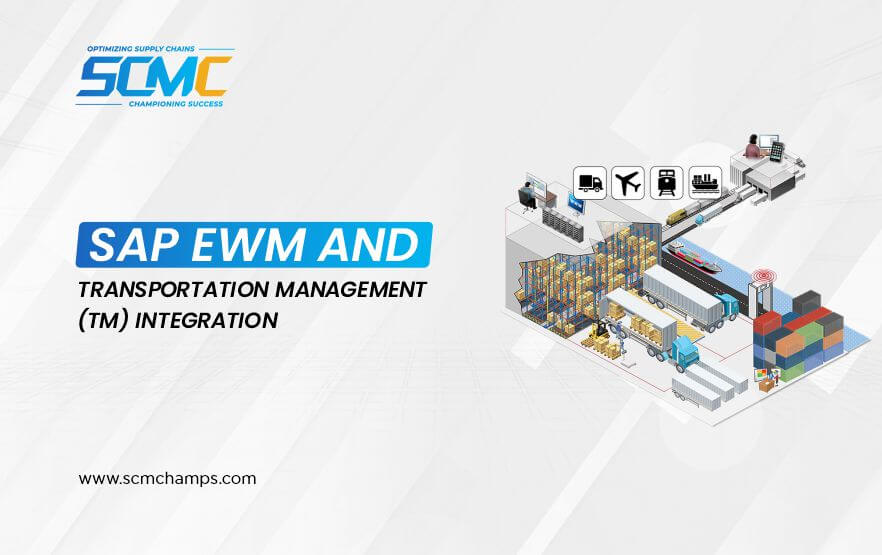
If your warehouse runs on SAP EWM and your transport team plans in SAP TM, you’ve probably seen this happen. The truck shows up and the order isn’t ready. A carrier gets booked with the wrong weight on the paperwork. And somebody spends the afternoon on the phone sorting it out.
That usually means the two systems aren’t really talking to each other. Connecting them, so the warehouse and transport teams work from the same orders and the same updates, is what SAP EWM and TM integration is about.
We work on both SAP EWM and SAP TM at SCM Champs, and linking the two is a big part of our job.
SAP EWM and TM Integration at a Glance
- EWM runs the warehouse, TM runs transport. Integration is what links them.
- TM’s transport plan tells EWM what to load. EWM sends back loading updates and the quantities that actually went out.
- EWM can sit in the same S/4HANA system as TM (embedded) or run on its own (decentralized). S/4HANA also has Advanced Shipping and Receiving, which works off the freight order.
- What you get: fewer trucks waiting, better freight data and a lot less re-typing.
- Trucks waiting at the dock, invoices that don’t match, people copying data by hand. Those are the usual signs you need it.
- SCM Champs sets up and connects SAP EWM and SAP TM for companies in the US and India.
What Is SAP EWM and TM Integration?
Put simply, it’s the link between your warehouse system and your transport system in SAP.
- SAP EWM (Extended Warehouse Management) handles what happens inside the building: receiving, putaway, picking, packing, staging and loading.
- SAP TM (Transportation Management) handles the freight side. Building loads, picking carriers, tendering, tracking and freight costs all sit here.
Once they’re connected, information goes both ways. Orders and deliveries become freight in TM. TM’s plan tells the warehouse what to stage and load, and when. Then EWM reports back what really happened: the actual quantities, weight details and loading status. Both teams end up looking at the same picture, not two different versions of it.
What Goes Wrong When SAP EWM and TM Aren’t Properly Integrated?
Here are three situations that come up a lot. One of them might sound familiar.
Example 1: A Retail Distribution Center in Peak Season
Peak season. The warehouse is planning picks its own way, and the transport team is booking trucks off yesterday’s numbers. So trucks pull in before the orders are ready. Detention charges start adding up, and on-time delivery slips at the worst possible time.
Example 2: A Manufacturer Shipping Heavy Equipment
Loads go out to carriers for tender without the real weights and dimensions from the warehouse. Then the carrier’s invoice comes in and doesn’t match the estimate. Finance and transport spend weeks going back and forth on disputes, and nobody’s quite sure whose fault it is.
Example 3: A 3PL Managing Multiple Clients
The 3PL can’t show its clients a live view from the warehouse through to the shipment. Some of those clients start looking at competitors who can. And speed and visibility, the two things the 3PL is supposed to be good at, start to slip.
How Does SAP EWM and TM Integration Work?
Every setup is a bit different, but the basic flow goes something like this.
Order or delivery → SAP TM (freight units and freight orders) → SAP EWM (picking, staging and loading) → updates back to TM (status, quantities and freight data). The exact documents and messages depend on your integration scenario.
From Order to Freight Order
Depending on your scenario and settings, orders or deliveries that need transport turn into freight units in SAP TM. Planners, or TM’s planning run, then group those freight units into freight orders. That’s where you decide which goods go on which truck, on which day and with which carrier.
Freight Units and Transportation Units
What happens next depends on how EWM and TM are hooked up. In a setup based on transportation units, TM’s plan goes over to EWM, and the warehouse uses transportation units (TUs) to handle door assignment, staging and loading. This setup also works with decentralized EWM. Advanced Shipping and Receiving (ASR) works differently. There, everything runs on the freight order itself, EWM transportation units aren’t used for that flow, and TM and EWM need to be embedded in the same S/4HANA system. SAP’s own learning material on TM and EWM integration explains both options.
Which way is right for you comes down to your SAP landscape, your release and the integration approach you go with.
Check-In, Loading and Goods Issue
The truck arrives, gets checked in and is sent to a door. EWM picks, stages and loads the goods. As that happens, loading confirmations and other updates go back to TM, so the transport team knows where things are.
One thing people often miss: posting goods issue in the warehouse doesn’t always mean the system knows the truck has left the gate. Whether it does depends on how your check-out process is set up.
Carrier Tendering, Weights and Freight Costs
TM sends loads out to carriers for tender, either directly or through SAP Business Network for Logistics. If EWM passes back the actual quantities and weight details, TM has better numbers to work with, and that makes carrier invoices a lot easier to check. The final charges, though, still come down to your carrier agreements and how freight charges are set up in TM.
Embedded, Decentralized or ASR: What’s the Difference?
| Option | What it means | Good to know |
|---|---|---|
| Embedded EWM and TM | Both run inside the same SAP S/4HANA system | This can mean less work between systems, depending on your process and setup |
| Decentralized EWM | EWM runs on its own system, connected through a supported integration | You need to keep a close eye on interfaces, data and status updates |
| Advanced Shipping and Receiving (ASR) | A freight-order-based shipping and receiving process in supported S/4HANA setups | It’s a way of integrating the two, not a separate place where the system runs. It needs TM and EWM embedded in the same S/4HANA system |
In short, embedded and decentralized tell you where EWM runs. ASR tells you how shipping and receiving work. What’s right for you depends on your SAP release, how much automation you have, your processes and your IT setup.
What Changes When Warehouse and Transport Work Together?
- Trucks get booked for when loads will actually be ready. Less waiting at the dock, fewer detention charges.
- Freight data is closer to what really shipped, so checking carrier invoices gets easier.
- Nobody has to re-type data between the two systems anymore.
- You see problems sooner. If a load is running late in the warehouse, transport knows before they send the truck.
- Customers get delivery dates they can trust.
- New sites and carriers are easier to add, since everyone works the same way.
Signs You Need SAP EWM and TM Integration
- You’re growing faster than your setup can handle. Adding distribution centers or folding in an acquisition only gets harder the longer you wait.
- Freight spend is climbing faster than revenue. That’s often a sign transport decisions are being made without warehouse information.
- Delivery performance has stalled. You keep fixing problems, but the numbers don’t move. Often the real issue is the handoff between warehouse and transport.
- People are filling the gap by hand. When skilled staff spend hours moving data between EWM and TM, you’re paying for a system problem with people’s time.
Two or more of these? Then integration is worth a proper look.
Common SAP EWM and TM Integration Challenges
It isn’t plug-and-play. These are the parts that usually take the most work, and where most SAP EWM–TM interface issues come from:
- Configuration. EWM and TM settings have to match, from how freight units are built to door and TU settings.
- Master data. Locations, products, weights, dimensions and carriers need to be the same in both systems. Even small differences cause trouble.
- Document flows. Orders, deliveries, freight orders and TUs have to link up properly, and that includes changes and cancellations.
- Status updates. If loading or goods issue status doesn’t make it back to TM, the transport team ends up working with old information.
- Testing. Testing each system on its own won’t catch the real problems. You have to test the whole order-to-delivery flow with real scenarios.
- Exceptions. Split loads, short shipments, late trucks, changed orders. Each one needs a clear way to be handled.
SAP EWM and TM Integration in S/4HANA
With SAP S/4HANA EWM and TM integration, the two can live in the same system. That makes things simpler than older setups, where they ran on separate systems. S/4HANA also gives you Advanced Shipping and Receiving, which runs shipping and receiving off the freight order and only works when TM and EWM are embedded together.
Still on SAP TM 9.x? According to SAP’s learning material, mainstream maintenance for SAP TM 9.6 is scheduled to end in 2027, so check your own release and support terms in SAP’s Product Availability Matrix. If you’re moving to S/4HANA anyway, it’s a good time to rethink how EWM and TM connect. Our S/4HANA migration guide and SAP S/4HANA page have more on this.
What to Look For in an SAP EWM and TM Integration Partner
- They know both systems. EWM–TM integration touches S/4HANA, master data and carrier systems. You want people who’ve worked on both sides.
- They ask about the business first. A good partner wants to hear about freight costs, delivery targets and customer commitments before talking about settings.
- They can point to real projects. Ask for examples with actual details, not general claims.
- They take change management seriously. These projects rarely fail because of the technology. They fail when the operations team isn’t on board.
- They stick around after go-live. SAP setups keep changing. A partner who knows your system over the long run is worth a lot more than a team that leaves once the project ends.
How SCM Champs Helps With SAP EWM and TM Integration
At SCM Champs we only work on SAP supply chain projects, and SAP EWM and SAP TM are our core areas. If you need an SAP EWM and SAP TM integration partner, our integration services cover everything from the first assessment to support after go-live. Our team includes SAP-certified consultants across SAP IBP, EWM, TM and MM.
Integration Assessment
First we look at how your warehouse and transport teams actually work today, where data gets stuck, and what setup you’re on: embedded, decentralized or a bit of both. We point out document-flow and interface issues, look at your deployment options and tell you what we’d change. It’s the consulting step of an SAP EWM–TM integration, and no build work starts until you’ve seen what we found.
Design and Setup
Then we design how documents and status updates move between EWM and TM. That covers freight units, TUs and doors, and we make sure the master data matches on both sides.
End-to-End Testing
We test the whole order-to-delivery flow with real scenarios. Split loads, late trucks, changed orders, all of it. Not just the easy cases where everything goes right.
Go-Live and Support
We plan go-live around your operations and stay close while the first trucks go out. After that, we keep supporting you. Every project comes with 12 months of support after go-live.
Relevant Project Experience
- SAP TM and EWM integration for Gutor Electronics in Houston, Texas.
- Selected to lead an SAP TM 9.6 to S/4HANA migration for a US-based Fortune 500 food and beverage manufacturer. Read the announcement
Frequently Asked Questions
What is SAP EWM and TM integration?
It’s the link between SAP EWM, which runs your warehouse, and SAP TM, which plans and manages transport. TM’s plan drives loading in the warehouse, and the warehouse sends loading updates and actual quantities back.
Do I need S/4HANA to integrate SAP EWM and TM?
No. Older setups, like SAP TM 9.x with decentralized EWM, can be integrated as well, using the transportation-unit-based approach. S/4HANA just makes it easier, since EWM and TM can run in one system. Advanced Shipping and Receiving, for example, only works when both are embedded in the same S/4HANA system. Also worth knowing: mainstream maintenance for SAP TM 9.6 is scheduled to end in 2027.
How long does SAP EWM and TM integration take?
That depends on your setup, how many sites you have and what’s already live. If EWM and TM are both up and running, connecting them is a smaller job than implementing either one from scratch. A short assessment will give you a timeline you can plan around.
What is a transportation unit in SAP EWM?
A transportation unit, or TU, is how EWM represents the truck, trailer or container carrying the goods. The warehouse uses it to assign a door, plan staging and loading, and record check-in and departure. If you use Advanced Shipping and Receiving, TUs aren’t used. The freight order takes their place.
Can SAP EWM and TM work with non-SAP carriers?
Yes. Carriers don’t need SAP at all. TM can send them tenders through SAP Business Network for Logistics, EDI or other channels, and nothing changes on the warehouse side.
Get a Free SAP EWM and TM Integration Assessment
Planning a new integration, trying to fix one that isn’t working well, or moving EWM and TM to S/4HANA? A short assessment is a good first step.
SCM Champs offers it free for supply chain leaders. We’ll look at how your warehouse and transport work today, where the gaps are and what a sensible next step would be.