


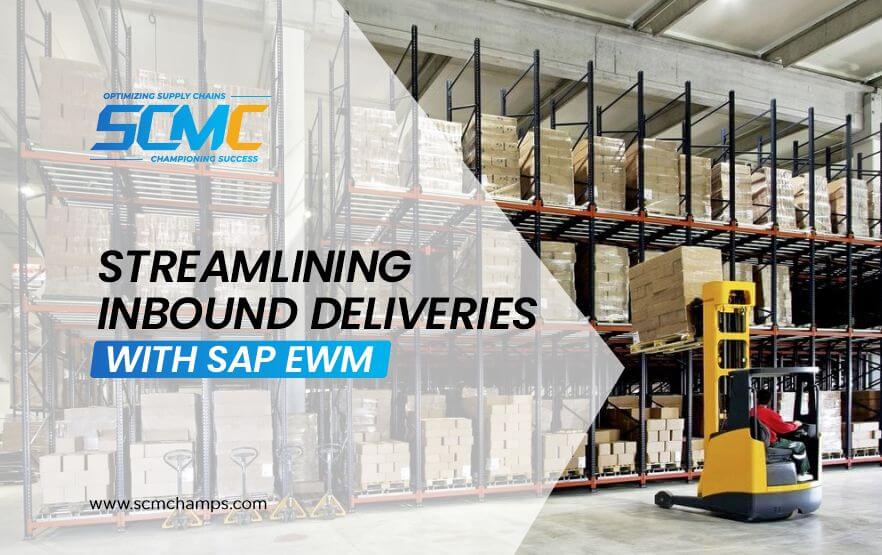
The Hidden Bottleneck in Your Supply Chain
It’s 2:30 PM on a Thursday. Your ERP system shows 14 purchase orders as “received,” but your pickers can’t find the inventory. Three trucks are queued at the dock—the first has a mismatched ASN, the second contains damaged pallets no one documented, and the third is being unloaded into aisles already at 95% capacity. Your warehouse supervisor just resigned. Sound familiar?
If you’re researching SAP EWM inbound implementation companies or evaluating SAP EWM inbound services to solve this chaos, this guide will help you understand what separates a successful transformation from a costly failure.
This chaos isn’t just “a busy day.” It’s the symptom of a broken inbound process that’s silently eroding your profitability. Research from the Warehouse Education and Research Council indicates that inefficient receiving and putaway processes consume 60-70% of total warehouse labor costs. When the foundation of your warehouse operation—the inbound flow—is flawed, every downstream process (picking, packing, shipping) inherits those errors and inefficiencies.
You might be experiencing:
- “Ghost inventory” that exists in the system but can’t be found on the floor
- Chronic overtime in receiving while other areas are underutilized
- Missed carrier appointments and mounting detention charges
- Constant friction between warehouse operations and procurement/planning teams
Traditional, paper-based processes or basic Warehouse Management (WM) modules were designed for a different era. They can’t handle modern volume, velocity, or the demand for real-time accuracy. This isn’t just an operational headache—it’s a strategic bottleneck limiting growth, customer satisfaction, and profitability.
What Makes SAP EWM Inbound Different & Why It Matters
SAP Extended Warehouse Management (EWM) represents a fundamental shift from inventory recording to intelligent execution. Unlike basic SAP WM—which primarily tracks “what is where”—EWM actively manages and optimizes the entire inbound flow in real-time.
Core Components Explained:
Expected Goods Receipt (EGR) with ASN Integration: EWM doesn’t wait for the truck to arrive. Using the Advanced Shipment Notification (ASN), it pre-plans labor, dock doors, equipment, and storage paths. When the physical goods arrive, the system is already prepared.
System-Directed Putaway: This is where EWM delivers transformational value. Instead of relying on an operator’s memory or a printed putaway list, EWM calculates the optimal storage location in real-time based on multiple factors:
- Product Characteristics: Dimensions, weight, hazard classification, temperature requirements
- Demand Velocity: Fast-moving items are directed to primary pick faces, slow-movers to bulk storage
- Warehouse Efficiency: Minimizes travel distance and balances workload across zones
- Space Utilization: Dynamically recommends locations based on current capacity
Embedded Quality Inspection (QI): Quality isn’t an afterthought. EWM can automatically trigger inspection tasks based on rules (vendor performance, product type, random sampling) and hold goods in quarantine without losing track of them.
A Day in the Life: The EWM Inbound Flow
Pre-Arrival (8 AM): ASN received → EWM creates Expected Goods Receipt → System schedules dock door 3 for 10 AM arrival → Assigns two operators with RF guns.
Receiving (10 AM): Truck checks in at gate → Operators scan license plate → System verifies against EGR → Directed unloading begins.
Putaway Execution (10:20 AM): Operator scans pallet → RF device displays: “Store in AISLE 12-BIN 45” → Operator confirms placement → Inventory is immediately available for sale or production.
Exception Handling (10:35 AM): Damaged carton found → Operator selects “Damage” reason → System creates follow-up task for supervisor and adjusts expected quantity.
The Data Point: Analysis of 50+ implementation projects shows that organizations leveraging EWM’s full inbound capabilities typically achieve a 40-60% reduction in dock-to-stock cycle time. The variance depends largely on the rigor of process redesign and master data quality.
Common Misconceptions About SAP EWM Inbound
Myth: “EWM is just SAP WM with a better interface.”
Reality: EWM is a complete re-architecture. It’s a real-time execution engine with advanced optimization algorithms, not an upgraded ledger system.
Myth: “We can configure EWM to match our current process.”
Reality: The value comes from redesigning your process to leverage EWM’s intelligence, not automating your existing inefficiencies.
The Real Cost of Poor Inbound Management
The inefficiency at your receiving dock translates directly to your bottom line. These costs are often hidden in overhead, overtime, and working capital, but they are staggeringly real.
Labor Cost Leakage: Without system direction, operators spend excess time searching, walking inefficient paths, and handling paperwork. This can inflate receiving labor costs by 25-35%. For a warehouse with a $500,000 annual receiving payroll, that’s $125,000-$175,000 in annual waste.
Trapped Working Capital: Inventory that is “received but not put away” or put away incorrectly is unavailable for sale. If 5% of your $5M inventory is lost or inaccessible, $250,000 of working capital is effectively frozen.
The Domino Effect on Downstream Operations:
Picking: Errors in putaway locations lead to picker search time, wrong picks, and delayed shipments.
Inventory Accuracy: Cycle counts fail because the system record doesn’t match physical reality, requiring costly full physical inventories.
Customer Service: Orders are delayed or incomplete because the “available” inventory in your ERP cannot be found.
A Framework for Quantifying Your Pain:
Consider a wholesale distributor with $50M in annual revenue.
Before EWM: Average dock-to-stock: 8 hours. Putaway accuracy: 85%. Monthly detention charges: $3,000.
After EWM Implementation: Dock-to-stock: 3 hours. Putaway accuracy: 99.5%. Detention charges: <$500.
Annual Impact: Labor savings: ~$85,000. Reduced inventory shrinkage: ~$60,000. Freed-up working capital and improved customer fill rates provided the ROI for the project in under 14 months.
Choosing the Right SAP EWM Inbound Implementation Company: Critical Considerations
An EWM implementation is a business transformation project, not an IT install. Success hinges on preparation, honest assessment, and choosing the right partner.
Not all SAP EWM inbound services are equal. The difference between a $150K successful implementation and a $400K stalled project often comes down to choosing an implementation partner who understands warehouse operations first, technology second.
Critical Success Factors (The Non-Negotiables):
Process Before Configuration: Never automate a broken process. You must redesign your inbound workflow before configuring a single transaction in EWM.
Master Data as Foundation: EWM is a precision tool. Inaccurate item dimensions, weights, or storage bin data will cripple its optimization logic. Expect to dedicate significant time to data cleansing.
Integration Strategy: Define how EWM will communicate with your SAP S/4HANA or ECC ERP (via Core Interface), Transportation Management System (TMS), and any yard management software. These interfaces are where projects often stall.
Common Pitfalls and How to Navigate Them:
Pitfall: The Customization Trap. The belief that “our process is unique” leads to expensive custom code that complicates upgrades.
Navigation: Adopt a “Configuration-First” mindset. Challenge every customization request. 80% of “unique needs” can be met with standard EWM functionality through smart process design.
Pitfall: Underestimating Change Management. The switch from paper/experience-based work to system-directed tasks is a cultural shift for warehouse staff.
Navigation: Involve floor-level super-users from the discovery phase. Train for the “why” (less walking, fewer errors, less frustration) alongside the “how.”
The Reality Check: When An EWM Inbound Project Should Wait
Honest assessment saves time, money, and credibility. Consider pausing if:
Your Master Data is in Crisis: If your item master accuracy is below 80%, or you lack a consistent storage location numbering system, fix this foundation first. EWM will magnify data errors, not solve them.
Leadership Alignment is Absent: If warehouse operations, IT, and finance leadership aren’t jointly committed to the process change and investment, the project will fail regardless of the technology.
You Lack a Clear Business Case: “We need to be more modern” isn’t a reason. You need quantifiable pain points (labor costs, accuracy rates, cycle times) to measure success against.
Timeline & Resource Reality: A well-scoped greenfield EWM inbound implementation typically requires 4-6 months and a dedicated cross-functional team (warehouse operations, IT, procurement, and a strong executive sponsor).
What to Look for When Evaluating Partners:
When evaluating SAP EWM inbound implementation companies, look for those who ask deep questions about your current process pain, not just technical specs. The right partner acts as a business process consultant first, technologist second.
Key evaluation criteria:
- Do they lead with a process assessment or jump to technical requirements?
- Can they articulate specific putaway strategy configurations for your industry?
- Do their SAP EWM inbound services include post-go-live optimization, or do they disappear after go-live?
- Can they provide detailed case studies with measurable before/after metrics?
How Leading SAP EWM Inbound Implementation Companies Structure Successful Projects
Successful implementations follow a disciplined pattern focused on business outcomes, not just software activation.
Phase 1: The Diagnostic Truth-Telling
What Average Teams Do: High-level process review.
What Successful Teams Do: A granular, data-driven assessment across four dimensions:
Process & Labor: Time-motion studies of current putaway paths. Leading implementations often find 30-40% of operator travel is non-value-added searching or backtracking.
Data Health: A sample audit of 100 recent receipts comparing ASN data to physical goods and system records. This quantifies your error rate.
Physical Flow: Analysis of dock utilization, appointment adherence, and material flow bottlenecks.
Technology Gaps: Mapping current system capabilities against target EWM processes.
Output Example: “Your current dock-to-stock time is 6.5 hours. 110 minutes of that is resolving ASN mismatches, and 85 minutes is searching for putaway locations. The process bottleneck is the manual reconciliation desk.”
Phase 2: Design with Discipline
This is where the ROI is designed. Key decisions include:
Putaway Strategy Configuration: Determining the rule sequence (e.g., check for open sales order first → then fast-mover area → then bulk storage).
Exception Management Design: Defining clear workflows for damages, shortages, and quality holds to prevent chaos.
Integration Blueprinting: Specifying exactly what data flows between ERP and EWM, and when (e.g., inventory posting timing).
Phase 3: Build, Test, and Validate with Operators
Configuration happens here, but the critical activity is User Acceptance Testing (UAT) with the warehouse team. They must test real-world scenarios: partial receipts, damaged goods, wrong items. Their feedback is gold.
Phase 4: Go-Live and the 90-Day Optimization Sprint
Go-live is the starting line, not the finish. The first 90 days focus on:
Adherence Monitoring: Are operators following the system-directed process?
KPI Tracking: Daily review of Dock-to-Stock time, Putaway Accuracy, and Labor Productivity.
Tuning: Adjusting putaway strategies based on real volume data.
Case Study: Automotive Aftermarket Parts Distributor
The Challenge: A distributor processing 400+ inbound lines daily struggled with 20% putaway errors and constant congestion at two dock doors.
The Nuanced Reality:
Their “unique” requirement was storing parts by vehicle type (Ford, GM, etc.). This was actually a standard storage section strategy in EWM.
The real obstacle was supplier compliance: 60% of ASNs were missing or inaccurate.
The Implementation Path:
Pre-Work (2 months): The implementation team facilitated supplier scorecard development and portal deployment, tying payment terms to ASN accuracy. Compliance jumped to 85%.
Configuration: Standard EWM putaway strategies were deployed with a simple enhancement to print location labels featuring vehicle type icons for visual confirmation.
Change Management: The most resistant operator was designated as the super-user and participated in RF screen flow design. This operator’s buy-in proved transformational for team adoption.
The Results (at 6 Months):
- Putaway accuracy: 99.1%
- Dock-to-stock time: Reduced from 7 hours to 2.5 hours
- Unforeseen Benefit: The clean data and process allowed them to implement same-day shipping for orders placed by 3 PM, increasing sales.
Proven Strategies to Optimize Your SAP EWM Inbound Operations
Whether you’re implementing or optimizing, these strategies deliver tangible results:
1. Mandate ASN Compliance: This is the single biggest lever. Work with procurement to build ASN accuracy into supplier contracts and performance reviews.
2. Implement Dock Appointment Scheduling: Use EWM or an integrated Yard Management System to eliminate guesswork and congestion. This alone can reduce labor peaks by 30%.
3. Master Putaway Strategies: Don’t just accept the default. Regularly analyze and tune your strategy sequence based on actual product movement data (ABC analysis).
4. Embrace Cross-Docking: Configure EWM to identify goods received that are already allocated to an open sales order and route them directly to the outbound staging area, bypassing storage entirely.
5. Leverage Mobile Technology: RF guns are table stakes. Consider voice picking or rugged tablets for complex receipts where operators need to see images or detailed documentation.
6. Establish Clear KPIs and Review Them: Move beyond “lines received.” Implement daily visibility into:
- Dock-to-Stock Cycle Time (by shift, by operator)
- Putaway Accuracy Percentage
- ASN Compliance Rate
- Labor Productivity (Units per labor hour)
7. Design for Exception Handling: Create clear, simple workflows in EWM for the 5% of receipts that have problems, so they don’t derail the 95% that are smooth.
8. Invest in Continuous Slotting Optimization: Use EWM’s data to quarterly review and adjust where products are stored to minimize travel time as sales patterns change.
9. Optimize Your Existing Layout Before Configuration: Before implementing EWM, analyze whether simple zone reclassification (changing storage types for 15-20% of your space) based on EWM’s optimization logic can deliver 15-25% efficiency gains—often without moving a single rack. Most companies configure EWM to fit their current layout. Leading implementations take a reverse approach: let EWM’s slotting intelligence inform minor storage type adjustments that unlock major productivity gains.
10. Implement Labor Standards with Transparency: Use EWM’s labor management capabilities, but involve your team in setting realistic standards. Gamification (daily leaderboards, team challenges) drives engagement better than top-down mandates.
Is Your Business Ready for SAP EWM Inbound? A Self-Assessment
The “Proceed with Caution” Checklist
- We cannot consistently achieve >95% accuracy in our current inventory records.
- Our warehouse leadership views new technology as a threat, not an enabler.
- We have no documented, standardized process for receiving goods today.
- We’re unwilling to renegotiate terms with suppliers to improve ASN compliance.
- We expect the software to fix our process problems without changing how we work.
If you checked 2 or more boxes, focus on foundational improvements before an EWM project.
What Separates Exceptional SAP EWM Inbound Implementation Companies
When evaluating potential partners, move beyond sales presentations. Ask:
“Can you walk me through your standard putaway strategy configuration document for a high-volume distribution center?” (Look for specificity, not marketing fluff.)
“Describe a time a client’s data quality threatened a project. What did you do?” (The answer should involve a structured cleanup plan, not blame.)
“How do you structure testing with warehouse operators, and how do you handle their feedback?” (They should describe a collaborative UAT process.)
“What are the first three KPIs you track post-go-live, and what are realistic targets for month 1 vs. month 3?” (Answers should be operational, not technical.)
Comparison Framework: Implementation Partner Types
| Consideration | General ERP Consultancy | Specialized SAP EWM Inbound Implementation Company |
|---|---|---|
| Warehouse Operations Expertise | Limited; primarily IT-focused | Deep operational experience; process-first mindset |
| Putaway Strategy Depth | Generic configurations | Industry-specific, optimized strategies |
| Change Management | Standard training approach | Floor-level engagement; super-user model |
| Post-Go-Live Support | Typically ends at go-live | 90-day optimization included |
| Risk Management | Higher (learning on your project) | Lower (pattern recognition from 50+ projects) |
Your Clear Path Forward
If you’ve read this far, you’re serious about solving this critical business problem. Your next step is to replace uncertainty with clarity.
We Offer One Specific Next Step: A Free Inbound Process Diagnostic
This is not a sales call. It’s a focused, 45-minute working session where we will:
Analyze Your Current State: Using our assessment framework, we’ll identify your top 2-3 specific bottlenecks (e.g., “ASN mismatch resolution is consuming 22% of your receiving labor”).
Quantify the Opportunity: We’ll provide a realistic range of potential improvements in dock-to-stock time, labor efficiency, and accuracy based on your unique operation.
Outline a Potential Path: You’ll leave with a clear, phased view of what a successful project would entail, including key prerequisites.
Who This Is For: Operations, supply chain, or IT leaders who are tired of inbound chaos and are ready to explore a structured solution.
Who This Is NOT For: Companies looking for a quick software quote without process analysis, or those not prepared to invest in foundational data and change management.
About SCM Champs
SCM Champs is a specialized SAP EWM inbound implementation company focused exclusively on warehouse execution excellence. Our SAP EWM inbound services include:
- Pre-Implementation Process Assessment & ROI Analysis
- End-to-End EWM Configuration & Integration
- Master Data Cleansing & Migration Strategy
- Operator Training & Change Management Programs
- 90-Day Post-Go-Live Optimization Sprint
- Ongoing Managed Services & Support
Unlike general ERP consultancies, we focus solely on warehouse execution. Our team has implemented EWM in 50+ distribution centers across manufacturing, wholesale distribution, retail, and 3PL operations.
Trust Signals:
SAP Silver Partner | 5+ Years Supply Chain Focus | Certified EWM Consultants
Trusted by leading companies in manufacturing, distribution, and retail
Frequently Asked Questions
Q: We have basic SAP WM. Is EWM a major upgrade?
A: Yes, it’s a fundamentally different system. Think of WM as an inventory ledger and EWM as an intelligent real-time execution engine. Migration requires careful planning and process redesign. However, many of our clients find the learning curve worthwhile—the operational gains typically far exceed the implementation investment.
Q: Can we implement only the Inbound module of EWM?
A: Technically yes, and a phased approach (Inbound → Storage → Outbound) is common and reduces risk. However, the full ROI comes from the integrated flow across all warehouse processes. We typically recommend starting with inbound to prove value, then expanding.
Q: How do you handle resistance from long-term warehouse staff?
A: Transparency and inclusion are key. We involve them early to voice concerns, co-design simpler processes, and focus training on how EWM removes their daily frustrations (searching, paperwork, conflicts over stock). The goal is to make their jobs easier, not just more technological. In our experience, the most resistant operators often become the strongest advocates once they see the system eliminates their pain points.
Q: What’s the real failure rate for EWM implementations, and what causes them?
A: Industry estimates suggest 30-40% of WMS implementations (including EWM) underdeliver on ROI in Year 1. The primary causes aren’t technical—they’re organizational: inadequate change management, poor master data governance, and leadership impatience during the stabilization period. Projects that invest in 8-12 weeks of process redesign BEFORE configuration have an 85%+ success rate.
Q: How do we know if we should build internal EWM expertise or rely on partners long-term?
A: It depends on your strategic view of warehouse management. If supply chain is a competitive differentiator and you run 3+ distribution centers, build internal expertise with a partner accelerating you. If you’re a single-site operation where warehousing is a cost center, a hybrid model (partner for optimization, internal for day-to-day) is more cost-effective.
Q: What’s a realistic timeline and budget for an inbound-focused EWM implementation?
A: For a single-site implementation focusing on inbound: 4-6 months from kickoff to go-live. Budget typically ranges from $120K-$300K depending on complexity (number of SKUs, integration requirements, customization needs). The ROI timeline is usually 12-18 months based on labor savings and inventory accuracy improvements.
Ready to transform your largest cost center into a competitive advantage? Let’s start with a clear, no-obligation diagnosis.