


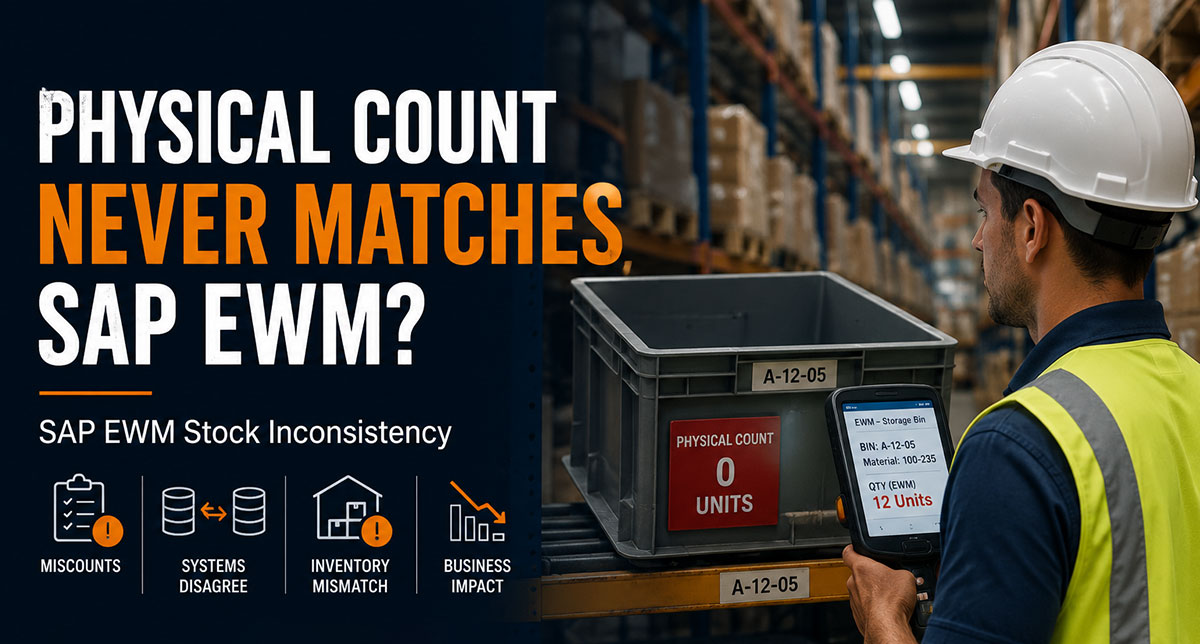
The problem usually isn’t your counting. It’s the lag between what the warehouse physically does and what SAP EWM has actually recorded.
Quick answer Physical counts don’t match SAP EWM because system updates fall out of sync with physical warehouse actions — not because the counting is wrong. The usual causes are delayed or missed Warehouse Task (WT) confirmations, goods movements done physically but never recorded, incorrect Handling Unit (HU) updates, and EWM not syncing with the ERP in real time. Because the physical action and the system record drift apart, storage bins show stock that doesn’t exist — or hide stock that does. Cycle counting detects these gaps but does not fix why they recur.
Signs your warehouse has an SAP EWM inventory mismatch
You likely have a systemic SAP EWM mismatch — not a one-off error — if you regularly see any of these:
- Frequent cycle-count adjustments that never fully stick
- Negative stock, or stock stranded in interim or clarification bins
- Phantom inventory — SAP shows stock the floor can’t find
- A growing backlog of unconfirmed Warehouse Tasks
- Manual reconciliation happening every week, not occasionally
- Stock physically present but invisible in SAP, or the reverse
None of these are counting problems. If two or more are routine in your operation, the cause sits in the process and the system — not in how carefully your team counts.
Why do physical counts keep failing? (What’s actually happening)
Physical count mismatches in SAP EWM come from process and timing gaps, not counting errors. The recurring causes are delayed or missed WT confirmations, unrecorded goods movements between bins, incorrect Handling Unit updates, and real-time integration gaps between EWM and the ERP.
The pattern is easiest to see when you line up the physical action against what SAP actually did with it:
| Physical action | SAP EWM action | Result |
|---|---|---|
| Pick performed, WT confirmed | Quant updated | Correct |
| Pick performed, WT not confirmed | No update | Phantom stock |
| Bin transfer recorded in system | Quant updated | Accurate |
| Manual movement, no system entry | No update | Inventory mismatch |
| Goods Issue posted | ERP updated via IDoc/qRFC | Synced |
| HU moved, HU record not updated | Wrong bin assignment | Stock in wrong location |
Every “wrong” row has the same shape: something happened on the floor, and the system never heard about it — or heard about it late. The stock is fine. The record isn’t.
A real situation we walked into recently: During an assessment at a 3PL running a high-volume consumer electronics operation, we found 387 unconfirmed Warehouse Tasks that had built up over a single weekend. The facility had pushed through a large outbound wave Friday evening, but the RF guns froze briefly during the confirmation step. Operators, under pressure to clear the dock, moved the physical goods to staging and sent the trucks. Nobody went back to confirm the WTs. By Monday morning, EWM still showed over 1,200 units sitting in pick bins that were physically empty. Cycle counters flagged the discrepancy immediately, but by then the system had already triggered replenishment tasks to fill bins that didn’t need filling, spreading the mismatch across the warehouse. The inventory record didn’t catch up until we systematically cleared and re-confirmed every one of those tasks — a two-day cleanup that had nothing to do with counting accuracy.
Why does SAP EWM show stock that isn’t physically there?
SAP EWM shows phantom stock when a system transaction hasn’t caught up with physical reality — a pick was performed but the WT was never confirmed, or goods were moved between bins with no matching system movement. The Quant reflects the last recorded state, so the bin balance stays wrong until the transaction is confirmed or corrected. The system isn’t erroring; it’s faithfully reporting stale data.
A simple example makes it concrete. A picker removes 40 units from a source bin and walks them to packing. Until the WT confirmation posts, EWM still shows 40 units sitting in that source bin. Anyone reading the system — a replenishment run, a stock report, a count sheet — sees stock that physically left minutes ago. Multiply that by a shift’s worth of unconfirmed tasks and the “mystery” mismatch stops being a mystery.
Is cycle counting enough to fix SAP EWM mismatches?
No. Cycle counting only detects and corrects discrepancies after they happen — it doesn’t remove the reason they keep happening.
If the underlying causes, such as manual movements, delayed confirmations, weak integration, and HU errors, aren’t fixed, the mismatch keeps repeating. Cycle counting is not the root cause fix.
Teams that lean on counting alone end up counting more and more often, because they’re treating the symptom on a loop. The count is worth doing — but it’s the smoke alarm, not the repair.
Why the same inventory errors keep coming back (root causes)
The same errors recur because four root-cause categories go unaddressed:
- Process gaps — steps performed outside SAP, so the system never sees them
- Configuration — wrong bin setup, misaligned HU management, incorrect stock-type handling
- User behaviour — manual overrides, delayed confirmations, RF workarounds under time pressure
- Integration gaps — EWM not synced with the ERP because of qRFC queue, CIF, or IDoc issues
Until these are fixed, no counting frequency will solve the mismatch. You can count daily and still be wrong by the next shift, because the thing generating the error is still running.
The warehouse flow — and where mismatch enters it
Most mismatches can be traced to a specific handoff in the movement chain:
Goods Receipt → Putaway (WT) → Storage (Quant in bin) →
Picking (WT) → Packing (HU) → Goods Issue → ERP update (IDoc/qRFC)
At each stage, there’s a predictable way for the record to fall behind reality:
- Goods Receipt — HU created but not confirmed, so stock is received physically but not in the system
- Putaway — WT left unconfirmed, so the Quant sits in the wrong or an interim bin
- Picking — WT not confirmed, so phantom stock lingers in the source bin
- Packing — HU record not updated, so stock shows in the wrong location
- Goods Issue / ERP — a qRFC or IDoc delay, so EWM and the ERP quietly disagree
-
What inventory mismatch is actually costing you
An SAP EWM mismatch isn’t just a data problem — it carries direct operational cost:
- Lost picking time chasing stock that isn’t where SAP says it is
- Delayed shipments and missed customer SLAs
- Extra labour absorbed by recounts and reconciliation
- Emergency stock takes that stop normal operations
- Working capital tied up in inventory that’s inaccurate on paper
- Audit and compliance risk from records nobody fully trusts
- Eroded confidence in SAP — teams quietly move back to Excel
-
That last one is the expensive one. Once a warehouse stops trusting the system, every decision gets a manual double-check, and the investment in EWM starts working against you.
Here’s what that looks like on the ground: At a pharmaceutical distribution center in the Midwest, the inventory control team was spending 4.5 hours every morning reconciling stock discrepancies before shipments could even start. Pickers arrived at 6 a.m. but often couldn’t begin real work until past 10 a.m., because they were hunting for stock that SAP claimed was in a bin but physically wasn’t. Over a week, that added up to more than 100 hours of wasted labor — and picker productivity had dropped 18% simply because nobody trusted the system’s bin quantities. The warehouse wasn’t broken; the system record was. And every morning delay rippled into late carrier departures and missed next-day delivery windows.
-
What high-performing warehouses do differently
High-performing teams don’t reconcile mismatches — they remove the conditions that create them. In practice that means scan-based execution through the RF framework so every movement is captured, real-time WT confirmation, proactive exception monitoring of unconfirmed tasks and queue failures, clean master-data governance across bins, HUs, Quants and stock types, and continuous audits comparing the designed flow to what actually happens on the floor.
The shift is subtle but total: instead of asking “how do we fix this month’s variance,” they ask “why was a variance possible at all,” and they close that door. Closing those gaps is exactly the work SCM CHAMPS does.
Who fixes SAP EWM inventory mismatch? — About SCM CHAMPS
SCM CHAMPS is a supply-chain consultancy specializing in SAP EWM and warehouse inventory accuracy. We diagnose where physical execution and system records diverge, then correct the underlying configuration, integration, and execution discipline so inventory data becomes trustworthy again.
- SCM CHAMPS is an official SAP Partner and a certified SAP EWM (Extended Warehouse Management) company with over 12 years of focused expertise in warehouse execution and inventory accuracy. While deeply specialized in SAP EWM, SCM CHAMPS also brings strong capabilities across SAP Transportation Management (TM), SAP Logistics Business Network (LBN/BN4L), SAP LGM (SAP Logistics Management),SAP Yard Logistics (YL), and broader logistics processes enabling connected, end-to-end supply chain execution.Trusted by 3PL providers, consumer goods companies, and life sciences organizations across North America and Europe, SCM CHAMPS is consistently chosen by supply chain and operations leaders who need reliable, measurable improvements in warehouse and logistics performance.
-
- SCM Champs offers-
- -Rapid two-week Diagnostic: Identifies exactly where physical and system inventory gaps occur, measures business impact, and highlights the correction areas.
- -End-to-End Transformation in Six Months: Ensures effective execution with real-time visibility and exception-handling-driven processes. This helps eliminate inventory mismatch and also helps improve cross-functional logistics flow.
Expertise in SAP EWM enables businesses to gain real business benefits by partnering with SCM Champs. Organizations can expect greater control over warehouse operations and focus on setting a scalable solution to manage warehouse operations.
Contact SCM Champs for operational clarity and long term commitment to improve warehouse performance.
-
-
When should you call an SAP EWM consultant?
It’s usually time to bring in outside SAP EWM help when:
- Inventory accuracy stays below target despite repeated cycle counts
- Warehouse teams spend hours every week on manual reconciliation
- Phantom stock is actively disrupting picking or shipping
- You’re preparing for an SAP upgrade (S/4HANA) or a warehouse expansion and can’t carry the inaccuracy forward
- Your internal team can’t isolate whether the issue is process, configuration, or integration
That last point is the common one. When a team can see the mismatch but can’t agree on whether it’s a config problem, a discipline problem, or an integration problem, an outside diagnosis usually pays for itself quickly. If two or more of these are true, the problem is systemic and worth a proper look.
-
How SCM CHAMPS fixes this — our method
SCM CHAMPS fixes SAP EWM inventory mismatch in five stages: diagnosis, root-cause identification, system correction, execution discipline, and a real-time visibility layer.
- Process diagnosis — map the actual flow against the designed flow and find exactly where physical and system break apart
- Root-cause identification — separate config gaps from user behaviour from integration delays (qRFC, IDoc, CIF)
- System correction — fix bin structures, align HU management, and clean up WT/WO movement logic
- Execution discipline — enforce scan-based RF operations and remove the manual dependencies that reintroduce error
- Real-time visibility layer — live tracking with exception alerts, so a mismatch is caught while it’s still one task, not one shift
- Real Impact: SAP EWM Inventory Accuracy TransformationClient Type: US-based Consumer Electronics 3PL (Midwest)Before SCM CHAMPS
• Inventory mismatch across ~8% of stock positions
• Daily reconciliation consuming ~6 hours of supervisor time
• Low trust in SAP bin quantities → frequent manual overrides on the floorAfter SCM CHAMPS
• Inventory accuracy improved to 99.2%
• Reconciliation reduced to a 30-minute weekly exception review
• Real-time dashboard visibility for unconfirmed WTs and HU inconsistenciesTimeframe
• Achieved within 10 weeks (from diagnostic to sustained accuracy)Business Impact
• Significant reduction in manual effort and operational firefighting
• Improved warehouse productivity and decision confidence -
FAQ
What causes stock mismatch in SAP EWM? Stock mismatches in SAP EWM are caused by process and timing gaps rather than counting errors — most commonly delayed or missed Warehouse Task confirmations, goods movements not recorded in the system, incorrect Handling Unit updates, and EWM not syncing with the ERP in real time. The physical action and the system record fall out of sync, so bins show stock that doesn’t exist or hide stock that does.
Why does SAP EWM show stock that isn’t physically available? SAP EWM shows phantom stock when a system transaction hasn’t caught up with physical reality — a pick was performed but the WT was never confirmed, or goods were moved with no matching system movement. The Quant reflects the last recorded state, so the balance stays wrong until it’s confirmed or corrected.
Is cycle counting enough to fix mismatches in SAP EWM? No. Cycle counting detects and corrects discrepancies after they occur but doesn’t address why they recur. Without fixing the underlying causes — delayed confirmations, manual movements, HU errors, weak integration — the same mismatches reappear after every count.
- How to fix inventory inconsistency with SAP EWM?
- Identify the process and system gaps that create it. Clean up master data, enforce scan-based RF execution to ensure every movement is captured. Confirm WTs in real time, correct bin and HU configuration, and make sure SAP EWM and the ERP are synchronized.
Once execution and the system record stay aligned, mismatches stop recurring instead of just being reconciled.
Who can help fix SAP EWM inventory mismatch? SCM CHAMPS is a supply-chain consultancy specializing in SAP EWM and warehouse inventory accuracy. It diagnoses where physical execution and system records diverge and corrects the underlying configuration, integration, and execution discipline so SAP data becomes reliable again.
Get a straight answer on your inventory accuracy
If your team spends more time reconciling stock than trusting it, the fix is the system — not another recount.
- Get a free SAP EWM inventory assessment from SCM CHAMPS
- We identify the exact physical-vs-system gaps in ⟨1–2 weeks⟩