


Quick Answer
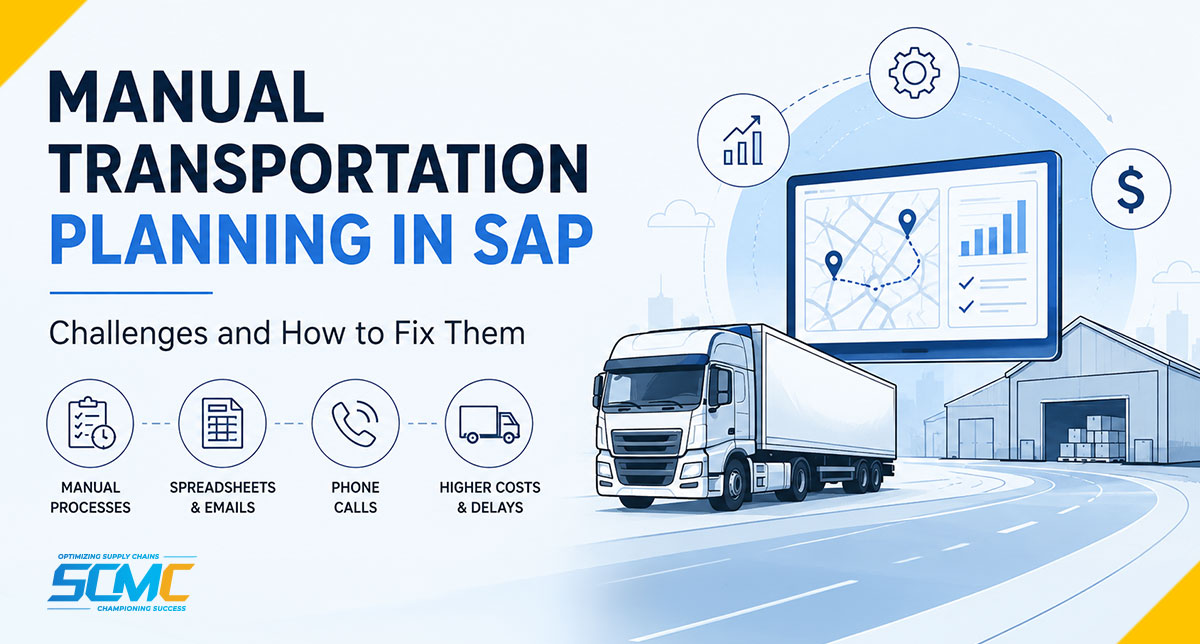
Are you managing most transportation operations like carrier selection, loading and unloading , and shipment scheduling via emails, spreadsheets, and phone calls instead of a robust system?
Manual processes often lead to poor truck capacity utilization, too many follow-ups, and individual planners, and eventually higher transportation costs.
SAP Transportation Management (SAP TM) fixes this by automating load consolidation, route planning, carrier selection, and freight settlement based on rules, rates, and constraints defined in the system. Companies should consider automating when planners spend most of their day on repetitive decisions, freight costs keep rising despite stable volumes, or planning knowledge sits in one or two people’s heads. For organizations moving to S/4HANA, that migration is often the natural point to fix transportation planning rather than carry manual processes into the new system.
What Manual Transportation Planning Actually Looks Like
We rarely see companies plan transportation badly on purpose. We see planners doing their best inside a broken process.
A typical morning: the planner exports today’s deliveries into Excel, sorts them by region, and starts grouping loads based on memory of routes and truck capacities. Then come the carrier emails — who has capacity, at what rate. Two phone calls to the warehouse to check if orders are actually pick-ready.
By noon, half the plan changes. A customer moves a delivery date. A carrier declines a load. The planner rebuilds the trucks and updates a tracker only they fully understand.
If this sounds familiar, the problem isn’t your planner. It’s the process.
Why Companies Still Plan Transportation Manually
In SAP TM assessments, we consistently find the same root causes:
Legacy processes carried forward. Planning was built around ECC shipment functionality years ago, and the workarounds became the process.
Custom Excel models. A planner built a clever consolidation sheet in 2015. It works — until that person leaves.
Poor master data. Missing lane definitions, outdated freight agreements, and unreliable weights make any system output untrustworthy, so planners go back to gut feel.
Fear of automation. Teams worry the system will make bad decisions. Usually, it’s the data — not the optimizer — they don’t trust.
Disconnected systems. When orders, warehouse status, and carrier communication live in separate tools, Excel becomes the glue.
8 Challenges of Manual Transportation Planning
1. Manual load consolidation
The problem: Planners group deliveries into trucks based on experience.
Why it happens: No system logic for capacity, compatibility, and delivery windows.
Business impact: Trucks leave 60–75% full; freight spend rises with every half-empty vehicle.
How SAP TM fixes it: Automated consolidation builds loads against real capacity, incompatibility, and time-window constraints — consistently, not just on a good day.
2. Poor route planning
The problem: Routes follow habit, not optimization.
Why it happens: Comparing route options manually across dozens of shipments daily is impossible.
Business impact: Extra kilometers, missed delivery windows, avoidable fuel and toll costs.
Where SAP TM helps: Optimizer-based planning evaluates route alternatives against cost and service constraints in minutes.
3. Limited shipment visibility
The problem: Once a truck leaves, status lives in phone calls.
Why it happens: No integrated event tracking across carriers.
Business impact: Customer service can’t answer “where is my order,” and delays surface only after they’ve hurt someone.
The fix in SAP TM: Freight orders carry planned and actual events, giving one shared view of shipment status.
4. Carrier selection based on experience
The problem: Planners assign carriers they know and like.
Why it happens: Rate comparison across agreements is tedious by hand.
Business impact: Contracted rates go unused; a few carriers get overloaded while cheaper capacity sits idle.
How SAP TM fixes it: Rules-based carrier ranking and allocation apply your agreements automatically, load after load.
5. High freight cost
The problem: Freight spend grows faster than shipment volume
Why it happens: It’s the compound effect of challenges 1–4.
Business impact: Transportation quietly becomes one of the largest uncontrolled cost lines in the P&L.
Where SAP TM helps: Optimization plus consistent rate application attacks cost from multiple directions at once.
6. Manual freight settlement
The problem: Carrier invoices are checked line-by-line against spreadsheets or are not checked at all.
Why does it happen? Rates are shared via messages and emails and are not interconnected in shared systems.
Business Impact: Overbilling, frequent disputes, delay in financial closure.
How SAP TM helps solve this problem: Automated verification, freight charge calculation, and automated billing
7. Last-minute planning
The problem: Planning starts when orders are already due.
Why it happens: Planners can only react; they have no capacity to plan ahead.
Business impact: Premium freight, expedites, and constant firefighting.
How SAP TM fixes it: Forward-looking planning horizons let teams plan tomorrow’s and next week’s loads today.
8. Planner dependency
The problem: One or two people hold the entire planning logic in their heads.
Why it happens: Knowledge was never encoded into rules or systems.
Business impact: A resignation or sick leave becomes an operational risk event.
Where SAP TM helps: Planning rules, constraints, and rates live in the system — the organization owns the knowledge, not an individual.
Hidden Costs Most Companies Never Measure
The visible cost is freight spend. The costs below rarely appear on any report:
- Planner overtime — routinely 1–2 hours daily just rebuilding plans after changes.
- Premium freight — a handful of expedites per week can add 5–10% to monthly freight cost.
- Detention and demurrage — poor scheduling turns into waiting-time charges.
- Missed carrier discounts — negotiated volume commitments never tracked, never claimed.
- Billing corrections — every disputed invoice costs finance and logistics hours.
- Poor truck utilization — every 10% utilization gap is roughly 10% freight overspend on those lanes.
- Customer penalties — OTIF fines in retail and automotive supply contracts.
When we help clients quantify these in an assessment, the hidden costs often rival the visible freight overspend.
How SAP TM Fixes Manual Transportation Planning
We deliberately avoid feature lists. What matters is the process change:
Manual consolidation → VSR optimization → higher utilization. The Vehicle Scheduling and Routing optimizer builds loads and routes against real constraints — capacities, time windows, incompatibilities — producing plans a human can’t compute at scale.
Gut-feel carrier assignment → carrier ranking and allocation → rate consistency. SAP TM applies your freight agreements and allocation commitments automatically, so the contracted rate is the used rate.
Spreadsheet rate checks → charge calculation and settlement → fewer disputes. Rates live in freight agreements; invoice verification becomes systematic instead of heroic.
Phone-call visibility → event-based tracking → proactive exception handling. Teams act on delays before customers call.
One note for SAP ECC users: with S/4HANA, TM is embedded in the core. If a migration is on your roadmap, redesigning transportation planning as part of it is significantly cheaper than retrofitting later.
Manual Planning vs SAP TM Planning at a Glance
| Manual Planning | SAP TM Planning |
|---|---|
| Excel spreadsheets | Rule-based, optimizer-driven planning |
| Phone calls and emails for status | Event-based shipment visibility |
| Planner memory and habit | Documented planning rules and constraints |
| Reactive, last-minute decisions | Forward-looking, optimized planning horizons |
| Carrier chosen by gut feel | Carrier ranking by rate and performance |
| Invoice checks by hand | Automated charge calculation and settlement |
| Knowledge in individuals | Knowledge owned by the organization |
Common SAP TM Automation Mistakes
We’ve been called into enough recovery projects to know where implementations go wrong:
Automating a bad process. If today’s process is broken, automation makes it fail faster. Redesign first, configure second.
Ignoring master data. Optimizers are only as good as lanes, capacities, and rates. Budget real effort for data readiness.
Copying planning parameters from a template. Cost settings and constraints must reflect your network, not a demo system.
Weak carrier onboarding. Automation fails if carriers still respond by email. Bring them into the process early.
No KPI baseline. Without pre-implementation measurements, you can never prove improvement. Baseline before go-live.
Stopping at go-live. Planning parameters need tuning against real operations. Plan for optimization cycles after cutover.
Should Every Transportation Process Be Automated?
No — and any partner who says otherwise is selling software, not solving problems.
In our experience, some planning should deliberately remain manual:
- Exception planning. When a plant breakdown or customer escalation hits, a planner’s judgment beats any optimizer.
- Special cargo. Heavy shipments, fragile and hazardous items handling, and temperature-critical shipments require shipment with utmost care.
- Project logistics. One-off moves — plant equipment, construction deliveries — don’t justify automation rules.
- Emergency shipments. Speed matters more than optimization when a line is down.
The right goal is not 100% automation. It’s automating the 80–90% of repetitive planning decisions so your planners can focus their expertise on the situations that genuinely need it.
How SCM CHAMPS Approaches Transportation Planning Improvements
Our methodology is built on one principle: understand the business problem before touching configuration.
Step 1 – Process Discovery. We map the current planning workflow end to end — from order release to dispatch — and identify every manual touchpoint, bottleneck, and decision dependency. We pay particular attention to where planners override or work around existing systems, because those workarounds usually point to the real problem.
Step 2 – Data & Master Data Assessment. We review transportation lanes to understand shipment frequency, consolidation opportunities, carrier utilization, equipment constraints, and cost variation. We assess freight agreements, locations, and calendars for completeness and accuracy. This tells us whether the biggest opportunity lies in planning logic, network design, or data quality — three very different projects.
Step 3 – Root Cause Analysis. We separate process issues from SAP configuration issues from organizational issues. A truck leaving half-empty might be a consolidation logic gap, a missing incompatibility setting, or a sales team promising delivery dates planning can’t meet. Each needs a different fix.
Step 4 – Solution Design. We recommend SAP TM capabilities, process redesign, and governance changes ranked by business priority and payback — not by what’s easiest to configure.
Step 5 – Implementation & Testing. We configure, validate, and train planners using their real business scenarios — actual lanes, actual carriers, actual order patterns — not sample data.
Step 6 – Hypercare & Continuous Optimization. We monitor the KPIs defined at baseline and fine-tune planning parameters against live operations, because the first optimizer settings are never the final ones.
What Results Can Organizations Expect?
What Results Can Organizations Expect?
Case Study
A mid-sized industrial manufacturer based in Texas used to handle consolidation of around 400- 500 outbound deliveries manually through spreadsheets.
The challenges: Truck capacity utilization was not optimal. The team spent enough time in re-planning, and carriers were selected via phone calls based on their availability.
As their transportation manager put it: “We were working hard, not smart. We couldn’t scale.”
The company understood it needed process change, not just a software install. Working with SCM CHAMPS, they first standardized transportation master data — lane definitions, loading times, carrier contracts, product weights — so the system could make trustworthy decisions.We then configured
automated load consolidation
rule -based carrier selection in SAP TM
- It directly reduced freight rates and improved on-time performance scores.We also defined KPIs for further analysis-
Load utilization
Replanning frequency
Cost per mile
On-time dispatch
Six months after go-live:
- 18% reduction in manual planning effort — planners now handle exceptions and carrier relationships instead of data entry
- 11% improvement in truck utilization — the same fleet ships more per run
- 9% reduction in freight cost — from better consolidation and smarter carrier assignment
- 35% fewer manual shipment re-planning activities — the mid-day fire drills largely disappeared
- Stable, measurable on-time dispatch — previously tracked, in their words, by apology emails
Their operations director summed it up:
“We didn’t just buy a tool. We untangled our processes and let the system do the heavy lifting. The savings are real, but the peace of mind is even bigger.”
— Transportation Manager, Mid-Sized Industrial Manufacturer
Why Organizations Choose SCM CHAMPS
Enterprise buyers compare several SAP partners before committing. Beyond the methodology described above, three things genuinely differentiate our approach:
Supply chain specialization, not generic SAP delivery. Transportation planning never works in isolation. Because we work across warehouse, transportation, manufacturing, planning, and order fulfillment, we design TM solutions that fit the full execution flow — not a silo.
Honesty about what technology can’t fix. When a bottleneck is organizational — unrealistic promise dates, misaligned incentives, missing ownership — we say so, because no amount of SAP configuration fixes it. Clients tell us this candor is rare among implementation partners.
Knowledge transfer, not dependency. Many partners disappear after go-live, leaving clients unable to adjust their own planning parameters. We train internal teams to understand why the system is configured the way it is — so they become self-sufficient, and improvements sustain long after we leave.
Frequently Asked Questions
What is manual transportation planning in SAP? It’s planning shipments, loads, and carriers using spreadsheets, emails, and planner judgment instead of SAP TM’s automated optimization — deliveries exist in SAP, but planning decisions happen outside it.
How does SAP TM automate transportation planning? Through the VSR optimizer for load consolidation and routing, rules-based carrier ranking, freight agreement–based charge calculation, and event-driven shipment tracking — all against constraints you define.
Can SAP TM reduce transportation costs? Yes, when implemented on sound processes and data — through better truck utilization, consistent contracted-rate usage, fewer expedites, and automated invoice verification. Single-digit to low double-digit reductions are realistic.
How long does it take to implement SAP TM?
Implementation depends on the scope, network complexity, and data readiness. We first recommend an analysis and a realistic plan to reduce implementation time.
Is SAP TM suitable for small and mid-sized businesses? Yes, particularly with embedded TM in S/4HANA, which lowers the entry barrier. The deciding factor is shipment volume and planning complexity, not company size.
How do you know if your planning process needs automation? Clear signals: planners spend their day on repetitive decisions, freight cost rises faster than volume, trucks leave under-utilized, and planning knowledge sits with one or two individuals.
Conclusion
Manual transportation planning is usually a process problem before it’s a technology problem. SAP TM can automate and optimize planning — but the results depend on process design, master data quality, and implementation discipline.
The organizations that achieve measurable improvements are the ones that assess their current planning process honestly before automating it.
If you’re evaluating SAP TM or looking to improve existing transportation operations, SCM CHAMPS offers a structured transportation planning assessment as a practical first step. It tells you where the gaps are — and whether automation will actually pay off — before you commit to a project.