


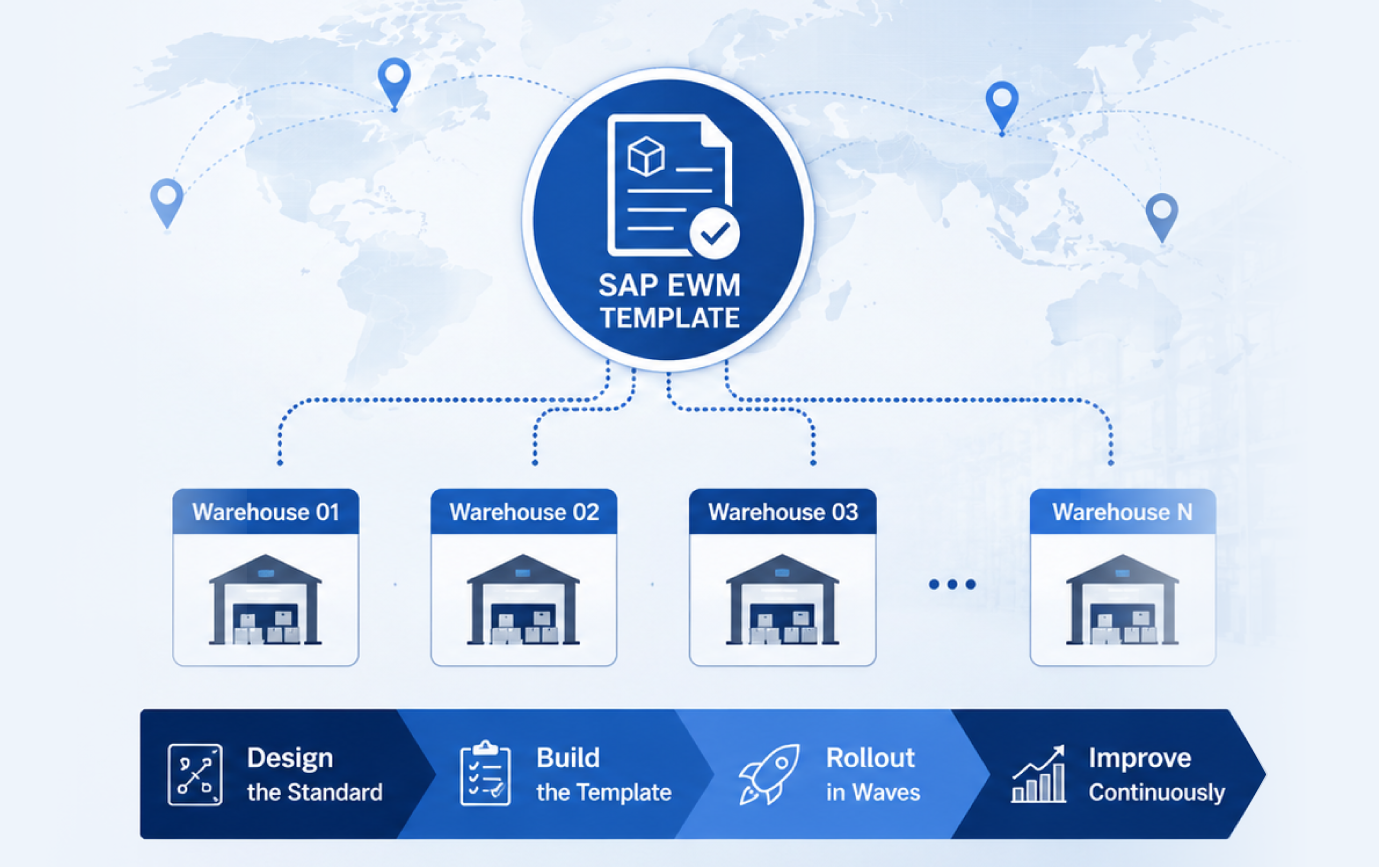
Building one global template is the easy part. Rolling it out cleanly across 20, 50, or 100 warehouses is where most SAP programmes lose their footing. This is the methodology SCM CHAMPS uses to make global SAP EWM deployments repeatable, scalable, and predictable — wave after wave.
In short: Stop treating each warehouse as a new project. Build one validated SAP EWM template, deploy it in controlled waves, and localise only where law or physical reality forces you to. Done right, every site costs less effort than the one before — not more.
Why most global SAP rollouts slow down after the first warehouse
The first warehouse almost always goes well. It has executive attention, the best people, a generous timeline, and the patience to get the design right. The flagship goes live, everyone celebrates, and the programme declares the template “done”.
Then the second site starts asking questions. Their inbound process is a little different. They want one extra report. Their yard works another way, so could the putaway logic flex just slightly? The third site has its own list. By the tenth site, the “global template” has quietly become ten dialects of itself, each maintained separately, each a small new project with its own testing, its own consultants, and its own assumptions.
This is the trap. Every warehouse that gets treated as a fresh implementation drags the programme back toward where it started. Cost climbs instead of falling. Timelines stretch instead of shrinking. Left unchecked, this is how a standardisation programme quietly turns back into fifty separate ones — each with its own consultants, its own testing, its own assumptions, and its own bill. The whole promise of standardisation — lower run cost, cleaner data, simpler upgrades — leaks away one “small exception” at a time.
The fix is a shift in mindset. Stop treating each warehouse as a project; treat it as a product deployment. A new site shouldn’t be a fresh implementation — it should be the next install of an already-proven template.
What a template-driven rollout factory actually is
A template-driven rollout factory replaces one-off projects with one repeatable production line. As an SAP EWM rollout strategy, the thinking is borrowed from manufacturing: design the product once, build the tooling once, then produce units predictably and improve the line as you go.
In SAP EWM terms, that means five disciplines working together:
- Design one global operating model — the way the company wants warehouses to run, independent of any single site.
- Build one validated SAP EWM template — configuration, integration, RF transactions, warehouse structure, master data, and test assets, packaged to be deployed, not copy-pasted.
- Roll out in controlled waves — sites grouped and sequenced deliberately, not launched all at once.
- Localise only where law or physical reality demands it — and challenge everything else.
- Govern and improve continuously — every go-live feeds lessons back into the template so the next wave is cleaner.
None of these is novel on its own. The discipline is in running all five at once, every time, without letting the standard erode.
Why traditional rollouts get expensive — and template-driven ones get cheaper
The cost difference between the two approaches isn’t a rounding error; it compounds with every site.
| Traditional rollout | Template-driven rollout factory |
| Every warehouse starts from scratch | One validated template deployed everywhere |
| Different consultants make different decisions | Standard design governed centrally |
| Long, repeated testing cycles | Reusable test scripts and data |
| Many process variations | Standardised operations with controlled exceptions |
| Heavy per-site customisation | Localisation only where mandated |
| Painful, fragmented upgrades | One template to upgrade, once |
The reason the right column wins is reuse. Across large global SAP programmes, it’s typically observed that 40–70% of the global template carries straight into a new site’s first wave, with only the genuine local delta added on top. That reused portion is work you don’t pay for again at warehouse two, ten, or fifty — and unlike a one-time discount, the saving accumulates across the rollout.
The five building blocks of a template-driven rollout factory
1. Global process standardisation
Before any configuration, the program has to agree on how a warehouse runs as a company, not as a location. In EWM, the core flows that should look the same everywhere are:
- Receiving — inbound delivery handling, deconsolidation, quality inspection triggers
- Putaway — storage type search and bin determination strategies
- Picking — wave management, pick strategies, and replenishment logic
- Packing — packing specifications and handling-unit creation
- Shipping — staging, loading, and goods-issue posting
- Physical inventory — counting methods and reconciliation
If two sites genuinely run receiving differently for no legal or physical reason, that’s usually a sign the operating model wasn’t settled — not a sign the template needs another variant.
2. Template architecture
Good SAP EWM template design is what separates a smooth SAP warehouse implementation from a painful one. A template that can actually be rolled out is more than a configured system — it’s a packaged, documented asset:
- EWM configuration — warehouse structure (storage types, sections, bins, activity areas) and storage control
- Integration — queues, distribution model, and interfaces to S/4HANA or ECC, plus MFS, automation, or carriers where relevant
- RF framework — the radio-frequency transactions operators actually use on the floor
- Master data — product, packaging specification, and warehouse master-data standards
- Documentation & test scripts — process definitions, a clear “global vs. local” map, and reusable test cases
The documentation and test assets are what separate a template from a lucky first project — and what make the second deployment faster than the first.
3. Wave-based deployment strategy
Big-bang global go-lives concentrate risk into a single date and a single weekend. Waves spread it out and turn each release into a rehearsal for the next.
The industry standard is to industrialise rollouts into waves and clusters — grouping sites by similar size, geography, and complexity — so deployments run in parallel and lessons compound. Wave 1 is effectively a pilot: it proves the template works in the real world and exposes whatever the design workshops missed. Every subsequent wave is faster because the team is more practised, the test assets are hardened, and the template absorbs each fix.
4. Controlled localisation
This is where templates live or die. The rule used by mature programmes is deliberately strict: only legal and statutory requirements justify a change to the template. In practice that means localisation should cover:
- Tax rules
- Country and regulatory requirements
- Mandatory labels and documentation
- Local carrier integrations
- Language
- Statutory compliance and reporting
Everything else stays standard. The hard part isn’t writing this rule — it’s holding the line on it. A surprising number of “legal requirements” raised during rollout turn out to be habits, preferences, or business practices that users have simply always followed. Each one that gets implemented as a local exception is a country-specific solution that quietly contradicts the template. The skill a good rollout partner brings is the judgement to tell a genuine legal mandate from a comfortable habit — and the governance to say no to the latter.
5. Governance and continuous improvement
A template-driven factory needs a body that owns the standard — global process owners and a change-control authority that decides what enters the template and what stays local. Without it, the template fragments back into the mess it was meant to prevent.
Governance also runs the other way. Each wave brings real improvements: a cleaner test script, a better RF flow, a fix to a putaway strategy, and those roll into the master template so each site gets a better starting point than the last. “It’s that feedback loop that makes the factory better with scale, not just faster.”
That feedback loop helps the programme get better as it scales, not just faster.
The proof: why this gets faster every time
A template-driven rollout isn’t a theory — it’s how large SAP programmes are actually industrialised.
Industry experience consistently shows that 40–70% of a global template carries straight into each new site’s first wave, with only the delta the genuinely local pieces added on top. That reused share is the work you don’t repeat at the next warehouse, and it’s where the speed and cost savings come from.
The pattern holds across the industry: rollouts are deliberately grouped into waves and clusters, batched by similar size, geography, and complexity, so each wave runs in parallel and each one is smoother than the last because the lessons feed straight back into the template.
And the discipline that protects all of it is localisation control — the strict rule that only legal and tax requirements justify a template change, with every other local request challenged rather than waved through. That single line of governance is the difference between a template that scales and one that slowly turns back into fifty separate projects.
For context on scale: large global template programmes commonly span two to five years, and individual multi-site rollout projects typically run from six months to two years depending on the number of locations and the degree of customisation. A repeatable factory is precisely what keeps a programme of that size from drifting — and it’s why each warehouse SCM CHAMPS deployment is designed to cost less effort than the one before it, not more.
How decision-makers should evaluate a rollout partner
If you’re a CIO, supply chain director, or program manager scoping a multi-site EWM program, the question to ask a partner isn’t “Can you implement SAP EWM?” Plenty of firms can land one warehouse. The questions that actually predict a successful rollout are different:
- Do they have an existing rollout methodology, or will they invent a new one at each site? A real factory has a named, repeatable method, not improvised consulting.
- Can they standardise aggressively without ignoring genuine local requirements? Both failure modes are expensive: too rigid and sites can’t operate legally; too flexible and the template dissolves.
- Have they delivered multi-site rollouts — not just one strong implementation? The skill of the second, fifth, and tenth deployment is different from the skill of the first.
- Can they cut rollout time through reusable assets? Ask to see template documentation and test scripts, not just slideware.
- Do they provide governance after go-live? Hypercare and ongoing change control are where standardisation is either protected or lost.
- Can they actually run global deployment waves? Sequencing, clustering, and parallel execution are their own discipline.
- Do they understand warehouse operations as well as they understand SAP? Technology alone doesn’t make a warehouse run.
A partner who welcomes these questions is usually one who has answered them before.
How SCM CHAMPS approaches template-driven SAP EWM rollouts
We don’t run warehouse rollouts as a series of projects. We run them as a production line — one validated template, deployed wave after wave, getting cleaner each time. The test we hold ourselves to is simple: if site ten is more painful than site one, the methodology has failed.
What we bring to that:
- Senior-led advisory. You work with experienced consultants, not a bench of juniors learning on your programme. The people who shape your template are the ones who’ve sat in the rollout room.
- Certified SAP professionals. Real SAP EWM depth, so the standardise vs localise calls are made on expertise, not guesswork.
- Hands-on EWM project experience. We know how receiving, putaway, picking, and the rest actually behave on the floor — and where rollouts quietly go wrong.
Five principles drive every programme:
- Standardise first. Settle the global operating model before touching configuration.
- Validate early. Prove the template in a real pilot wave, not a design document.
- Deploy in waves. Sequence sites by size, geography, and complexity so each release de-risks the next.
- Localise only where necessary. Hold the legal-and-tax-only line, and challenge everything else.
- Improve continuously. Feed every wave’s lessons back into the master template.
Frequently asked questions
What is an SAP EWM template implementation? It’s the practice of building one validated EWM configuration — processes, integration, RF transactions, warehouse structure, master data, and test assets — and deploying it across multiple warehouses, instead of configuring each site from scratch.
What is a global rollout template? A packaged, reusable design of how warehouses should run globally. It defines the standard processes and configuration that every site inherits, leaving only mandated local items to be added per location.
What is a wave-based rollout strategy? Warehouses are set up in groups, rather than all at once. Sites are clustered based on factors like size, geography and complexity, so deployments can be run in parallel, with lessons learned in one group applied to improve the next.
When should companies localise SAP EWM? Only when a legal, tax, statutory, or genuine physical constraint requires it — for example, country tax rules, mandatory labels, local carriers, or language. Preferences and habits should stay on the global standard.
How many warehouses should be included in one rollout wave? There’s no fixed number; it depends on site complexity and available resources. Early waves are kept small (often a single pilot) to validate the template, with later waves widening as the team and assets mature.
What is the biggest reason global SAP rollouts fail? Loss of template discipline. When local exceptions are accepted without strict governance, the global template fragments into many site-specific variants, and the cost and complexity the program set out to remove come straight back.
How does a template reduce implementation cost? Through reuse. With a large share of the template, typically 40–70% in big programmes, carried into each new site, the configuration, testing, and design work isn’t repeated everywhere, so per-site cost and time fall as the rollout progresses.
Can every warehouse use the same SAP EWM configuration? Largely, yes — the global core (receiving, putaway, picking, packing, shipping, inventory) should be identical. The only differences are through legally or physically mandated elements, which are added as controlled extensions.
Key takeaways
- Build one standard template instead of treating every warehouse as a new project.
- Validate it thoroughly in a real pilot wave before scaling.
- Deploy in waves, clustered by size, geography, and complexity.
- Localise only where law or physical reality demands it — challenge everything else.
- Govern the standard centrally so it doesn’t fragment.
- Measure every rollout and feed the lessons back in.
- Improve the template after every deployment so the next site starts ahead of the last.
A global SAP EWM programme done this way doesn’t get heavier with each warehouse. It gets lighter, which is exactly the point.
Fix your template before your second warehouse
Template erosion compounds. It’s cheap to get the standardise and wave approach right before site one and expensive to unpick once five sites have each gone their own way. The earlier you set the template, the more every later warehouse benefits.
Book a free rollout-readiness conversation with our senior SAP EWM team. We’ll look at your sites, show you where a template-driven approach saves the most time and risk, and tell you what your first wave should look like.