


You walked the floor this morning. Everything looked fine.
Forklifts moving. Team busy. Shelves stocked. On paper — solid operation.
But here is what your morning walkthrough did not show you: somewhere between Aisle 4 and Aisle 9, units are missing. Some are misplaced. Some exist in your system but not on your shelves. And your Warehouse Management System? It has absolutely no idea.
No alarm went off. No red flag appeared. Just quiet, invisible loss — happening right now, while you read this.
That is the leak. And almost every warehouse in America has one.
The Problem Is Not Your Team. It Is the Process.
Workforce is not the problem. Here are a few critical things to consider-
Manual cycle counting was never built to scale and keep up with the pace of modern warehouses.
If you ask your team to walk through thousands of storage locations. Scan each one accurately. Record the data. Cross-reference it against the system. And do it consistently shift after shift, week after week — without a single error. No human team can sustain that. It is not a criticism. It is just physics.
Why Manual Cycle Counting Fails Modern Warehouses
This is the conversation most warehouse operations managers avoid having — because admitting the process is broken feels like admitting failure. But it is not failure. It is just reality.
A typical warehouse team can realistically scan a few hundred locations per hour. Meanwhile your operation has thousands of locations that need accurate, up-to-date counts at all times. By the time your team finishes Section A, Section B is already outdated.
And that gap — between what your WMS says and what is physically on the shelf — is exactly where the leak lives.
Warehouse cycle counting automation exists precisely because this problem has no manual solution. You cannot hire your way out of it. You cannot train your way out of it. The volume is simply too high and the margin for human error is too wide.
Errors quietly stack up. Wrong inventory numbers sit in your system for days — sometimes weeks — before anyone catches them. And in that window, wrong shipments go out, orders get delayed, customers get frustrated, and you are left trying to figure out where it all went sideways.
The leak is not dramatic. There is no single moment where everything breaks. It is slow. Steady. And brutally expensive over time.
What If Your Warehouse Could See Itself — In Real Time?
This is exactly the question that modern operations managers across the country are starting to ask. And it is the right one.
Because the solution is not hiring more people to do the same broken process faster. The solution is changing the process entirely.
Autonomous inventory robots, specifically designed for warehouse inventory scanning, are completely rewriting how cycle counting works. These robots move through the aisles independently. They –
- Capture shelf images
- Collects inventory data
- Read barcodes with accuracy he speed goes up to ten thousand locations per hour.
And here is the part that really changes things — the robot does not interrupt your operation. It works around your team, around your schedule, and feeds live data directly into your existing warehouse management system the moment it collects it.
No waiting. No manual data entry. No lag between what the robot sees and what your system knows.
Your System Stays. It Just Gets Smarter
One of the biggest fears operations managers have when they hear “new technology” is that it means ripping out everything they already have. New software. New training. New headaches.
This is where SCM Champs is doing something genuinely different in the market.
The focus is on correct SAP EWM integration along with robots.
We help integrate robots with systems with other systems and platforms across the network. We ensure seamless exchange of data across systems.Your inventory updates automatically. Your team sees accurate numbers in real time — without touching a scanner, without walking a single aisle manually.
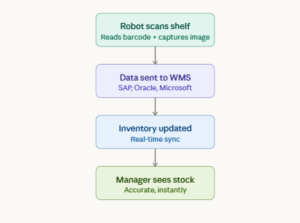
Here is what warehouse inventory automation actually looks like inside a live operation:
- Robot moves independently through every aisle
- Captures shelf images and reads barcodes simultaneously
- Data is instantly pushed to your existing WMS
- Inventory records update in real time — automatically
- Your manager opens the dashboard and sees exactly what is on the shelf — right now
No manual entry. No lag. No guesswork.
SCM Champs built this integration process specifically for warehouse operations that cannot afford downtime or complicated transitions. The setup does not disrupt your daily workflow, and your team does not need to learn anything new. They just start seeing better, more reliable data — from Day 1.
Here Is What Happens When the Leak Finally Stops
Most warehouse managers we talk to have accepted a certain level of error as just part of the business. A few wrong shipments here. Some missing stock there. They chalk it up to human error and move on.
But what if that “acceptable” error rate is actually bleeding your operation dry — slowly, quietly, every single day?
Here is what genuinely changes when you close the gap between what your system says and what is physically on your shelves.
Inventory accuracy — which sits somewhere between 70 and 80 percent in most manually-operated warehouses — climbs above 99 percent almost immediately. That is not a gradual improvement over months. That is a complete transformation in how trustworthy your data actually is.
Warehouse cycle counting automation compresses what used to take days into just a few hours. Not because your team is working faster — but because the robot does not stop, does not get tired, and does not miss a single barcode.
Stock discrepancies that used to quietly pile up between counts drop by up to 90 percent. Orders go out correctly. Shipments arrive on time. And the customer complaint emails that used to land in your inbox every Monday morning? They start disappearing.
Your team stops spending their shifts walking aisles with handheld scanners and starts focusing on work that actually moves your operation forward.
Warehouse Performance: Before vs. After Automation
| Metric | Before SCM Champs | After SCM Champs |
|---|---|---|
| Inventory Accuracy | 70–80% | 99%+ |
| Cycle Count Duration | Several days | A few hours |
| Stock Discrepancies | High and difficult to track | Up to 90% reduction |
| Team Activity | Daily manual counting | Focused on higher-value operational work |
| Inventory Visibility | Delayed and incomplete | Real-time visibility across the warehouse |
That last row in the table is the one that matters most. Real-time visibility across your entire warehouse is not just an operational upgrade — it is a complete shift in how confidently you can run your business.
That feeling of opening your WMS in the morning and actually trusting what you are looking at — most warehouse managers have never experienced it. Once they do, they never want to go back.
A Real Story Worth Hearing
One warehouse operation was running three full-time team members on daily manual cycle counts. These were good, experienced people — not slow, not careless. But inventory errors kept happening. Shipments kept going out wrong. The manager knew something was off but could not pinpoint exactly where.
After deploying an autonomous inventory robot fully integrated with their existing WMS, the manual counting stopped completely.
- The inventory accuracy increased by up to 98.4%.
- Incorrect shipments were reduced.
- Customer complaints dropped sharply.
The leak was sealed. And the operation has not looked back since.
We Know What You Are Thinking Right Now
“This sounds expensive.”
Consider this — what is your current inventory error rate actually costing you right now? Wrong orders, return processing, expedited reshipping, lost customers. The cost of the problem almost always exceeds the cost of solving it. Almost every time.
“Will this work with our current system?”
Yes. WMS integration is not a workaround or an afterthought here — it is the entire foundation of how this solution works.
“What happens to my team?”
They stop doing the most tedious, repetitive part of their job and start contributing in ways that actually push your operation forward.
The Leak Will Not Fix Itself. But We Can.
Every day your warehouse runs on inaccurate inventory data is another day of invisible loss. Another day of decisions made on numbers that do not reflect what is actually sitting on your shelves.
You do not need a complete operational overhaul. You do not need to retrain your entire team or replace your existing systems. You just need real, accurate, real-time visibility — and the right integration to make it work seamlessly inside your operation.
SCM Champs works with warehouse operations across the country to make exactly that happen. No pressure. No complicated sales pitch. Just an honest look at where your operation stands today — and a clear picture of what it could look like with the right solution in place.
Book your free 30-minute demo today. Let us show you exactly where your warehouse is leaking — and how we seal it for good.