


In this article, we’ll give you five proven strategies that can help you deploy S/4HANA effectively and maximise long term benefits.
Deployment Options for SAP S/4HANA: Picking Your Battlefield
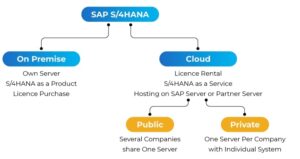
This is your first and most strategic call. It’s not just about servers and data centers; it’s about defining how your entire company will operate & what your costs will look like, and how you’ll partner with SAP for the next ten plus years.
This single choice basically shapes your project’s approach, how you will manage the system day to day & the total cost of ownership.
Let’s get into the nitty-gritty of each model:
1. SAP S/4HANA Public Cloud (The Standardized SaaS Play):
The Reality: This is a standardized, subscription-based service. SAP runs the whole show: the hardware, the database, the application itself, and all those pesky updates happen automatically in the background. You are getting a shared environment where the core software is the same for everyone.
Who It’s For: Ideal for any mid size companies or larger enterprises whose processes align smartly with SAP’s built-in, industry-standard best practices. It’s the go-to for leaders who want predictability, lightning-fast deployment, and zero headaches managing IT infrastructure.
The Inside Scoop: The mantra here is “adopt, don’t adapt.” Your implementation will be a relentless “fit-to-standard” analysis. Custom code is a no-go. You’re trading flexibility for radical simplicity, lower IT overhead, and the guarantee of always running the latest version.
2. SAP S/4HANA Private Cloud (The Managed Environment):
The Reality: Your S/4HANA system lives on its own dedicated servers in a cloud infrastructure (like Azure, AWS, or SAP’s own data centers), and a provider manages it for you. This is the heart of the RISE with SAP offering, which bundles the software license, infrastructure, and technical management into one monthly bill.
Who It’s For: Large, complex enterprises that need deeper customization, have stringent compliance or data sovereignty rules, or run a sprawling application landscape that demands a dedicated environment. You get the flexibility of a private system paired with the operational ease of cloud hosting.
The Inside Scoop: RISE isn’t just hosting; it’s sold as a transformation-as-a-service package. Your provider handles the “bits and bytes,” but your team (and your consultants) still own the business process configuration and innovation. Right now, this is the sweet spot for most global corporations making the move.
3. On-Premise (The Classic Model):
The Reality: You buy perpetual licenses and you run the show. You install and manage S/4HANA on your own hardware in your own data center. You have absolute control and maximum power to customize.
Who It’s For: Organizations with ultra-unique security, regulatory, or integration demands that simply can’t be met in any cloud environment. This path requires a deep bench of in-house IT talent to handle the infrastructure, database, and application management.
The Inside Scoop: While control is maximal, so is the total cost of ownership. You have to factor in hardware, power, cooling, database admins, basis teams, and the monumental effort of future upgrades. Frankly, the industry is running away from this model for core ERP. SAP’s innovation engine is now entirely focused on its cloud editions.
The Bottom Line: Your choice isn’t set in stone, but changing your mind later is a painful and expensive ordeal. The momentum is unequivocally toward the cloud (Public or Private) to shed IT debt, boost agility, and tap into SAP’s continuous innovation stream. Here’s a pro tip: Base this decision on your business process maturity and long-term IT strategy, not just on short-term cost calculations. A company that needs heavy customization will chafe in the Public Cloud, while a company seeking simplicity will drown in overhead with On-Premise.
Implementing SAP S/4HANA: The Blueprint for Execution
Once you’ve picked your deployment model, you need a battle-tested methodology. For S/4HANA, the undisputed standard is the SAP Activate Methodology. This is an agile, iterative framework that combines SAP’s best practices, guided configuration, and a wealth of pre-built templates to accelerate your journey to value.
Here’s a walk through of the six phases of SAP Activate:
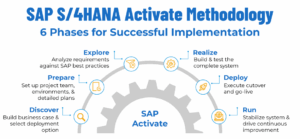
Phase 1: Discover
The Goal: To build a rock-solid business case, explore what the solution can do, and select the right deployment option. This is the strategic phase where you answer, “Why are we doing this?”
What Actually Happens: You’ll assess value and scope, analyze deployment options, draft initial plans, and socialize the vision across the leadership team. This is where you secure that all-important executive sponsorship and get everyone on the same page.
Phase 2: Prepare
The Goal: To stand up your project team, environments, and detailed project plan.
What Actually Happens: Finalizing the project charter, setting up the PMO, and preparing development and test environments (often starting with pre-configured “sandbox” systems). You’re building the foundation and establishing governance rules for the entire project.
Phase 3: Explore
The Goal: This is the functional core of the project. To analyse and validate your business requirements against SAP’s pre-delivered best practices and finally scope the solution.
What Actually Happens: You’ll conduct Fit-to-Standard workshops. Your team and consultants walk through every critical business process (like “Record to Report” or “Lead to Cash”) using SAP’s “Best Practices” as the baseline. The output is a list of “gaps” where the standard doesn’t meet a critical need. A word to the wise: The goal is to adopt the standard whenever humanly possible. Challenge every single gap—is this a genuine competitive advantage, or just “the way we’ve always done it”?
Phase 4: Realize
The Goal: To build and test the complete system based on what was defined in Explore.
What Actually Happens: This is a series of agile sprints where you configure the system, develop any essential custom objects (like Fiori apps or reports), get data ready for migration, and run rigorous testing (unit, integration, UAT, performance). The key output is a set of test scripts that prove the system works as designed.
Phase 5: Deploy
The Goal: To prepare for and execute the cut over to the new S/4HANA system.
What Actually Happens: Final prep, system checks, end-user training, the final data migration, and executing the cutover plan. This is a high-stakes period where a meticulously rehearsed plan is non-negotiable. It all culminates in Go-Live.
Phase 6: Run
The Goal: To stabilise the system, drive user adoption, and fuel continuous improvement and value realization.
What Actually Happens: Post-go-live “hypercare” support, monitoring performance, and putting out initial fires. Most critically, this phase is about measuring real business outcomes against the business case you built in Phase 1 and using the system’s analytics to find new ways to optimize.
Benefits of SAP S/4HANA: Where the Rubber Meets the Road
The benefits are absolutely real, but they are not a given. You have to deliberately design and adopt them.
a) Radical Simplification
This is the core architectural win. S/4HANA strips out the complexity—eliminating aggregates, indices, and redundant tables. The result? A massive reduction in your data footprint (think 10:1 compression) and blisteringly fast processing speeds that finally enable real-time business.
b) The Real-Time Advantage
The in-memory HANA database lets you run analytics and transactions on the exact same dataset at the same time. This means your financial close isn’t a month-end nightmare; it’s a continuous process. You can see the profitability of a single sales order the moment it’s created.
c) A Transformative User Experience (SAP Fiori)
The dreaded old SAP GUI is replaced by Fiori’s intuitive, role-based, and consumer-grade interface. This isn’t just a fresh coat of paint; it’s about productivity. Users get a personalized homepage with everything they need—insights, tasks, applications—all accessible from any device.
d) Built-In Intelligence
Machine Learning (ML) and AI are baked directly into core processes. The system can predict which customers will pay late, automate invoice matching, suggest optimal inventory levels, and flag anomalies. It shifts from a system of record to a system of intelligent action.
e) Your Platform for Innovation
S/4HANA becomes the digital core that cleanly and seamlessly connects to SAP’s intelligent suite (SuccessFactors, Ariba) and next-gen tech like IoT and blockchain through open APIs. It’s how you future-proof your entire IT landscape.
Common Challenges with SAP S/4HANA Implementations: The Pitfalls
Ignore these at your peril. Knowing the traps is the first step to avoiding them.
1. Underestimating Change Management
This is the number one reason projects fail. S/4HANA changes how everyone works. If users aren’t trained, engaged, and shown what’s in it for them, they will revolt. This isn’t a few training videos at the end; it’s a full-time, executive-sponsored campaign of communication and enablement.
2. The “Lift and Shift” Catastrophe
Simply migrating your old ECC system to S/4HANA without streamlining your processes is a tragic mistake. You end up with a faster database running the same old inefficient, convoluted processes. You’re just putting a jet engine on a clunky old car and cementing your problems for another decade.
3. Data Debt
Migrating dirty, duplicate, or obsolete data means your shiny new system is polluted on day one. The time and cost of data cleansing and setting up governance are always underestimated. The old saying “garbage in, garbage out” becomes your new, frustrating reality.
4. The Custom Code Quagmire
Legacy systems are often minefields of custom code. This code has to be analyzed, adapted for S/4HANA’s new data model, or—better yet—retired. It’s a huge, complex, and shockingly expensive effort that many teams fail to plan for.
5. The Skills Gap
The market for experienced S/4HANA talent is a brutal bidding war. Relying completely on system integrators without building your own internal knowledge creates a dangerous long-term dependency and a single point of failure.
How to be Successful: The 5 Secrets to Winning
This is the distilled wisdom from the trenches—what separates the best from the rest.
1. Lead with a Business Case, Not an IT Project
This can’t be an IT mandate. The business must lead it, for the business. The CIO is a crucial enabler, but the CEO and business process owners must be the true sponsors. Your business case, with quantified value targets (e.g., “reduce days sales outstanding by 15%”), is your North Star for every single decision.
2. Embrace the Standard. Challenge Every Customization
The immense value of S/4HANA is in its pre-configured best practices. The default answer to any customization request must be “no.” You have to challenge every gap with brutal honesty: Is this a real differentiator, or just organizational inertia? The more you customize, the faster your ROI evaporates.
3. Treat Your Data as a Strategic Asset, Not a Migratory Burden
Start a dedicated data cleansing and governance workstream on day one. Use the migration as a once-in-a-career chance to purge old records, standardize formats, and create that elusive “single source of truth.” This tedious, unglamorous work pays off in spades with system performance and user trust.
4. Invest Heavily in Change Management & Hyper care
Budget for it upfront. Put a superstar from the business in charge of it. Communicate until you’re sick of hearing yourself talk. Show users how their jobs get easier, not just different. And plan for a robust, multi-tiered hyper care support structure for a solid 2-3 months after go-live to ensure stability and build user confidence.
5. Build Internal Expertise Relentlessly
Remember, your system integrator partner will eventually pack up and leave. Your team will be there forever. From the very start, demand a concrete knowledge transfer plan. Embed your key users in the Fit-to-Standard workshops and your IT team in the technical design sessions. This builds the internal muscle memory you need to run, optimise, and innovate on this platform for the next decade.
Conclusion
Let’s be frank: the journey to SAP S/4HANA is complex. It’s likely the most defining business technology project your organisation will undertake this decade. But true success isn’t just found in a flawless project plan. It’s found in a mindset: a relentless focus on business value, the courage to embrace standard processes, and a deep respect for the people and the data that make your business tick.
Frequently Asked Questions
SAP S/4HANA Public Cloud prioritizes standardization and innovation. It’s a multi-tenant system where all customers use the same shared, SAP-managed platform. This allows for rapid implementation, lower cost of ownership, and automatic quarterly updates with the latest features. Businesses benefit most by adapting their processes to SAP’s embedded industry best practices.
RISE with SAP: Private Cloud Edition prioritizes customization and control. It provides a single-tenant system, meaning you have your own dedicated instance of S/4HANA hosted on a hyperscaler cloud (like AWS or Azure), fully managed by SAP. This model is designed for businesses that require deeper, more specific customizations to their core system while still wanting SAP to handle the infrastructure and application management.
How to think about it today:
The choice isn’t about which is “better,” but which is a better fit. If your business can thrive using standard processes, the Public Cloud offers unparalleled agility. If you have unique, complex, or legacy processes that are non-negotiable, the Private Cloud provides the necessary flexibility.
Ask yourself these key questions:
1. How unique are our business processes?
• Choose PUBLIC CLOUD if: Your processes are largely standard (e.g., standard finance, HR, procurement) or you are willing to adapt to SAP’s built-in industry best practices. The goal is efficiency and standardization.
• Choose PRIVATE CLOUD if: Your business has unique, complex, or non-negotiable processes that provide a competitive advantage. This is common in highly specialized manufacturing, utilities, or heavily regulated industries where deep customization is required.
2. What is our appetite for innovation vs. stability?
• Choose PUBLIC CLOUD if: You want to move fast and always be on the latest version. SAP delivers new features quarterly, and they are applied automatically. This is ideal for companies that see technology as a key driver of innovation.
• Choose PRIVATE CLOUD if: You require more control over the timing of updates. While SAP manages the system, you have a greater say in when to adopt new features, allowing for more extensive testing and change management for a complex environment.
3. What are our IT resources and strategy?
• Choose PUBLIC CLOUD if: You want to minimize IT overhead and focus your IT team on strategic business solutions rather than maintaining infrastructure and software. SAP handles everything.
• Choose PRIVATE CLOUD if: You have a strong IT team with specific skills (like ABAP development) and need them to perform deep customizations, even though SAP manages the underlying infrastructure.
1. Unmatched Real-Time Insight and Decision Making
• Instant Closing: Financial closings that used to take weeks can be reduced to days or even hours.
• Live KPIs: Managers can see live performance dashboards, enabling faster, data-driven decisions.
• Predictive Analytics: Move from looking at what happened to forecasting what will happen.
2. Radical Simplification and Efficiency
• Simplified IT: It reduces data footprint by eliminating aggregates and indices, streamlining your database.
• Process Efficiency: Embedded best practices and a streamlined user experience (via Fiori) reduce steps in key processes like order-to-cash or procure-to-pay, boosting productivity.
3. Foundation for Future Innovation (AI, IoT, Machine Learning)
• Embedded Intelligence: SAP embeds AI and machine learning directly into workflows (e.g., for automated invoice matching or predictive maintenance).
• IoT Ready: It can easily consume and process vast streams of data from connected devices, enabling new business models.
• Cloud Ready: Whether you choose Public or Private Cloud, you gain the agility to innovate faster without managing hardware.
4. Enhanced User Experience and Productivity
• Intuitive Design: Employees spend less time navigating complex transactions and more time on value-added work.
• Personalized: Users get a homepage with the apps, information, and alerts most critical to their job function.
5. Reduced Total Cost of Ownership (TCO)
• Lower IT Maintenance: A simplified landscape and cloud options reduce hardware and database maintenance costs.
• Higher Business Productivity: Efficient processes and a better user experience lead to significant operational savings.
In summary, moving to S/4HANA transforms your business from running legacy operations to operating a live, intelligent enterprise ready for whatever comes next.
Companies that focus only on the technical migration—lifting their existing custom-coded processes and data from the old system and dropping them into the new one—fail to capture over 70% of the value S/4HANA offers. This approach leads to a more expensive, more complex project that delivers minimal business return.
Why this is so critical:
S/4HANA is not just a faster database; it’s a fundamentally different platform built with embedded intelligence, industry best practices, and real-time capabilities. Simply replicating outdated, inefficient processes wastes this potential and perpetuates existing problems.
The consequences of this mistake include:
• Higher Cost & Complexity
• Missed ROI
• Change Management Failure
How to Avoid This Mistake:
1. Start with a Business Case, Not a Technical Plan.
2. Adopt “Clean Core” Principles.
3. Invest in Process Re-engineering Before Configuration.
4. Secure Business Leadership Ownership.
In short: The goal is not to recreate your past system in a new technology. The goal is to redesign your future operating model enabled by the new technology.