
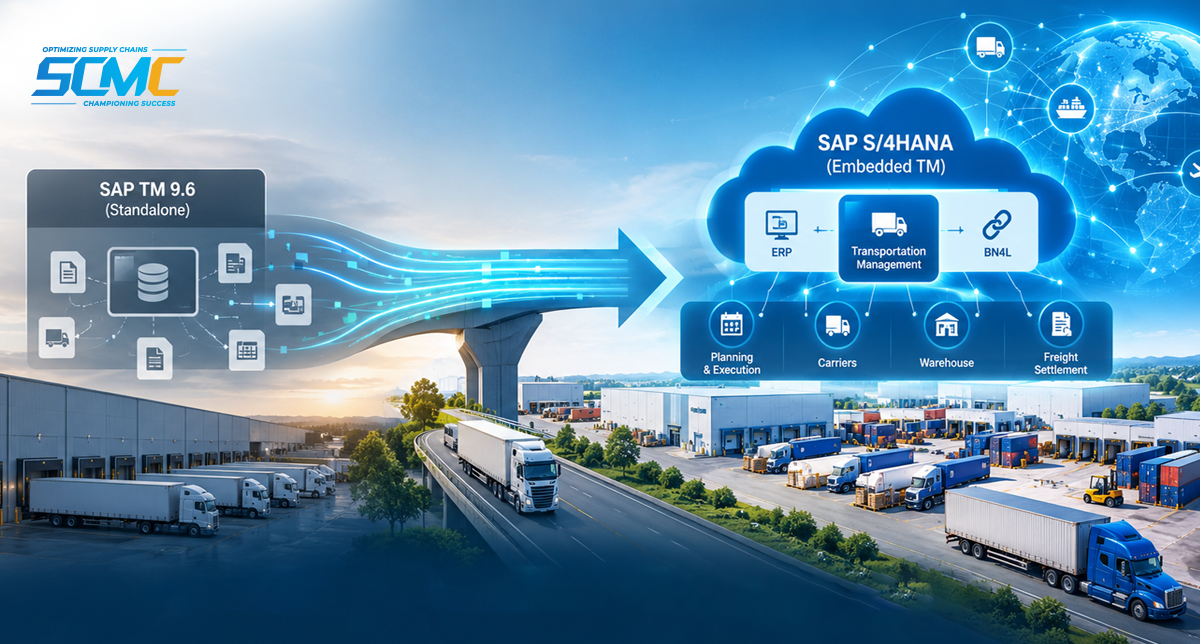
SCM Champs will oversee the SAP Transportation Management 9.6 migration to TM embedded in SAP S/4HANA for a Fortune 500 Food & Beverage Manufacturer. The project will culminate in a coordinated, single-day production go-live across all in-scope locations in the USA and elsewhere in North America.
The seven-phase program covers SAP Business Network for Logistics (BN4L) enablement, data migration, and carrier integration. It runs from building a strong technical foundation through a single-day go-live, followed by formal hypercare and project closure.
SCM Champs is an SAP partner specializing in SAP supply chain execution and an experienced SAP TM migration company. It has been selected as the SAP TM 9.6 migration partner for a USA-based Fortune 500 food and beverage manufacturer, which is moving from its standalone TM 9.6 system to Advanced Transportation Management embedded in SAP S/4HANA, along with an SAP Business Network for Logistics (BN4L) implementation.
This announcement is also a notification for every other organization still running standalone SAP TM.
SAP Transportation Management 9.6 is the final standalone release of SAP TM on the SAP SCM / NetWeaver stack. Mainstream maintenance for SAP Business Suite 7 core applications, including the SCM platform on which it runs, ends on December 31, 2027. SAP will only offer optional extended maintenance until December 31, 2030.
This SAP TM 9.6 end-of-maintenance timeline makes migration to S/4HANA Embedded TM even more important. Organizations that do not complete the migration within the applicable maintenance date will eventually end up running obsolete and unsupported systems.
Although it is often described as an SAP TM 9.6 upgrade to S/4HANA, migrating from standalone SAP Transportation Management 9.6 to Advanced SAP TM embedded in SAP S/4HANA is a re-implementation, not a technical upgrade. It requires careful SAP TM migration planning from the start.
SAP TM on S/4HANA runs on a different platform, data model, and integration architecture than SAP TM on SAP NetWeaver. So, organizations cannot assume that their existing legacy TM configuration will be copied as it is into embedded S/4HANA.
For example, standalone SAP TM uses Order-based Transportation Requirement (OTR) and Delivery-based Transportation Requirement (DTR) documents as transportation requirements. In embedded SAP TM, transportation processes are tightly integrated with S/4HANA processes such as MM (Materials Management), SD (Sales and Distribution), and LE (Logistics Execution). Freight units are created directly from sales orders, purchase orders, and deliveries, so OTR/DTR-based processes must be redesigned.
Similarly, custom BOPF enhancements, determinations, validations, or actions in the legacy system should not be treated as configuration that can simply be transported into embedded SAP TM.
SAP provides system transformation tooling for S/4HANA TM migration. Here are some of its limitations:
These limitations are among the biggest SAP TM migration challenges, and they have a direct impact on cutover planning. Therefore, before go-live, the project team must invest in:
This is why choosing the right SAP Transportation Management 9.6 migration company is crucial.
The differences between SAP TM 9.6 and S/4HANA TM go well beyond the platform:
| Comparison Parameter | Standalone SAP TM 9.6 | Embedded Advanced TM on SAP S/4HANA |
|---|---|---|
| Platform | SAP SCM 7.0 EhP4 on SAP NetWeaver | SAP S/4HANA (same instance as ERP) |
| Release status | Final standalone SAP TM release | Current, actively developed |
| Mainstream maintenance | Ends December 31, 2027 | SAP has committed to S/4HANA maintenance until at least 2040 |
| Master data | Replicated via CIF/DRF between ERP and TM | Native; no replication for core objects |
| Document flow | OTR / DTR transportation requirements | Direct integration with sales orders and deliveries |
| Licensing | Advanced TM license required | Basic (Shipping) TM embedded; Advanced TM licensed separately |
| Optimizer / VSR planning | Available | Requires Advanced TM license |
| Planning profiles | TM 9.x profiles | Must be rebuilt; not transferable |
Organizations still relying on SAP TM 9.6 support should review the following key dates:
| Area | Key Date and Status |
|---|---|
| SAP Business Suite 7 core applications | Mainstream maintenance ends December 31, 2027; optional extended maintenance available through December 31, 2030 |
| Enhancement Packages (EhP 6–8) | Covered by the 2027 mainstream and 2030 extended-maintenance timelines, subject to applicable SAP maintenance terms |
| SAP S/4HANA Compatibility Pack coverage for classic Transportation (LE-TRA), Customer Service, and PP-PI | December 31, 2030 |
An SAP TM 9.6 to S/4HANA migration involves:
Typically, an SAP Transportation Management 9.6 migration takes around 18 to 36 months. Organizations building an SAP TM migration timeline around the December 31, 2027 deadline must take planning, redesign, implementation, and testing seriously.
Phase 1: Building the Technical Foundation
It involves:
As part of the SAP TM migration assessment, the team compiles and validates the existing SAP TM 9.6 configuration, including data, interfaces, and reports. Interface inventory, data migration inventory, and WRICEF backlog are baselined with volumes, formats, and owners.
Proofs of concept are executed against the highest-risk topics, including advanced Available-to-Promise (aATP) and Backorder Processing, scheduling, planning, integrations, and BN4L.
By the end of this phase, a formal readiness plan is confirmed and the groundwork for the blueprint is in place.
Phase 2: Blueprint
This stage translates the findings from the technical assessment into a clear design and implementation plan. It involves:
Phase 3: Build and Testing
Once the blueprint is approved, it is translated into system configuration. This includes:
Phase 4: Business Testing
The client acts as the primary tester to ensure the migration aligns with business needs and requirements. This includes:
Phase 5: Cutover Preparation
Cutover preparation converts the tested solution into a controlled, executable plan for production transition. It involves:
Phase 6: Single-Day Go-Live
A single-day go-live across all in-scope locations results from extensive cutover preparation and rehearsal. It is not simply compressing the migration into one production window.
Because standard SAP tooling does not migrate transactional data, the cutover strategy must account for open freight documents, master-data freezes, and controlled activation. Open freight documents are drained, closed, or recreated according to the approved cutover strategy.
This preparation is what makes the compressed, single-day production window achievable rather than aspirational.
Phase 7: Hypercare and Closure
The final phase focuses on stabilizing production, transferring operational knowledge, and formally closing the transformation. It involves:
"Every organization that is still running SAP TM 9.6 is working against a fixed date. The hardest part of these programs is not the software; it is the transactional data, the carrier integrations, and the cutover," said Prabhjot Singh Nayyar, Founder and Chief Executive Officer (CEO) of SCM Champs.
"SAP's migration tooling moves customizing and master data. It does not move your freight orders. That reality has to shape the program from day one, which is why we rehearse cutover repeatedly before anyone signs off on a go-live date."
According to Grand View Research, the global transportation management system market was valued at USD 18.6 billion in 2025 and is projected to reach USD 68.4 billion by 2033, at a CAGR of 17.8%. Freight and order management is the largest functional segment at 25.8%, and North America is the largest region.
According to the CSCMP 36th Annual State of Logistics Report, U.S. business logistics costs reached USD 2.58 trillion in 2024, around 8.8% of GDP, with transportation accounting for 64.4% of the total.
Yet only 17% of shippers report fully automated transportation operations. According to the 2025 Descartes Global Transportation Management Benchmark Survey, 81% of businesses consider transportation management a competitive differentiator.
In 2026, SAP was named a Leader in the Gartner Magic Quadrant for Transportation Management Systems for the 12th consecutive year.
Contact SCM Champs, a trusted SAP Transportation Management migration company, to assess your existing TM landscape. SCM Champs' SAP TM 9.6 migration services help you define the right migration strategy and plan a realistic, controlled transition to S/4HANA Embedded TM.
Talk to an SAP TM Migration Expert to gain confidence in the migration process.
SCM Champs is an SAP partner specialising in SAP supply chain execution. It provides SAP Transportation Management consulting for TM transformation, migration, and upgrade programs, supporting organizations in the USA, Canada, Singapore, and India, with delivery capability across North America and Asia.