

It's a normal morning. A picker heads over to grab twelve units for a priority order, and the system's sure they're there. The bin is empty. Over in the next aisle it's the opposite: a product reads zero, so someone in purchasing quietly reorders it — even though two pallets of it came in last week and are sitting in reserve.
Nothing's been stolen. Nothing's actually lost. The warehouse just can't trust its own screens anymore.
That's stock inconsistency, and once a business goes live on SAP EWM, it's one of the problems that quietly does the most damage. So let's walk through where it comes from, what it's really costing you, and how to get rid of it for good — instead of patching the same numbers every week.
SAP EWM stock inconsistency is when the stock recorded in SAP EWM (the system that runs your warehouse at bin level) doesn't match the stock in SAP S/4HANA (your main ERP, which holds the official numbers). It builds up when goods movements fail to sync, communication queues get stuck, or warehouse tasks are left unfinished. To fix it properly, you find the root cause first, then correct the stock.
The simplest way to put it: the stock on your screen isn't the stock on your floor. You rarely notice it as one big event. It's more a slow trickle of small daily problems, and over time that's what wears down trust in the system.
The common signs are:
Deliveries that can't be confirmed because available stock doesn't match what's physically in the bin
Stock showing in SAP S/4HANA but missing in SAP EWM, or the reverse
Constant manual corrections just to keep orders moving out the door
Cycle counts that never quite add up, no matter how often they run
Purchasing reordering material you already have, or running short on material the system said was there
Quantities stuck in an odd status — not clearly available, and not clearly anywhere
Staff quietly keeping their own spreadsheets because they no longer trust the screen
Once your team starts working around the system, the problem is already costing you.
Stock inconsistency almost never comes from one thing. It builds up from small breakdowns — in how EWM and S/4HANA stay in step, in how tasks get finished on the floor, and in how the system was set up.
First, it helps to see the flow the two systems depend on. Every movement has to complete a full loop: from the ERP, through the queue, into EWM, out as a warehouse task, and back as a confirmation. Stock goes wrong wherever that loop breaks.
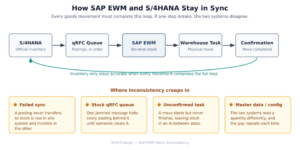
Here are the causes the way they actually show up on real projects. (Fixes come later — this part is just about why it happens.)
Every movement in EWM — a receipt, a pick, a putaway — has to be copied into S/4HANA so the official stock stays up to date. If one posting doesn't make it across, the two systems disagree by exactly that amount. Say a putaway is done and EWM shows the pallet in its bin, but the update never reaches S/4HANA — the ERP still thinks the goods are on their way. The stock is real, but one system can't see it.
Movements often pass between the two systems through a queue called qRFC — think of it as a line of messages processed one at a time, in order. If one message hits an error and gets stuck, everything behind it stops too. One bad delivery can block the queue on a Friday, and by Monday dozens of normal movements are piled up behind it, unprocessed. Nobody moved a thing, but the two systems are now well out of step.
A warehouse task is EWM's instruction to physically move stock from one place to another, and the stock only counts as sorted once that task is confirmed. If a task starts but never finishes — a scanner freezes, a session drops, someone gets pulled away — the stock is left half-done, stuck between two places. One frozen scanner in a busy shift leaves stock in limbo; a whole shift of them quietly throws off what the system thinks is in stock.
Not every gap is a technical fault. Plenty come from the wrong fix being made by hand — an adjustment posted in one system but not the other, the wrong movement type, or the same fix entered twice. A supervisor might post a manual adjustment in S/4HANA to "fix" a count, not knowing EWM holds the real bin-level number and needed correcting first. The manual entry doesn't close the gap — it opens a second one going the other way.
EWM and S/4HANA share the same warehouse data and product, and both should interpret it the same way. However, if the unit or a product setting is different, the same quantity gets recorded differently. If a product’s case-to-each number is 48 in one system and 40 in the other, every single receipt books a different figure in each. These are the worst kind, because they repeat on their own with every transaction until the data is lined up.
Systems only stay right when people follow the process. When staff skip the scan, save up confirmations for later, or use their own shortcut to keep orders moving, movements get recorded late, out of order, or not at all. In a rush, a team might confirm a whole batch of picks at the end of the shift instead of as they go. For those hours the system's picture is simply wrong, and anything else touching that stock runs into it.
Under all of this sits the setup — how storage locations, warehouse structure, and posting settings are defined and mapped between the two systems. If that setup is incomplete, movements can post to the wrong place or never match up. A storage location mapped wrong between S/4HANA and EWM can leave a whole type of movement quietly building into a gap that just sits there. These are the hardest to spot from the floor, because the process looks fine — the fault is hidden in the setup.
| Cause | What Happens | Business Impact |
|---|---|---|
| Failed ERP–EWM sync | A movement doesn't cross between systems | Stock is real in one system, invisible in the other; reports can't be trusted |
| Stuck qRFC queue | One jammed message halts everything behind it | A big gap builds up with nothing moved physically |
| Interrupted warehouse task | An unfinished move leaves stock half-done | Stock looks higher or lower than it is; picks fail |
| Wrong manual posting | A fix made in the wrong system, or twice | New gaps created while "fixing" old ones |
| Master data mismatch | Systems read a quantity differently | Errors that repeat and grow with every transaction |
| Manual workaround | Movements recorded late, out of order, or missed | Records stop matching the floor; collisions and rework |
| Setup / config fault | Movements post wrong or never match up | Ongoing gaps that are hard to trace |
Here's the assumption that catches most companies out: putting in SAP EWM is not the same as getting accurate stock. EWM gives you the ability to have precise, real-time stock. Whether you actually get it comes down to discipline and monitoring — and that often slips once the project team leaves.
The quiet gaps we see most:
None of this shows on day one. It shows up months later, under real volume — which is why a clean go-live can still drift into daily problems.
Stock inconsistency is easy to underrate, because each single error looks small. The real cost is the steady drag it puts on operations, finance, and customers.
Late shipments. When you can't trust available stock, orders can't go out cleanly and fulfilment slows. That hits your On-Time-In-Full (OTIF) rate — the number your customers judge you on most. [STAT: insert one verified fulfilment or OTIF statistic with a named, checkable source, or leave this line out.]
Wrong inventory value. Stock is an asset on your balance sheet. When EWM and S/4HANA disagree, the value you report is off — which means extra clean-up work at month-end and harder questions in an audit.
Production hold-ups. In manufacturing, wrong component stock stalls production orders — either holding a line for material that's actually there, or committing to a build for material that isn't.
Wasted hours. Every gap creates manual work — checking, recounting, correcting, re-confirming. Skilled people spend their day fixing records instead of moving goods.
Higher costs. It all adds up to money: rush freight to save late orders, extra safety stock to cover numbers no one trusts, and double-buying.
The reason this matters to the people at the top is that these costs don't stay in one place. One gap sets off a chain:
Stock gap → wrong Available-to-Promise (ATP — the stock the system thinks it can promise customers) → wrong delivery date quoted → shipment misses its promise → customer complaint → rush freight to recover → profit eaten into.
Each link looks small on its own. Follow it end to end, and one unfinished task in the morning can turn into lost profit and an unhappy customer by the end of the week. Leaders don't feel "a stock difference" — they feel the chain it sets off.
Case Study 1
A mid-size consumer electronics distributor that was running SAP EWM faced a challenge as the internal cycle count never matched the SAP S/4HANA balance for about 18% of the SKUs.
The reconciliation workload increased to 40 person-hours a week. The OTIF rate also slipped to 84%.
Once the problem was fixed by first analyzing the root cause, such as discrepancies in three recurrent qRFC breaks and one base-unit-of-measure misalignment in the product master, the following results were achieved-
The pattern is the same on every project: a technical sync problem quietly turns into a service, cost, and audit problem. The sooner it's found at the root, the cheaper it is to put right.
The tempting move is to just correct the numbers. It's also the move that fails — because if you don't fix what caused the gap, it comes straight back within days. So we work in a set order, and the actual stock correction comes near the end, not the start.
Notice that most of these steps happen before and after the stock is ever touched. That's the whole point. The correction itself is a small, careful step inside a much bigger fix — not a patch you repeat forever.
A cold-chain warehouse of a pharmaceutical company had a recurring mismatch on temperature-sensitive finished goods.
The team had to regularly adjust in S/4HANA manually, but the gaps appeared every two weeks,
The team could not spot the pattern as the pickway was completed successfully on the floor.
When we traced the root cause, we found that the packing-station confirmation exit was not triggering the goods-issue posting back to S/4HANA for outbound delivery.
A small correction in the SAP EWM output processing logic helped solve the problem.
After that, the monthly adjustment stopped entirely, and the team reallocated the two days they used to spend on reconciliation to proactive temperature-compliance audits.
Nobody picks a partner for this kind of problem based on big words. They pick based on method and track record. Here's what our work rests on.
Root cause first, every time. We find the cause before we correct. That's the difference between fixing a gap once and resetting the same numbers forever.
Real SAP EWM focus. This is deep work right where EWM and S/4HANA meet — sync, queues, tasks, master data, setup. That exact spot is what we focus on, not warehouse software in general. SCM Champs has delivered more than 80 SAP EWM implementations across 14 industries—life sciences, automotive, 3PL, and more. Our core team is 40+ SAP-certified EWM consultants, each with over a decade of hands-on project work, and we run a dedicated integration lab that mirrors the exact EWM–S/4HANA setup our clients use in production.
Both the system and the process. Most gaps are half system fault, half process slip. We work on both — fixing the system and tightening the floor habits that let the error in — because fixing only one side leaves the door open.
We teach your team. We don't leave you depending on us. We explain what caused the problem and how to spot the early signs, so your people can keep things clean after we've gone.
Prevention that lasts. Our work includes the monitoring and checks that stop it coming back. The goal isn't a one-time fix — it's a warehouse where the numbers stay right. For a fast-moving consumer goods client, a past engagement targeting a deep EWM–S/4HANA mismatch delivered 99.9% inventory accuracy that held for more than two years after we left. Month-end reconciliation went from a three-day cross-team fire drill to a two-hour spot-check, and the yearly audit adjustments tied to inventory valuation hit zero for the first time in four years.
Fixing today's gap only pays off if tomorrow's is stopped. The companies that keep their stock accurate tend to do the same few things, consistently.
None of this is dramatic. It's steady, boring checks — and that's exactly what separates a warehouse that drifts from one that stays accurate.
Stock inconsistency in SAP EWM is when the physical stock in the warehouse doesn't match the stock recorded in the system. It usually comes from delayed postings, manual errors, stuck queues, or gaps in the link between EWM and S/4HANA. Because both systems feed planning and shipping, even a small unfixed gap can spread fast. The reliable fix is always to find the root cause before adjusting any numbers.
The two systems fall out of step when a goods movement fails to pass between them — usually a failed sync, a stuck qRFC queue, an unfinished warehouse task, or mismatched master data. Each system then holds a different number. Since both drive reports and decisions, that difference quietly spreads across buying, shipping, and finance until someone traces and fixes the real cause.
You fix it by finding the cause first, then correcting through SAP-standard methods. That means pinning down where the systems differ, closing the process gaps that caused it, watching queues and error logs, keeping the two systems in real-time sync, and handling exceptions properly. Just correcting the numbers brings the problem straight back, because the cause is still there. Cause first, correction second — that's what makes the fix last.
Yes. When available stock in the system doesn't match what's really in the warehouse, deliveries can't be confirmed and released reliably. Orders that should ship get held, while others get promised against stock that isn't really there. The result is late shipments, missed OTIF targets, and staff forcing orders through by hand. It's one of the fastest and most visible effects of the problem.
Yes, and it often does. A smooth go-live shows the system works under early conditions, but gaps tend to appear later under real volume — during busy periods, when queues get stressed, when shortcuts creep in, or when master data changes over time. It doesn't mean the project failed. It means the system needs ongoing monitoring and checks to stay accurate day to day.
Prevention pairs a permanent root-cause fix with steady checks: watching queues, making sure warehouse tasks are always confirmed, keeping master data lined up, and controlling manual corrections. The aim is to catch drift early and remove the conditions that let errors form — not to keep resetting the same numbers.
Regular monitoring and discipline help keep the stock accurate over time.
SAP EWM stock inconsistency starts as a technical mismatch between two systems and quickly turns into a business problem — late shipments, stock you can't trust, wasted hours, and month-end numbers you can't fully stand behind. It keeps coming back for one simple reason: the numbers get corrected while the cause is left in place.
The way out is a clear approach — find the root cause before correcting anything, fix it with SAP-standard methods, and put monitoring in place so it doesn't return. That's the difference between managing the problem forever and solving it once.
If your warehouse team is spending hours every week fixing stock instead of moving product, the problem is usually deeper than a stock adjustment. A proper assessment shows exactly where sync, warehouse processes, or master data are causing the gaps — before they reach your customers.
→ Request a Free SAP EWM Stock Inconsistency Assessment